Morigoto Crayon
A branch-shaped crayon carrying the scent of wood, extracted from forest resources
A few branches lie scattered on the desk. Pick one up, and it carries a faint scent of wood. Run it across paper, and color remains. Morigoto Crayon is a drawing material made from the oil and wax byproducts of essential-oil production. The essential oils are extracted from the branches, leaves, and wood of trees such as cedar and cypress grown in forests across Japan — oil hidden in parts that never reach the timber market is redirected into a new use. Its shape follows a single aim: to recreate the sensation of picking up a branch in the forest. The drawing tool itself takes the form of the very forest material it comes from. Developed as a joint project with Sankei Building, it will be introduced at “KiGi AKIHABARA,” an urban timber office under construction in Akihabara. Neither a novelty item nor mere decoration, the crayon is meant to connect the forestry supply chain to the people who use it — through holding it, drawing with it, and smelling it. The project asks how a building's statement of “connecting the city and the forest” can be embodied not in words, but in the tactile quality of a material.
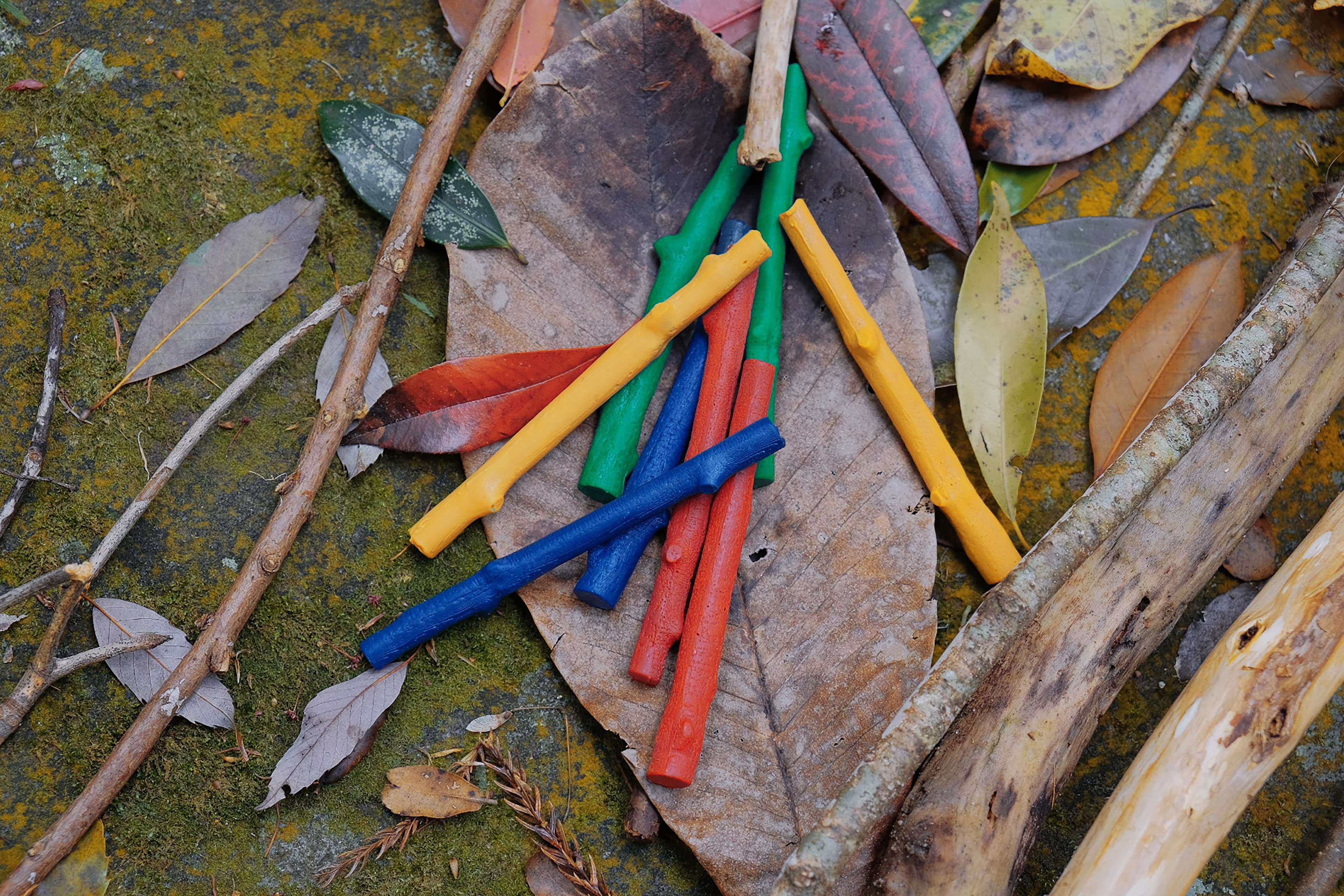
FIG.1
Designing Scent and Form
We’re creating scented crayons with a branched structure, made from naturally derived waxes and essential oils. They’re quite different from so-called “art supplies” designed specifically for drawing. While they feature decorative colors and organic shapes, the scent takes center stage. That’s why it’s hard to convey their appeal until you actually use them.Although they have a cute appearance aimed at young children, they were difficult to produce.
The process proceeds as follows: modeling → 3D printing → creating a silicone mold → melting the material in a double boiler and pouring it into the mold → once it cools and hardens, it’s complete. I’d like to document how each of these steps involved a constant back-and-forth between rationality and irrationality .
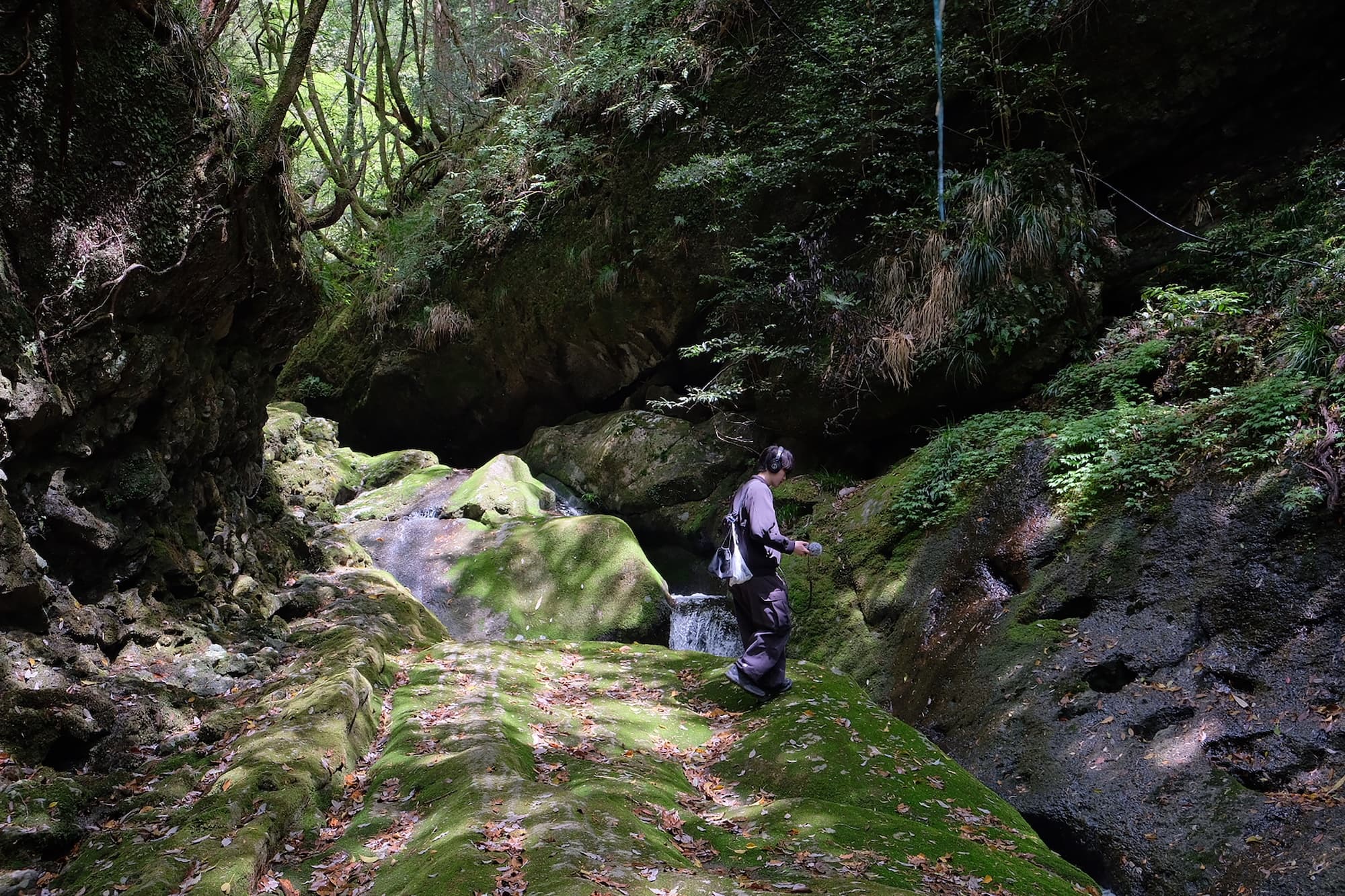
FIG.2
Modeling—Using Rationality to Trace Irrationality
While visualizing in my mind what “branches are supposed to look like,” I first aimed for an organic shape.I distorted and broke down the form once, then finally observed branches from multiple tree species and readjusted the design toward realism. Perhaps I could describe it as “tracing an irrational creative process using rational means, while rationalizing it along the way.” I made decisions based on past experience and my own intuition.
For the 3D format, I adopted SubD, which leans toward CG, is fairly flexible, but has low reproducibility. I sacrificed reproducibility in favor of organic form, but because I could manipulate it intuitively, like clay, I was able to accumulate a large number of iterations in a short time. As a result, my computer screen is now littered with a vast number of imaginary branches that are hard to tell apart.
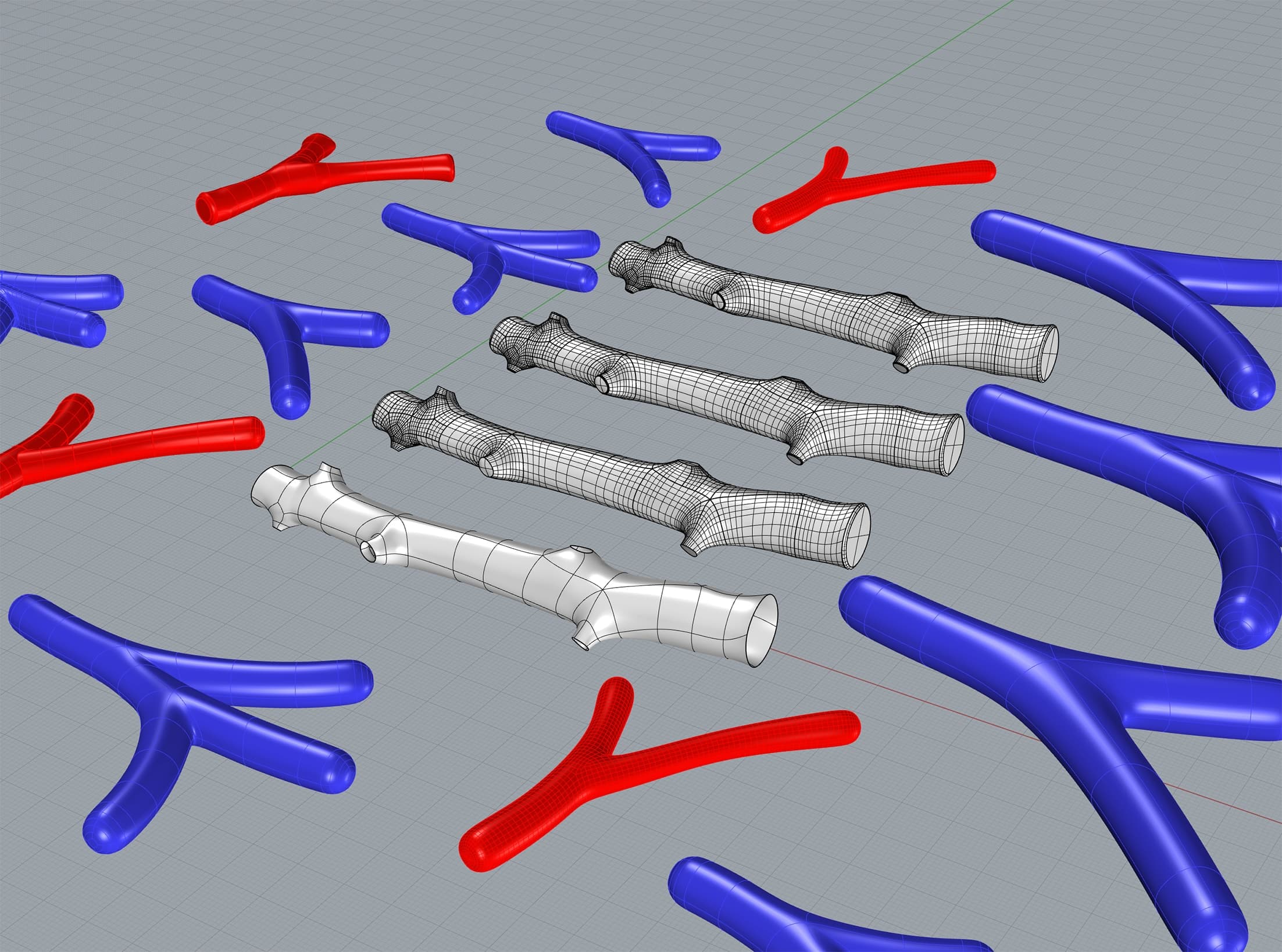
FIG.3
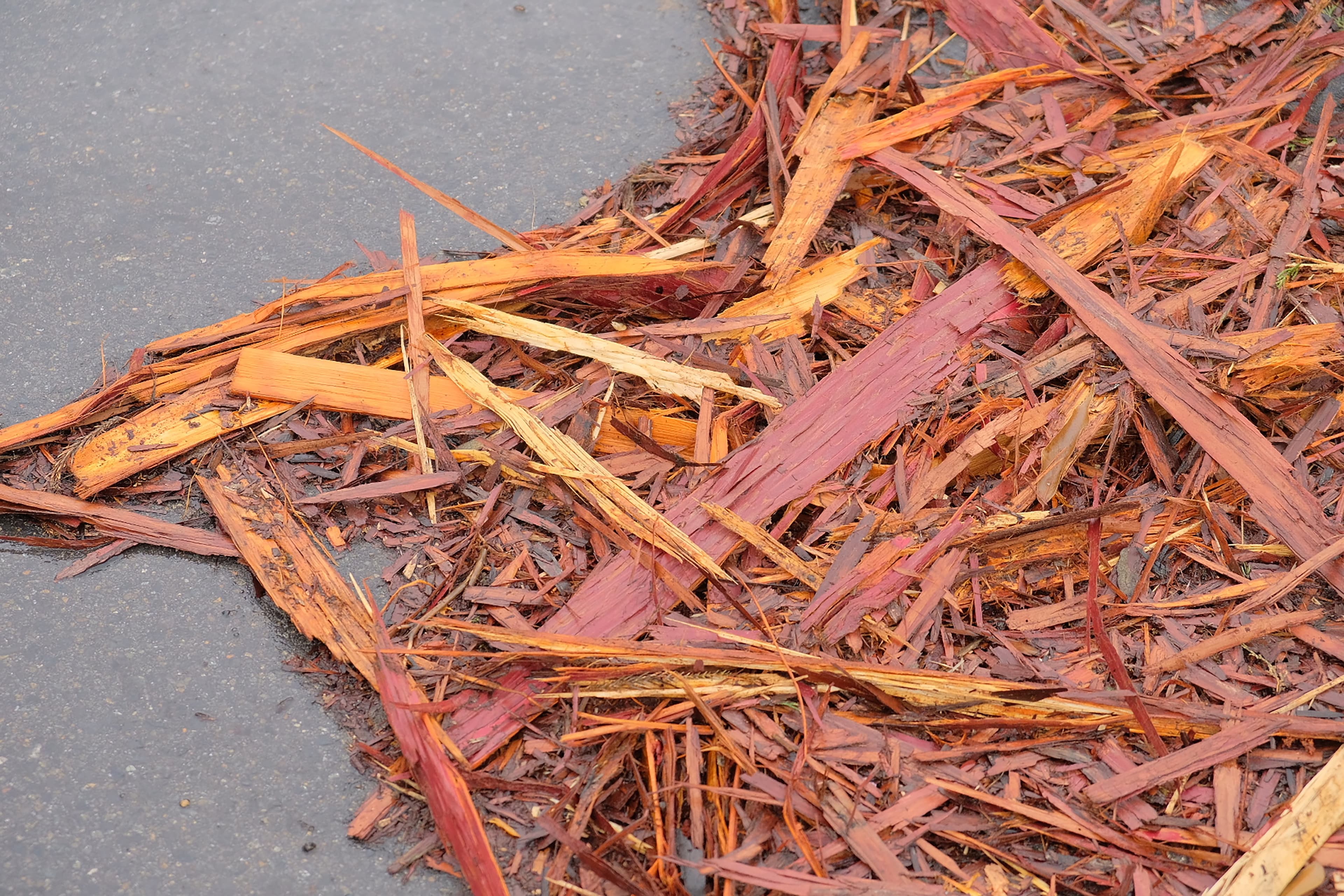
FIG.4
Silicone Molding—A Technique in the Gray Area
Mold-making is a sophisticated technique that combines many materials. Fill the mold frame halfway with oil clay, then embed the 3D model—coated with a release agent (silicone oil)—“about halfway.”When liquid silicone is poured in and allowed to cure, its height becomes the parting line. After flipping the mold over and removing the oil clay, pouring the silicone again completes the two-part mold.
It was a race against time, so we ran not only the development facility in Kameido but also my personal 3D printer at full capacity. Since we printed using whatever filament was available at the time, we ended up with a collection of master models in a variety of unintended colors.Although the molds themselves don’t need color, the unbleached models added a touch of liveliness to the process. What I’m doing is industrial design, craft, and digital fabrication all at once. To create crayons that haven’t yet been seen, all of these elements coexist on the same workbench.
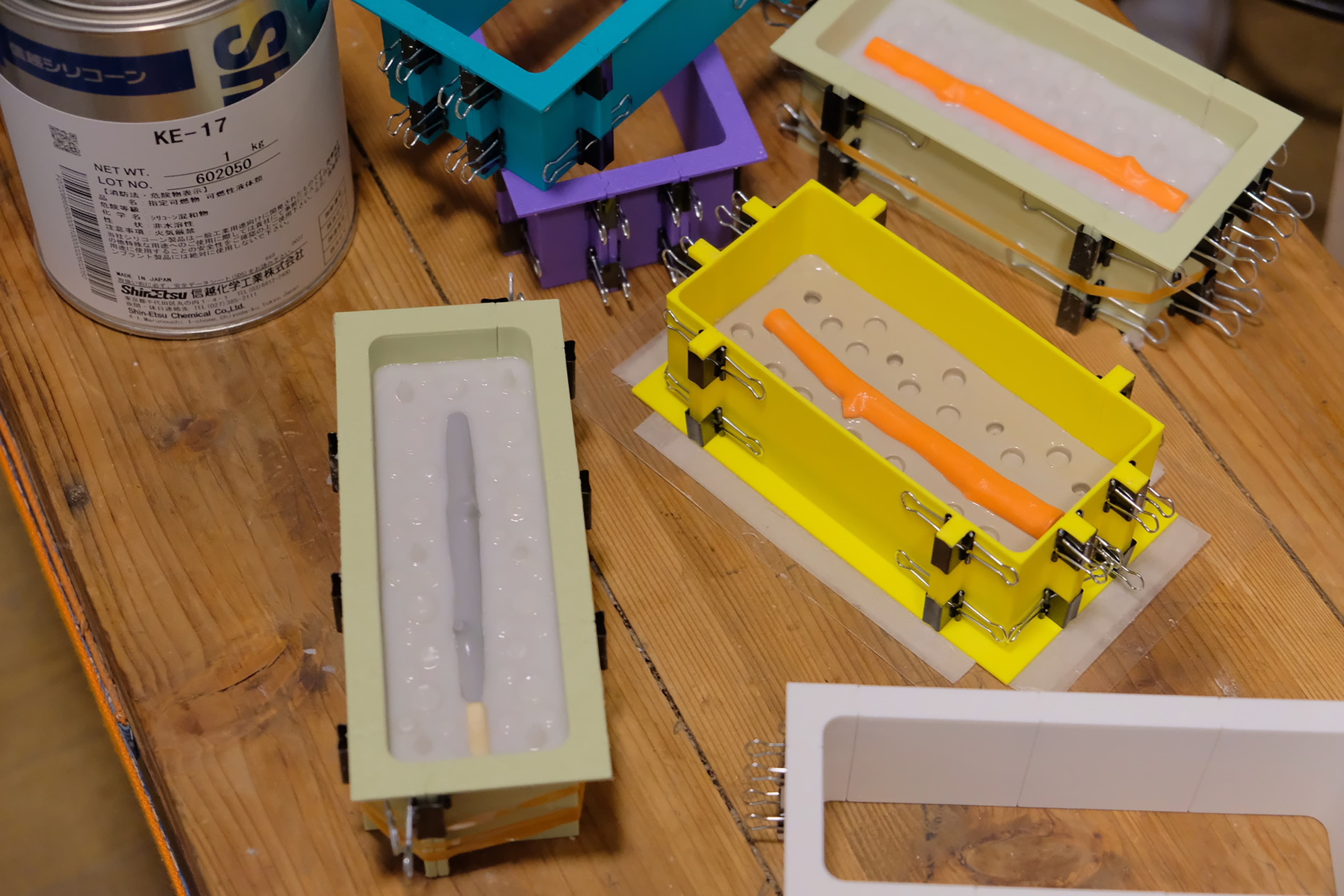
FIG.5
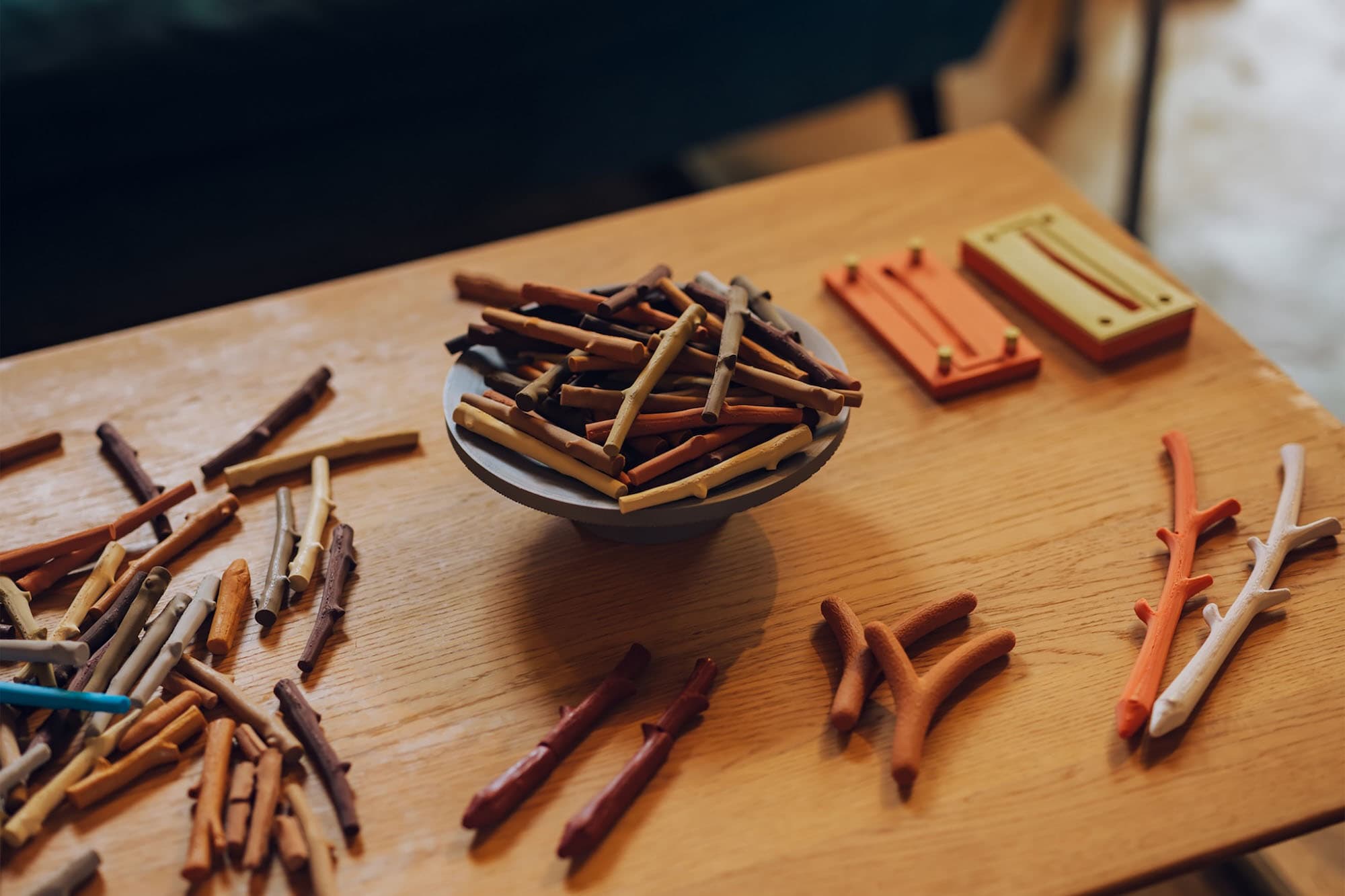
FIG.6
Between Rationality and Irrationality
By using only natural materials, such as beeswax, for all components, the crayons naturally became more prone to breaking. In an effort to make this “irrational” creation viable as a product, I’m making fine adjustments to the mixture ratios, the positions of the knots, and the diameters—desperately trying to make a U-turn back toward rationality.
I’m tempted to call it a “tug-of-war,” but that doesn’t quite fit. Rather than pulling against each other along a straight line, it feels more like swinging a pendulum back and forth, gathering the necessary elements within that range of motion. I believe that this back-and-forth—without swinging all the way to either extreme—is the essential design process for this project.
The Expressiveness and Intensity of Color
Color is a wavelength of light and a spectrum, and it is influenced by the color rendering index of the light source. Depending on refraction, reflection, and the degree of translucency, what we perceive as color changes its expression moment by moment. Even if it appears to be a so-called “single color,” you can never see exactly the same expression twice.
Coloring itself is decorative. If the substrate is simply a surface onto which pigment is rubbed—whether it’s lime or any other material—it doesn’t matter. Since this isn’t a product specifically designed for drawing, I initially felt that color was nothing more than a catalyst.However, as I began using bases made of wax or natural oils, and as the scent of essential oils blended in, the visual and olfactory senses began to blend together, creating a synesthetic and intense impression. Color possesses a certain “strength”—a driving force and appeal that naturally draws you in while engaging other senses.
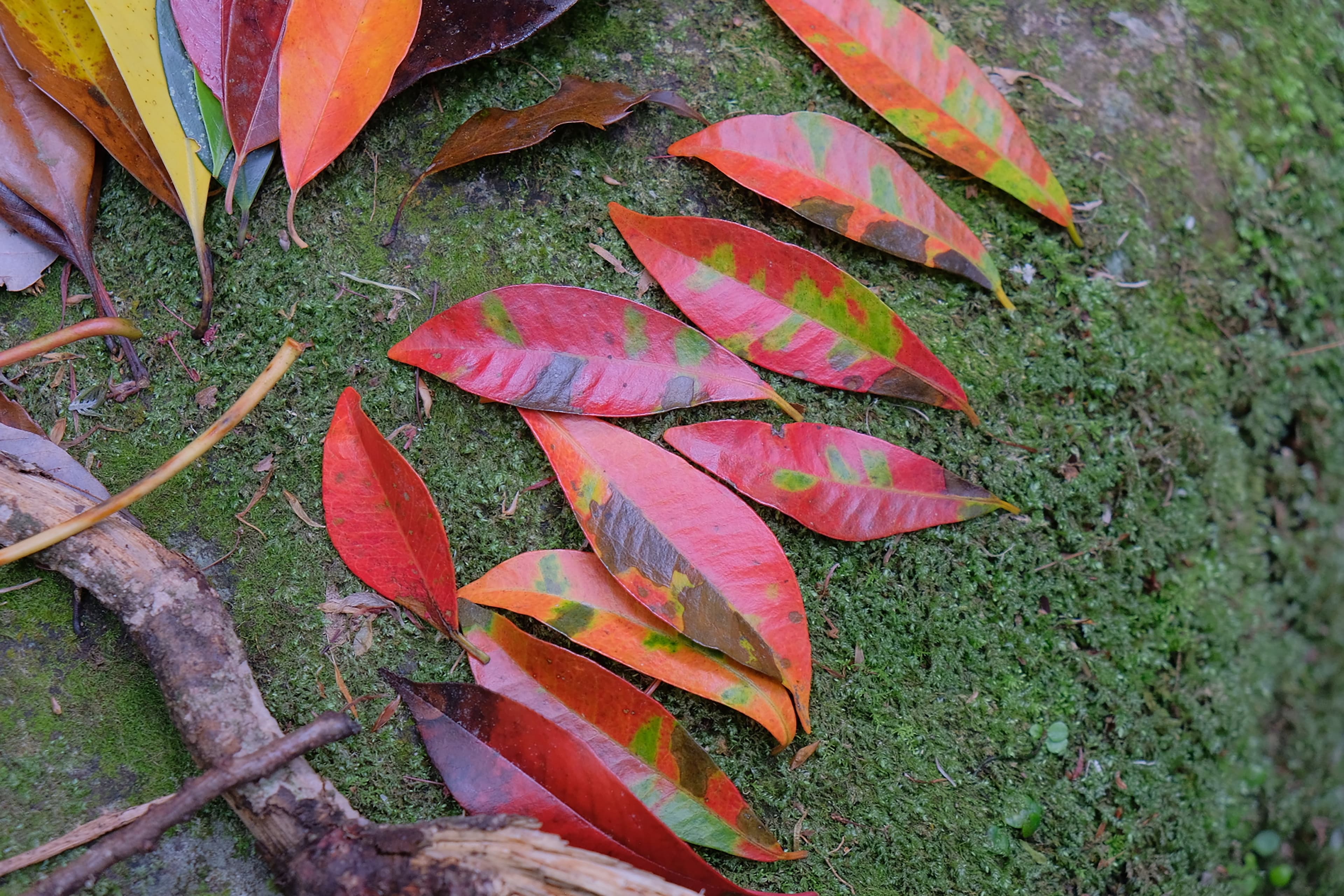
FIG.7
Aging Colors
CMF, as applied to products such as home appliances and automobiles, is a technique that fixes the texture of colors and materials—which are meant to age—as decorative elements to make them appear attractive. In the sense that it freezes change in time, CMF can be described as a technology that bleaches away aging itself.
However, objects like crayons—which, as chemically synthesized materials, have their interior and surface integrated into a single entity (essentially monomaterial objects)—do not readily benefit from this. Due to the characteristics of their composition, the crayons we produce will, if left untreated, undergo the “bloom phenomenon”, commonly known as whitening.Unlike typical crayons, which use petroleum-based waxes and can be sealed with a coating, these crayons cannot be sealed, so the aging process continues unchecked. Whereas CMF applies a “photograph” over the signs of aging, these crayons never let go of the “live broadcast” of that aging process. The colors inherent in natural materials are alive and will eventually age.I believe that enjoying the fleeting nature of both color and scent—as they gradually fade away—is the most honest approach that a design “connecting the city and the forest” can take.
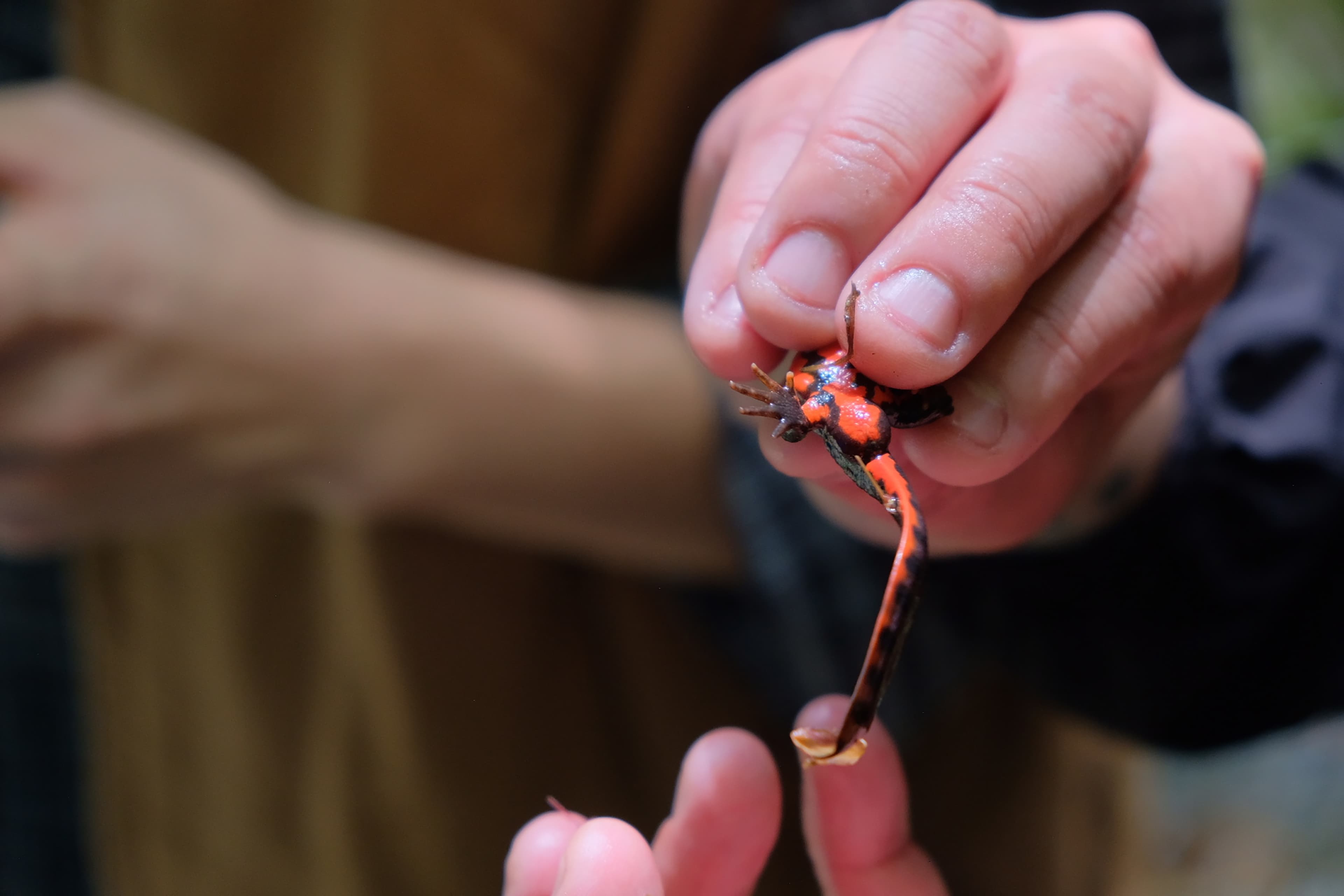
FIG.8
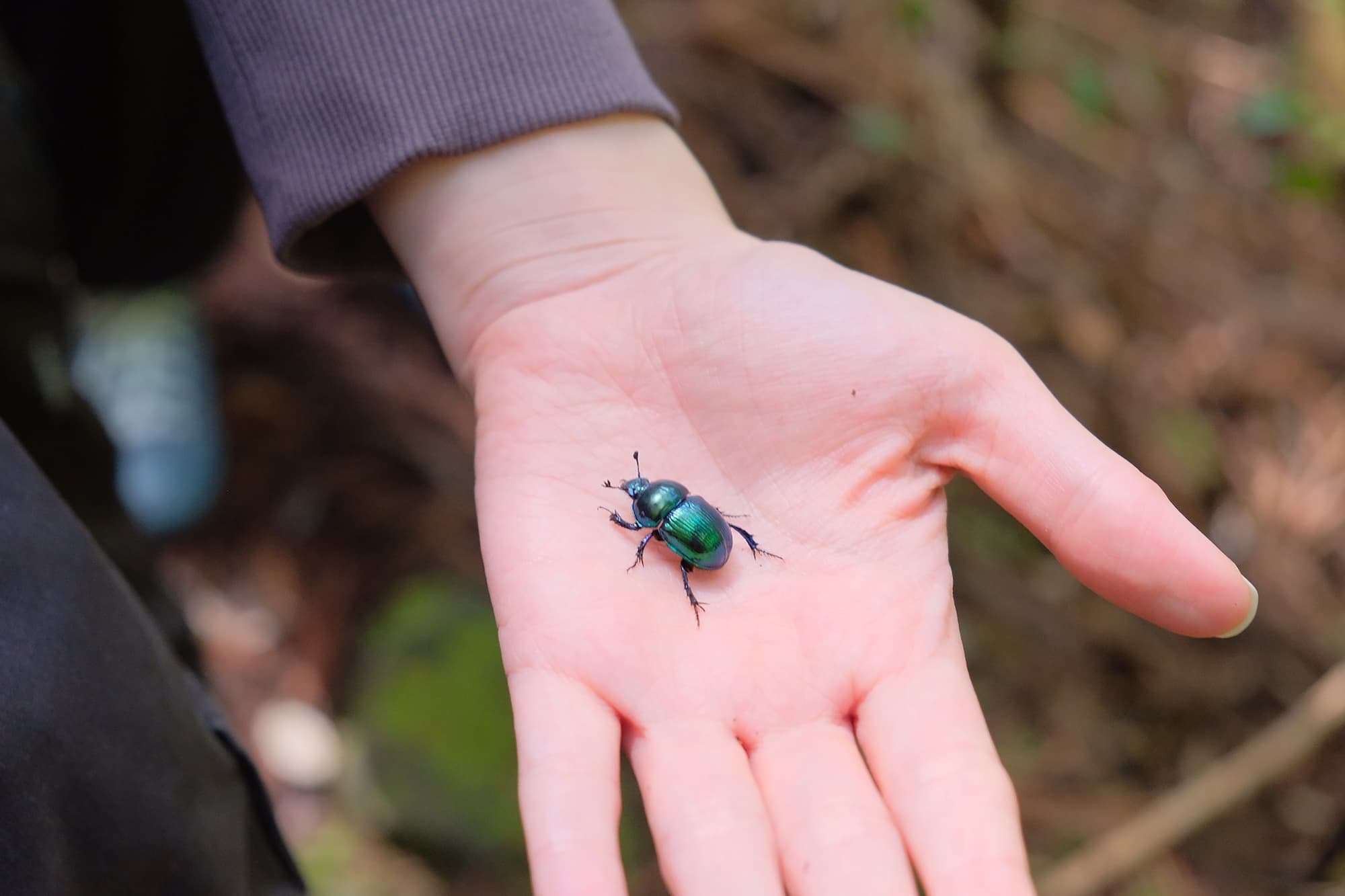
FIG.9
RELATED TEXTS

Architect / Product Designer
ANNOUNCEMENT
2026.10.21.

ASIBA rebrands as a "Creative Ecosystem for Practice and Research"
ASIBA Rebranding 2026
ANNOUNCEMENT
2026.10.21.

Can We Shift the World's Trajectory, Little by Little? ASIBA's Three Practices
ASIBA ATLAS 2026 Report #2
REPORT STATEMENT
2026.10.20.
Where the Willful Ecosystem Stands Today: Three Years Since Incubation
ASIBA ATLAS 2026 Report #1
REPORT STATEMENT
2026.10.20.
The Art of Pretending to Be a Branch
峯村瑠一
ESSAY
2026.07.01.
The Tale of Crayon Development
竹田 樹生
ESSAY
2026.07.01.
CREDIT
inhouse
collaborator
external