峯村瑠一
FIG.1
When I heard the phrase “technology becoming standardized and stripped of its character,” my first thought was about things becoming “too easy to understand.” It means that no matter who uses it, they’ll arrive at the same result. It means being able to handle it efficiently, without hesitation, and without failure. That has been one ideal that technology has strived for since the modern era.On the other hand, within that “correctness,” the quirks of materials, the hesitation of the hand, the scent of a place, and traces of the maker’s judgment gradually become harder to discern. Perhaps “colorless technology” does not simply refer to inorganic technology, but rather to technology from which relationships, origins, and bodily sensations have been erased.
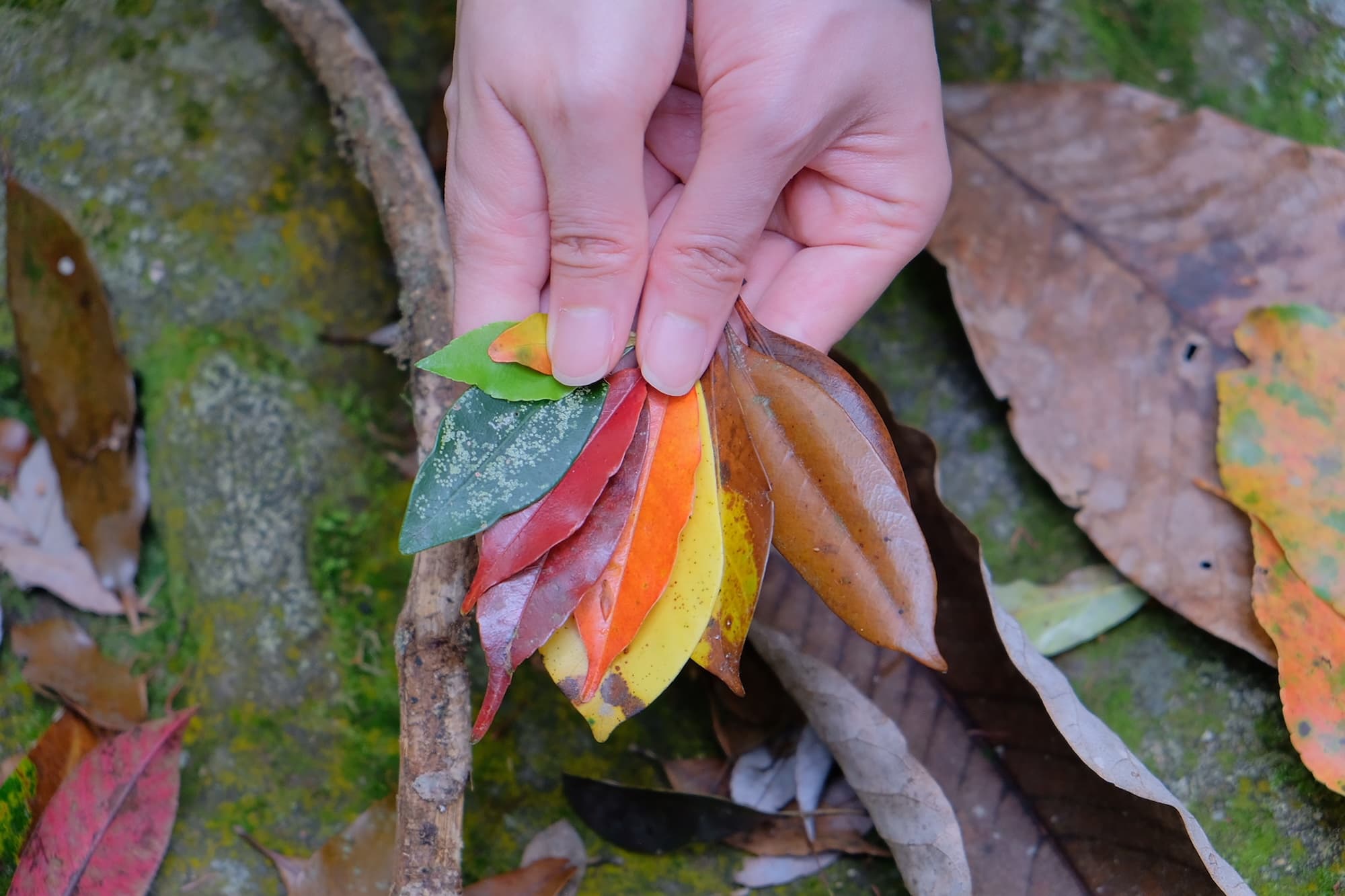
So, what, then, is “technology with color”? I believe it is less about technology that produces vivid results and more about a state in which texture remains within the technology itself.Where did the materials come from? Whose hands did they pass through? Why did they take that shape? It’s the desire to seek answers to such questions. It’s the fact that meaning isn’t confined to a single interpretation, but rather that the user discovers the reasons for it later on. Isn’t it within that margin that a kind of “allure” of the craft resides?
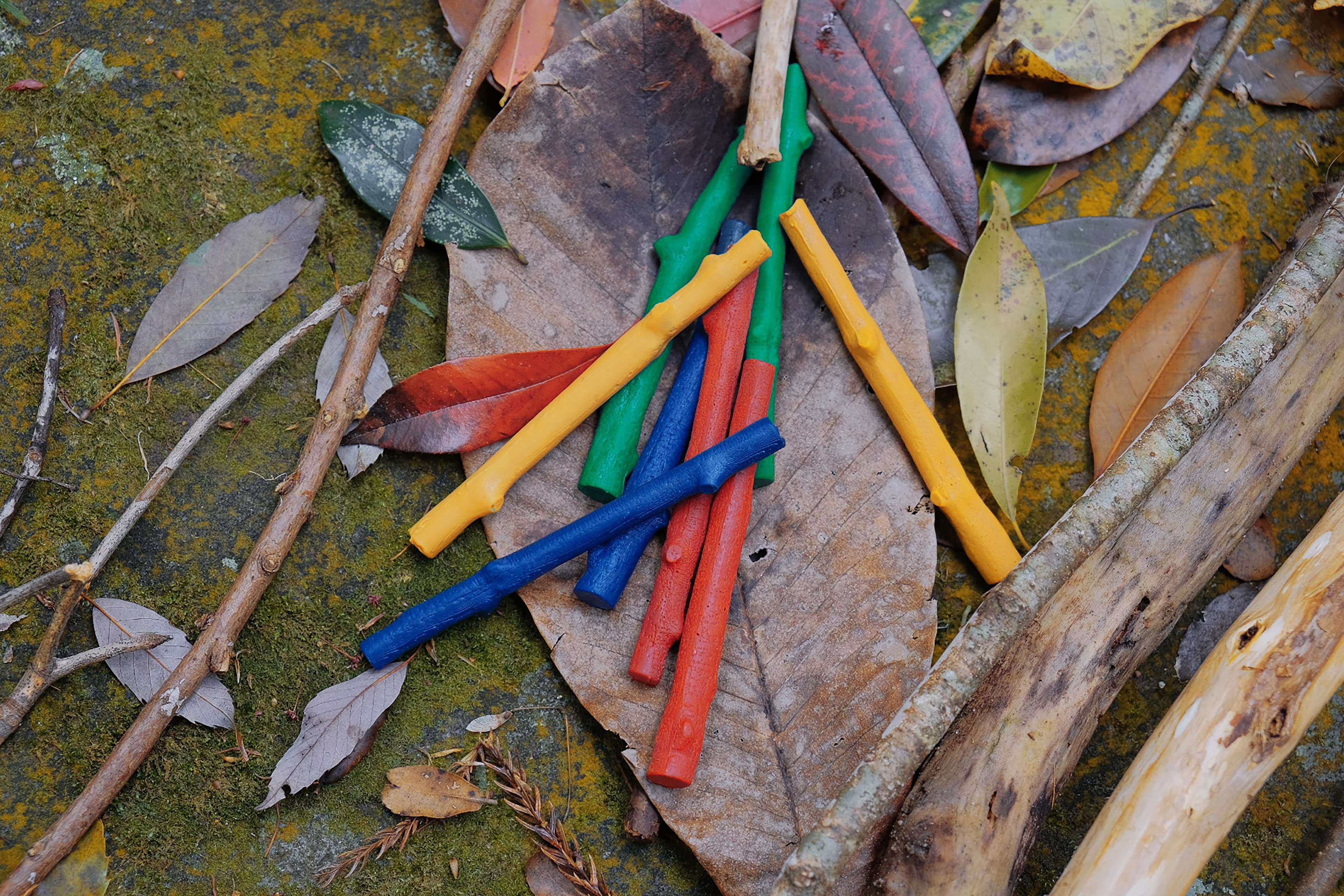
Right now, we’re making branch-shaped crayons that carry the scent of wood. When we tried to translate our experiences in the forest into the city, the shape that came to mind was that of a branch.Even now, for some reason, I find myself instinctively picking up branches lying in the forest or along the side of the road. I feel like swinging them around, writing something on the ground with them, breaking them, or simply smelling them. If I find one with a shape I like, I want to put it in my bag and take it home. Even before being given a specific function, branches already elicit certain actions from people.
Just as with branches, I wanted these crayons to be objects whose meaning and uses branch out differently depending on the person holding them. If we think of them purely as crayons, a shape that’s straight, easy to grip, hard to break, and fits neatly into a box might be more practical. Yet we chose to give them a branch-like shape.It has knots, bends, and varying thicknesses, making it slightly unstable when placed on a desk. From a purely efficiency standpoint, these are “noise”—elements that deviate from the standard. Yet it is precisely this noise that conveys information to the hand: the slight awkwardness of holding it, the slight uncertainty about its use.The fact that it’s a little hard to explain. Because of that clumsiness, the user’s body becomes slightly more attentive. They pick it up before it’s explained to them and start playing with it before its purpose is determined. I believe this shape creates the state just before such actions arise.
This crayon is not a real twig. It is, after all, an artificial object pretending to be a twig—in other words, a fake twig. Yet perhaps it is precisely this “fakeness” that holds meaning. If it were a real twig, we could simply accept it as a natural object.But this is something that looks like a branch yet isn’t one; it resembles something from the forest yet belongs to the city; it has a scent yet is also an art supply. This slight discrepancy gives rise to the question, “What is this?” Realizing that “this isn’t a branch” becomes the trigger for remembering what a real branch is. Its very fakeness becomes the gateway to the forest.
Crayons have color. Yet I also wonder: are we truly the ones who give them that color? Perhaps all we can do is mix pigments, shape them, and seal in their scent. The color truly comes to life only when someone holds it, rubs it on paper, and draws something.Art supplies aren’t simply things to be “used.” The lines they leave behind are records, traces, and a form of communication with someone else. Color isn’t something contained within the product itself; it is born through the act of creation.
There’s a saying: “Seeing the trees but not the forest.” But surely we can see both the trees and the forest. Our awareness can shift from the small crayon in our hand—which mimics a branch—to a forest where real branches lie scattered. Drawing can serve as a gateway to contemplating the nature of materials, the land, and craftsmanship.I hope this crayon will find its way into someone’s hands—not merely as a tool for applying color, but as a small branch for drawing the future. Like branches in a forest, it lies scattered in various places, taking on a slightly different meaning each time it is picked up. Perhaps “colorful craftsmanship” is the art of leaving such blank spaces intact, rather than erasing them.
Credit
Related Works
2026.07.01.