竹田 樹生
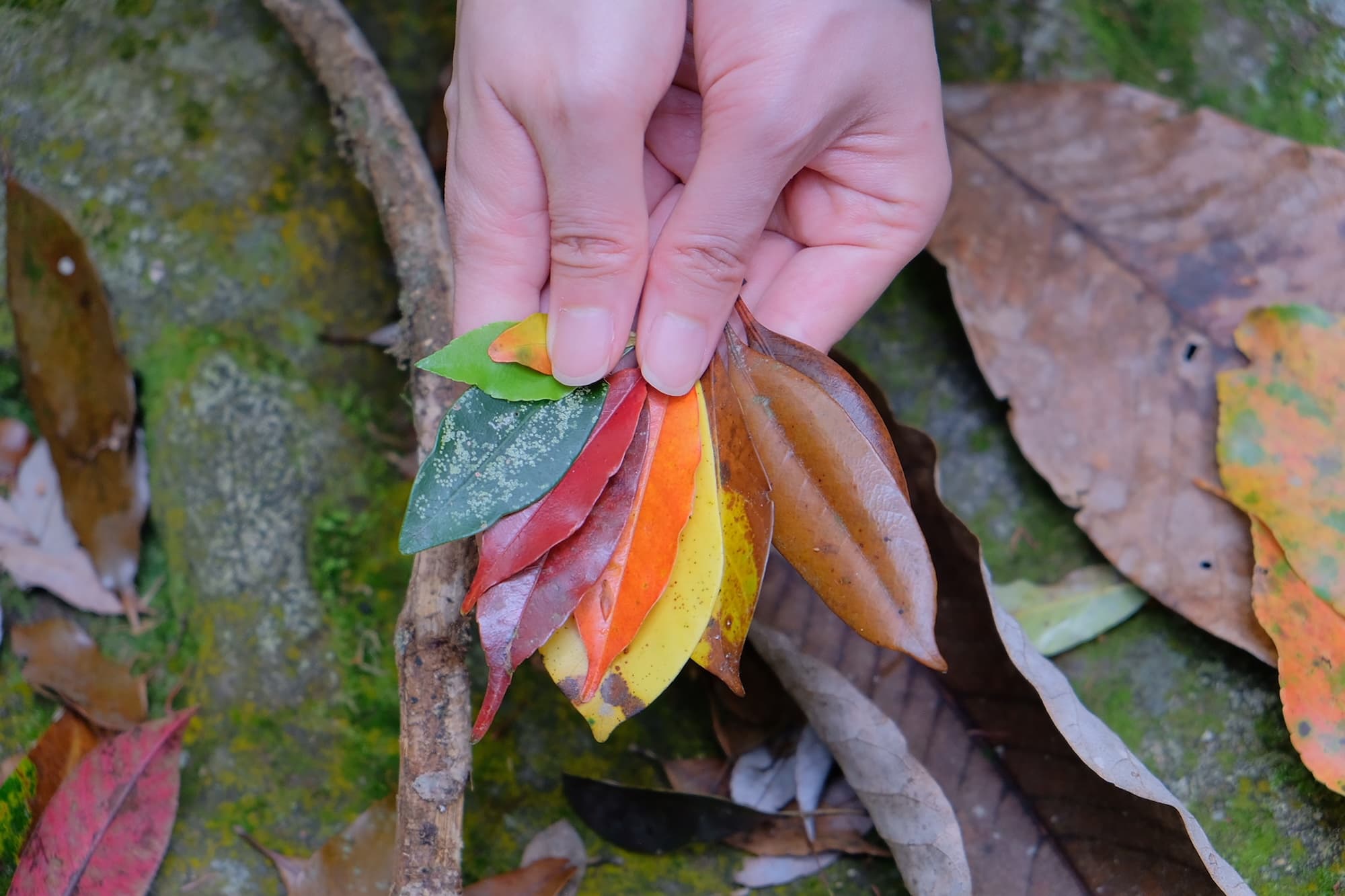
FIG.1
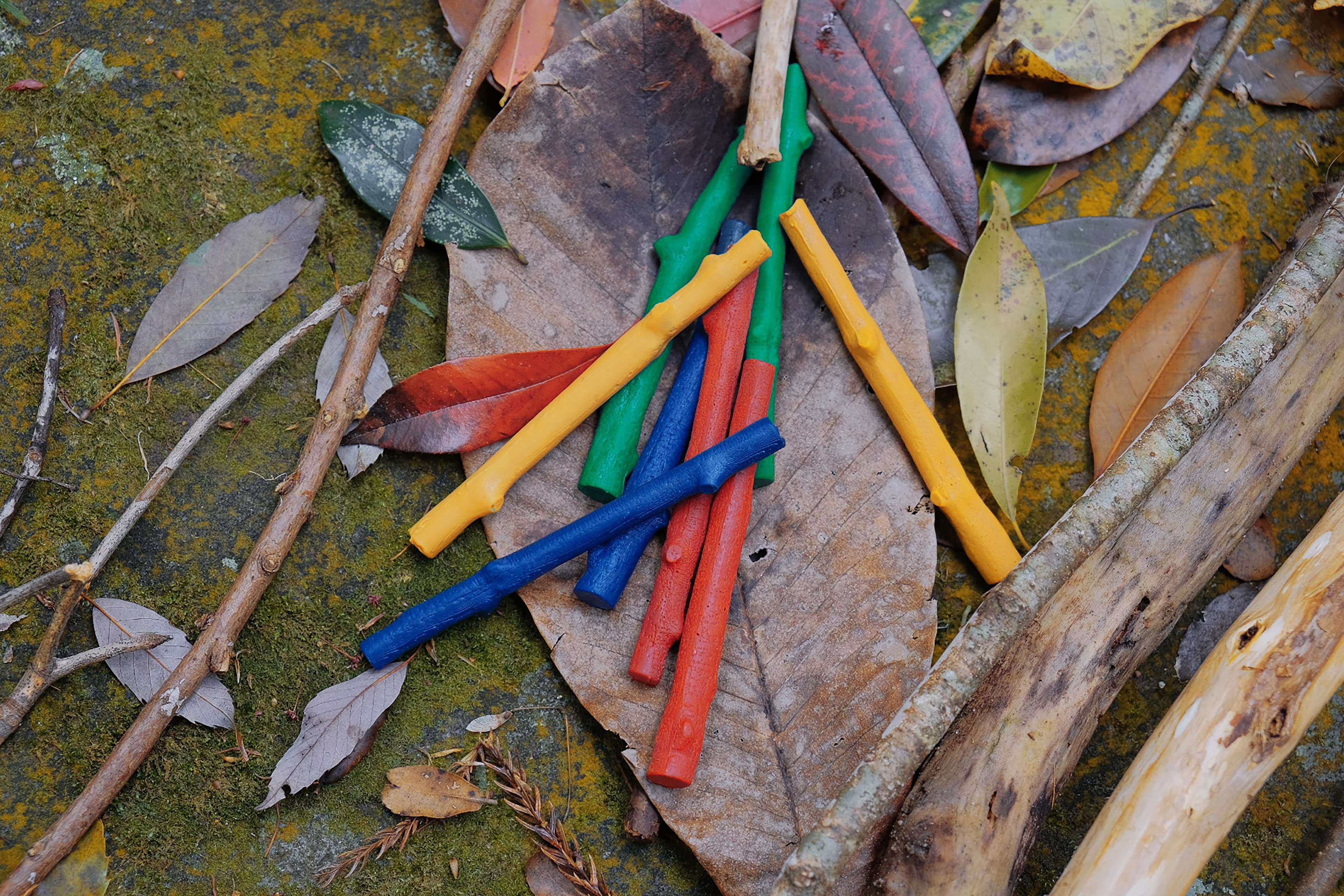
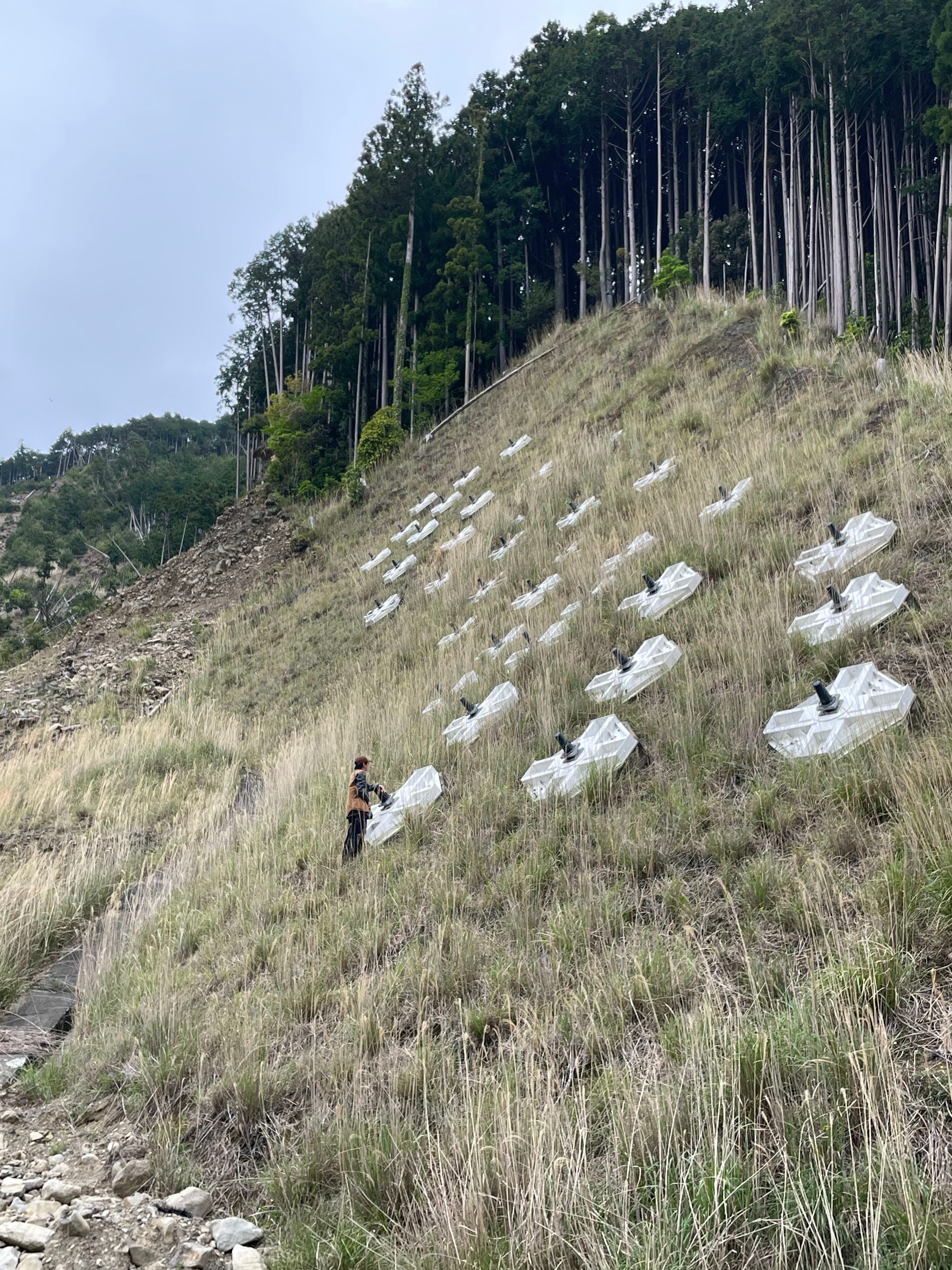
The story behind the creation of these crayons ultimately leads back to the forest. I’d like to record here some notes from a visit to the Tanabe Forest, made possible through the kindness of Somano Base, who has been collaborating with us on this project.
The elements that make up the forest—trees, branches, and leaves—are densely packed from top to bottom, yet there are open spaces that seem to allow the wind to blow right through the middle. I felt that this spatial composition—dense at the top and bottom, yet open in the middle—is the very characteristic that makes a forest a forest.I also noticed how the scenery inverts on the way there and back, or when going up and down. The same path looked like an entirely different place.
I also had some insights regarding materials. That strong, sparkling sheen—as if created by specular reflection—is a characteristic often found in living things like insects and fish, or in water flowing down a river—in other words, “things that move.”(In that sense, perhaps even the colors of crayons—which have a lustrous surface like skin and whose appearance constantly changes as they age—are, in a way, “alive” and moving.)
But what I really want to write down is the “way of encountering” scents in the forest.In the forest, we first recognize an object through the powerful sense of sight; we actively approach it ourselves, touch it, and only then do we “sense” the faint signal of its scent. Even though it is faint, the trace left by our touch lingers gradually, making it easy to remember.
This way of encountering things aligns perfectly with the kind of connection I want my products to foster: the experience of sensing lingering scents or traces left by others. The scent rising from my fingers after touching the soil, mingling with the sweat on my hands, made me feel as though the way I perceived it was entirely up to me. I felt a sense of comfort and possibility.
Conversely, mass-produced or standardized products tend to avoid leaving unintentional traces. Even the “scent” found in the market is often deliberately stripped of its character so that it provides the same experience no matter who uses it.
I suddenly recall the time I worked part-time as an instructor at an art and design class. In the classes for toddlers and young children, we would collect only the white and black crayons from the 12-color set and treat them as shared classroom supplies.The main reason was to help students intuitively grasp the logic of subtractive color mixing, a fundamental principle of analog art materials. Another reason was that children who were accustomed to writing tended to instinctively reach for black and white even when drawing.
Subtractive color mixing refers to the phenomenon where brightness decreases as the colors of an object are mixed together. Colors can be categorized into “light source colors”—the colors of light itself—and “object colors”—the colors produced when light strikes an object and is reflected, absorbed, or transmitted.Object color is determined by the mixing ratio of the three primary colors: cyan, magenta, and yellow. In other words, by adjusting the proportions of these CMY colors, you can create any color you like. Furthermore, mixing equal parts of CMY results in a dark gray.Strictly speaking, white, black, and gray are called achromatic colors and lack saturation (i.e., color tone), but when they result from mixing chromatic colors, a hint of color remains. (Between black and white lie countless shades of gray, each with its own subtle nuances.I believe the moment that truly tests your sense of color selection is when you’re choosing the perfect shade of gray.)
About six months after buying a set, the number of colors on hand starts to dwindle due to wear and tear, or because the crayons have broken down and become so small that they’re eventually lost. Since the classroom sells individual crayons as replacements, you’d think students would simply buy the colors they’re missing—but they rarely do. It’s a hassle to ask their parents, or they simply forget.There were even some daring students who, as if to say, “Who cares which colors are missing?”, would break all their crayons into small pieces and pack them into the box like a game of Tetris.
There were all kinds of students. Some children only became careful about choosing colors once their supply dwindled. Others figured out how to layer colors on their own and learned the technique of mixing them. Still others began to deepen their self-understanding—noticing their tendencies toward certain colors or simply their likes and dislikes—for the first time in that process.
There may be some truth to the paradox that a design which doesn’t dictate colors is the one that produces the greatest variety of colors. On the other hand, it can also feel like a theory or manual for basic training.
In any case, all children are unpredictable and fascinating. I truly hope that the crayons we’re developing will be used by many children.
Credit
Related Works
2026.07.01.