鏡 理吾
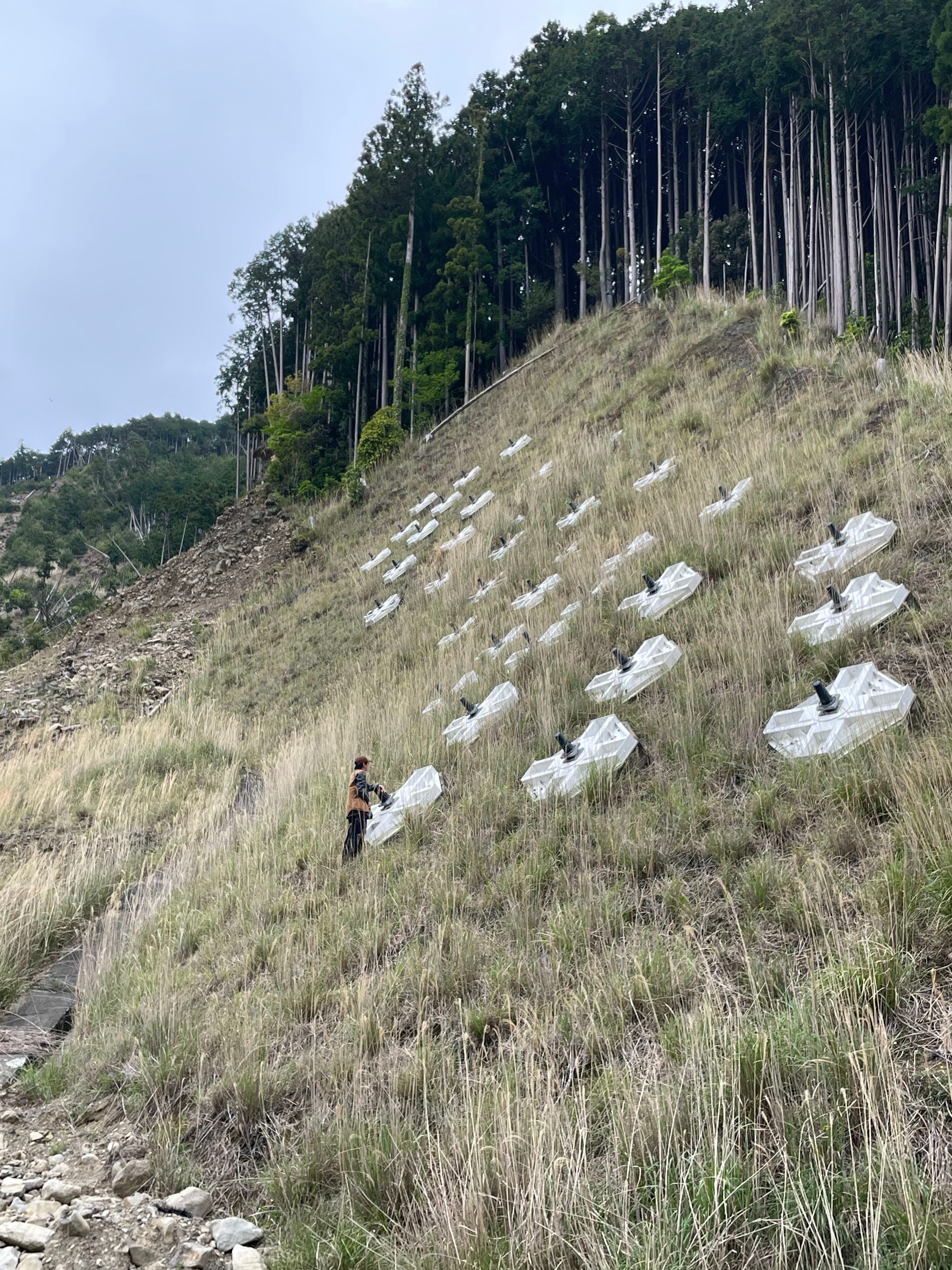
FIG.1
“What kind of science-fiction and architectural imagination is needed to escape from boring science fiction and boring cities?”
The group discussion began by juxtaposing these two terms—science fiction and architecture—which have different scopes. The text cited as “required reading” to guide the discussion was *Boring Cities and Boring Science Fiction: Escaping the Future as Told in the Past* by science fiction writer Kyosuke Higuchi.
Higuchi argues that the visions of the future found in recent creative works and manifestos are, for the most part, outdated concepts proposed by the 20th century, and that the future we envision has become a boring one. On that basis, he calls on us:
Yes, let’s read 21st-century science fiction. Let’s read plenty of science fiction from this new era.
By writing and reading science fiction of this new era, we can reach out toward the “possibilities of creation” in a “somewhere other than here.” As one example of science fiction from this new era capable of revolutionizing the fixed notions of utopia that have prevailed until now, Higuchi cites Ren Banme’s *The Smooth World and Its Enemy*.
Beginning with the strange sentence, “I woke up to sweltering heat, opened the curtains, and saw a snowy landscape through the window,” this work is set in a world where a sense called “Jōkaku”—the ability to “perceive parallel worlds”—has been discovered and enhanced.The people of the “Smooth World” “go this way and that way, moving among all possibilities as they live,” and those with active “Jōkaku” can “see, hear, and touch all possibilities.”
They can perceive every possibility that exists simultaneously with a sense of physical reality. Higuchi regards the “Smooth World” depicted by Tomona as one of the utopias we should strive for.
Living in every parallel world simultaneously. Recognizing all possible and impossible states of the world—woven together from every possibility and impossibility—as existing right here.(...) Such a world is unquestionably a utopia, and it would be difficult to deny it. If that is the case, there is no reason why humanity should not aim for the “Smooth World” as a utopia of the 22nd century.
The opening passage of Tomona’s text reads: “I woke up to the sweltering heat; when I opened the curtains, I saw a snowy landscape through the window.”During a group discussion at the semi-public editorial meeting titled “Technology and Craftsmanship,” Igata pointed out that it was clear this was an homage to the all-too-famous opening line of Yasunari Kawabata’s novel *Snow Country*: “As the train emerged from the long tunnel at the border, it was a snow country.”
Igata: When you read Kawabata’s opening passage, what kind of scenery comes to mind?
Kagami: I had the same experience when I went to Niigata last winter. At that time, the Shinkansen emerged from a tunnel, and a dark snowy landscape spread out before my eyes.
Igata: That’s interesting. What I imagine is an overwhelming whiteness. I think it’s a shift from darkness to the light reflecting off the snow. And there’s a sense of pure surprise at that.
Kagami: Kawabata’s writing conveys that sense of surprise at having suddenly found oneself immersed in the world of a snowy region, doesn’t it? Ban’s version might be more descriptive. He says “I saw,” which gives the impression of viewing it from a somewhat objective perspective.
Igata: In a seamless world, I feel like the sense of crossing a border without realizing it—or the fleeting moment of passing through a single point, like a tunnel—and the emotion that comes with it are lost. The moment you can move back and forth between a timeline where you’re surprised and one where you’re not, the surprise itself vanishes.
The difference between the worlds depicted by Tomona and Kawabata lies in whether the subject perceiving that world can maintain a sense of wonder regarding its own reality. In a world of “jōkaku”—where all reality dissolves—we cannot believe what we see and feel as it truly is.If we cannot believe it, no sense of wonder can arise. While Higuchi praises Banme’s depiction of parallel worlds for guaranteeing a sense of physical reality, is the raw sense of wonder—the sheer astonishment at the sight of Kawabata’s snow and its whiteness—truly guaranteed?
Science-fiction-like imagination that depicts “somewhere other than here” and opens up possibilities for a new era. Let us position architectural imagination here as the guarantee for the “sense of wonder” that is lost in the process.
One work of creative writing that depicts architecture in a science-fiction style that comes to mind is David Macaulay’s picture book *Motel of the Mysteries*.The protagonist is an archaeologist living in the year 4022. The story follows his excavation of a buried remnant of modern American civilization and his attempt to unravel the society of that era through ideas that seem utterly preposterous to us today. At the very beginning, a massive structure—resembling a triangular prism laid on its side with a circular notch cut out—suddenly appears.
From our modern perspective, we immediately recognize this as the pediment of Manhattan’s “AT&T Building” emerging from the ground. However, the people of the year 4022 are unable to understand the function of this massive structure and conclude that it must have once been a temple.Although its purpose remains unclear, it certainly commands attention. The appearance of such architecture evokes the landscape. For something to be considered “landscape-like,” three conditions must be met: a large spatial scale, a large temporal scale, and a sense of reality.
Topography is vast. The spatial scale of mountains and valleys is immeasurably large, exceeding the scope of what we can tangibly perceive. Yet, through architectural imagination, we can engage with this majestic topography. Architects have painted pictures within the landscape, bringing together technology and people to bring them to life.The Pyramids, the Colosseum, the AT&T Building. And architecture itself—born of human imagination—has become a kind of “topographical” entity that far exceeds our spatial scale. At the same time, both topography and architecture exist within a long temporal scale.The time spans of the landscape—tens of thousands or even hundreds of thousands of years—effortlessly transcend our familiar senses and draw us into a world of science-fiction-like imagination.And by imagining the scene 4,000 years ago when the pyramids were built, or by letting our thoughts wander to 2,000 years in the future when the AT&T Building has become a ruin, architecture, too, becomes an entity that deviates from the ordinary scale of time.It is said that many of the high-rise apartment buildings being constructed across the country will be difficult to demolish in the future due to a combination of profitability concerns, consensus-building challenges, and technical issues. In the near future, these high-rise apartment buildings may become part of the landscape—as ruins that are no longer needed but cannot be torn down.
The practice of architecture demands a science-fiction-like imagination from us, both spatially and temporally. Yet at the same time, architecture has another aspect: the requirement that it possess reality. Through the functional and structural requirements, the surrounding environment, and other factors, architecture is not merely imagined but takes concrete form and actually comes into being when situated within various given conditions.
Topography shares this characteristic: conditions determine form. All topography is shaped by consistent physical forces.It is precisely because it is based on consistent rules that we can interpret topography and perceive its reality. An idea expressed verbally becomes more accessible to a wider audience when drawn. By building models, drafting plans, and actually constructing a building, architecture—which begins as imagination—becomes a reality that anyone can understand.
Science fiction can open up possibilities by presenting visions of a future that is not here. Architecture, too, possesses the characteristic of a medium that can present something that is not here and now, due to its vast spatial and temporal scales. Yet at the same time, architecture is a tangible reality within physical and social conditions.In the world where Jōkaku works, all possibilities exist simultaneously; yet, in reality, only one architecture exists. That is why we can share the same reality with someone who is a little distant from us, or with someone who is a little further into the future.
Igata: What happens when I consider my “sense of wonder” from an architectural perspective?
Kagami: I believe there are two kinds of architecture: architecture that divides people and architecture that connects them. Perhaps that relates to surprise.
Igata: That’s true—even though Jōkaku seems connected, I feel like it can make you feel incredibly lonely.
Kagami: I don’t think architecture is a product; it’s something that inherently involves society. Creating architecture has a major impact on the surrounding area and on the future. I don’t think that’s a bad thing in itself, but I believe it’s important to leave room for people to discover and use it in their own ways. Since the way the terrain is used isn’t prescribed, you can engage with it as an individual while still connecting with others.
Topographic architecture possesses both temporal and spatial imagination, as well as the reality of being “here and now.” That’s why, through architecture, we can reach out to somewhere other than the “here and now” and share that sense of wonder.
Topography—and architecture rooted in topography—does not impose anything on us; rather, it guarantees multiple ways of engaging with it. If there’s a mountain, you can simply gaze at it, or you can climb it. You can pass through a tunnel and be amazed by the snowy landscape that lies beyond.