CREEN Conference Special Interview #1
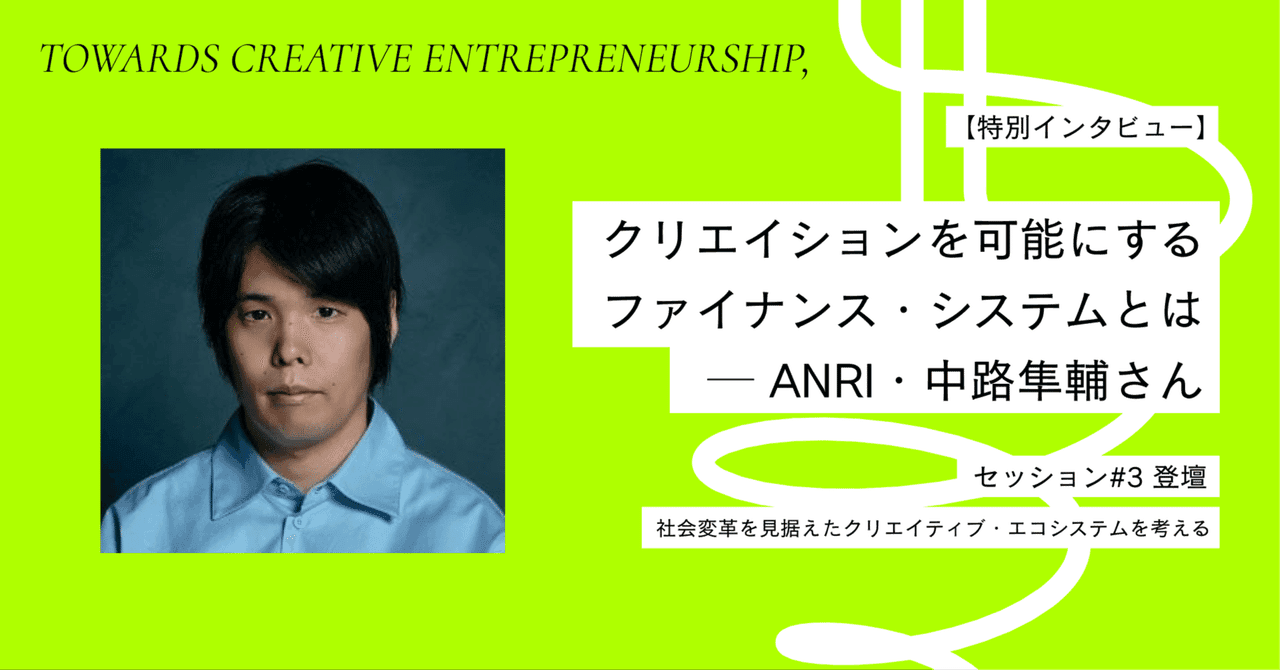
FIG.1
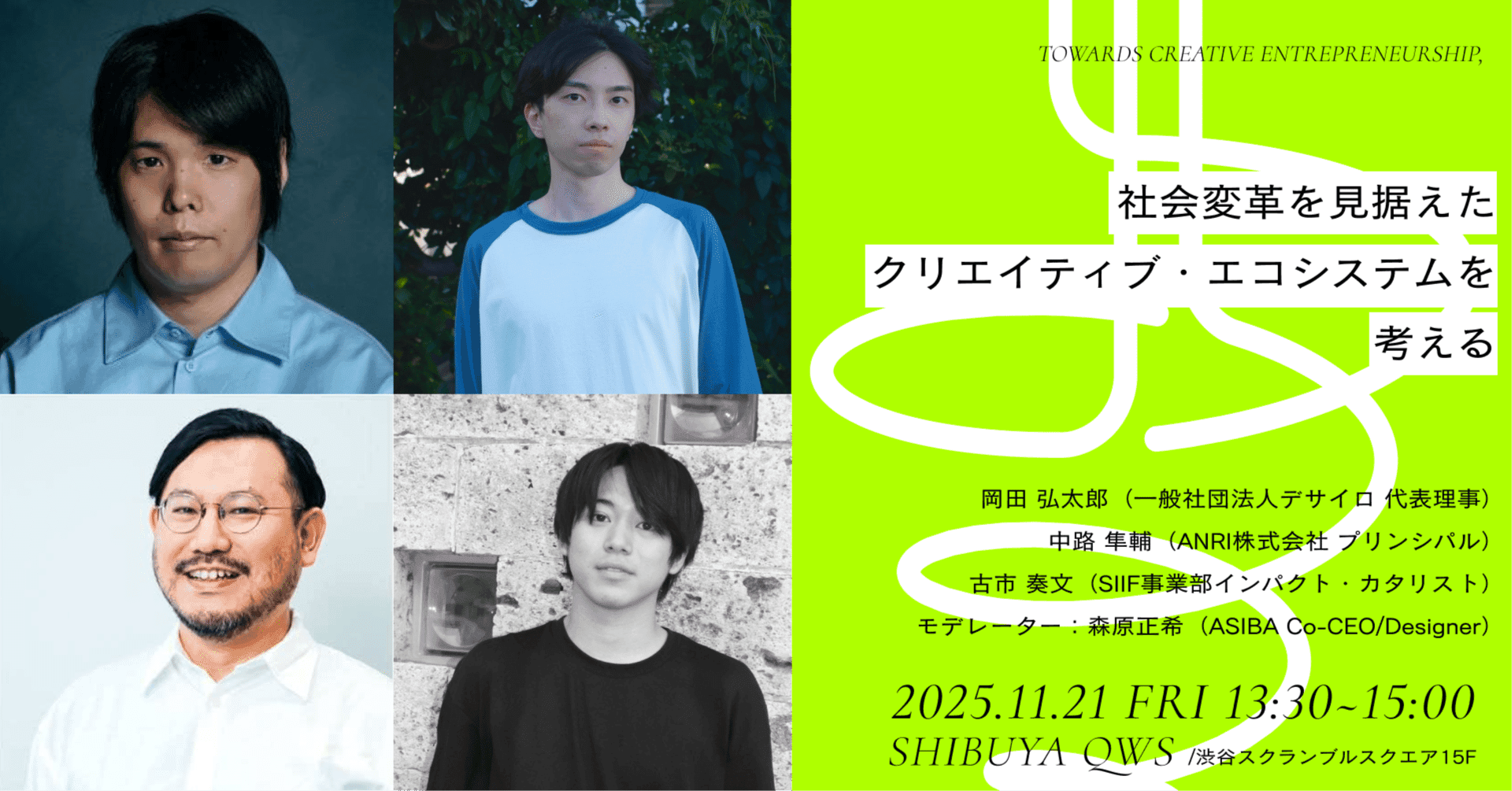
── On Friday, November 21, the one-day conference “Towards Creative Entrepreneurship: Exploring the Potential for Social Implementation in the Creative Sector and Its Methodologies” will be held at Shibuya QWS.For this installment, we spoke with Shunsuke Nakaji of venture capital firm ANRI, who will be speaking in Part 3: “Envisioning a New Creative Ecosystem with a View Toward Social Transformation.”
Shunsuke Nakaji, Senior Principal, ANRI Co., Ltd. Born in Kagawa Prefecture in 1991
. Senior Principal at ANRI, Editor-in-Chief of “FASTFORWARD,” and in charge of the ANRI Humanities Scholarship.He became involved with startups while a student at Waseda University and joined Google Japan immediately after graduation. After working at LUXA and DCM Ventures, he joined ANRI in 2018. He is involved in investment activities, focusing primarily on seed rounds. He is currently taking on the challenge of investing in companies capable of bringing about significant change during the round with the highest level of uncertainty.
Mr. Nakaji Morihara, what do you think the financial system should look like to enable creativity?
Nakaji: One issue I’ve long been conscious of is that in today’s society, the only options for cost of capital are “low-blood-pressure banks” and “high-blood-pressure VCs.” In other words, while banks are fine with slow growth, VCs demand, “Grow by 30%—or even 50% or more—in a single year.”I believe that the lack of flexibility in the stance of capital providers is, in some ways, hindering the diversity of players and the scope of creativity.
Morihara: In other words, when people with a spirit of entrepreneurship and creativity—who fall somewhere between speculative and stable—try to start something new, the binary choice between banks and VCs has its limitations.
Nakaji: I think Web 3.0 was seen as one potential solution to this. I think the underlying mechanism is elegant, and implementation is already well underway in the financial systems space. However, when it comes to effective utilization at the application layer, the reality is that it’s hardly being used anymore. Just like with LoveBub or Pokémon cards, the moment supply and demand emerge and people can buy and sell freely, prices either crash or skyrocket. In other words, it turns into nothing more than a game of dumping built into the economic value. But precisely because we’re in this situation now, I think it’s meaningful to revisit our original intent and ask ourselves, “What did we actually set out to do in the first place?”
Morihara: Historically speaking, there’s always been an aspect of creation that has depended on the support of wealthy capitalists and patrons. For example, while some forms of crowdfunding—which have become commonplace today—have a strong element of support, more often than not, people contribute money in hopes of receiving a return.
Nakaji: I feel like capitalism is so dominant in today’s society that everything seems to boil down to discussions about what kind of return there will be. That’s precisely why I think it would be good to step back and revisit the discussion from the perspective of what truly brings joy to people. The reason I started the Humanities Scholarship was rooted in the awareness that people aren’t driven solely by economic rationality. Take a project like NOT A HOTEL, for example—while it certainly has economic rationality, there must be an underlying emotion that makes people think, “I want this,” which goes beyond that. Personally, I don’t think capitalism is bad. In fact, I like it and believe we should use it wisely—but at the same time, I have this lingering sense that relying on it alone makes society feel “dry and lifeless.” I’m constantly thinking about the balance between capitalism and our humanity, and how we can strike that balance.
Morihara: I feel that to produce good creativity, there needs to be a time when the arrow points inward. In other words, the more you think, “I have to get a return” or “I have to explain this,” the more the arrow gradually points outward, and the creativity becomes increasingly mundane.
Nakaji: Ultimately, I think accountability does play a part in making creativity less interesting. It’s a bit ironic coming from a VC who demands explanations, though (laughs). One symbolic example is Mori Building’s decision to create an art museum on the top floor of Roppongi Hills.Normally, the top floor would be turned into a hotel where high rates could generate substantial profits, but they turned it into a cultural hub instead. I think that was a decision only possible because it was an unlisted, owner-operated company, but as a result, it has attracted people and boosted the economic vitality of the entire area. In that sense, too, I find the fields of architecture and urban planning truly fascinating.There’s a sense that there’s a purpose, yet it feels as if there isn’t—it’s somewhat philosophical. I always find myself thinking, “I wish more wealthy people would build and live in meticulously crafted architecture rather than just living in high-rise condos.” Of course, from a financial perspective, buying a high-rise apartment is the more rational choice. Still, when it comes to actually building a structure, I think what you ultimately arrive at is a matter of personal aesthetics. You could say it’s a feeling that wells up from within—a sense that “doing it this way is cool.”
Morihara: How do you envision establishing these elements—such as ownership-driven decision-making and aesthetics—as part of an ecosystem?
Nakaji: I don’t see a clear form yet, but I think “aesthetic matching” could be one direction. In other words, a system where people who share the sentiment, “This is cool,” connect with one another, and the system is sustained by those who agree. In a sense, it might even be considered healthier than a system that requires you to go out of your way to explain things to the general public. Looking at society today, I get the sense that we’re living in an era where, while not everyone is becoming wealthy, the number of people becoming extremely wealthy is increasing. I believe that a shift in the aesthetic sensibilities of this wealthy minority will be one of the keys to transforming society as a whole in the future.Rather than simply spending money aimlessly or growing their wealth through investments, they’ll use it to engage with the future of culture and aesthetics—and translate that into action. There may be a sensibility there that resonates with figures like Kitanoji Rosanjin, Seigo Matsuoka, and Sen no Rikyū. Ultimately, I believe the role of venture capital is to create more wealthy people. That’s precisely why I’m so interested in what values the wealthy individuals of the future will hold. The reason I created a magazine at ANRI Bookstore was also rooted in a desire to share this “new aesthetic of the emerging wealthy class.”
Morihara: Within the current economic system, creators are often expected to deliver results within a short timeframe. On the other hand, there are fields—such as architecture and urban planning—where it’s normal for things not to change for a decade or more. How do you view the temporal gap created by this system?
I believe that a venture capital firm like Nakaji VC is, by its very nature, an entity that bridges these different time scales. It’s about buying time with money—that is, using VC to shorten steps that would otherwise take a long time, thereby guiding companies to the next stage, such as an IPO or an M&A. However, I also feel that if you bring a creative perspective into this, the answer becomes something entirely different. That’s why I’m so committed to seed VC—rather than simply “accelerating the pace of promising ventures,” I find meaning in the very act of investing in unfamiliar fields, even if it’s done with a heavy dose of bias. Making decisions based on numbers and growth rates is something even AI can do—in fact, I think AI does it better. But when someone says, “I don’t really know why, but I want to try this with 100 million or 200 million,” only a human can believe in that and make the decision. Actually putting 100 million into it might be a mistake of sorts, but I believe the trust that exists within human relationships is ultimately what allows us to tolerate such mistakes. What we need to consider next is the process of how to put that “uncertainty” into words and broaden the circle of understanding. I believe the compass that will guide us in this endeavor is the humanities—the discipline that structurally grasps the world and ascribes meaning to it.I look forward to discussing this relationship between creation, finance, and the academia that supports them with all of you on the day of the talk event.
Credit
Related Works
Related Texts
Special Interview: The Ethics of Design Challenging Structures - Public and Design with Rika Ishizuka
CREEN Conference Special Interview #5
INTERVIEW
2025.11.18.