CREEN Conference Special Interview #5
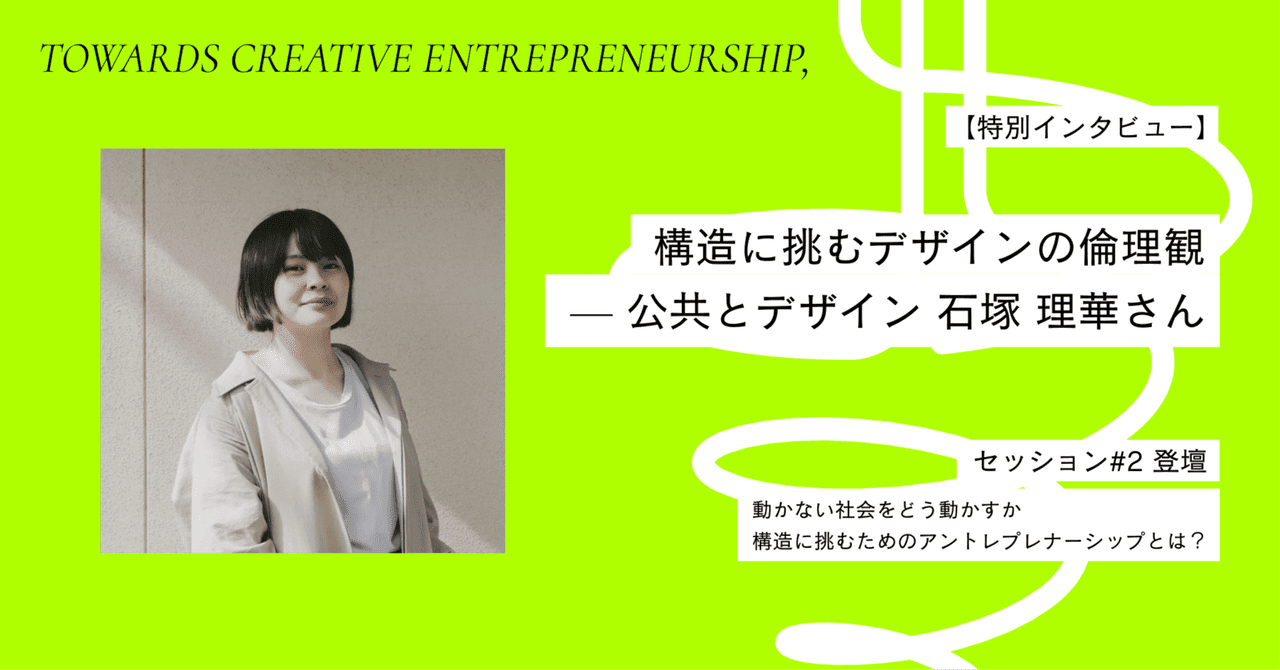
FIG.1
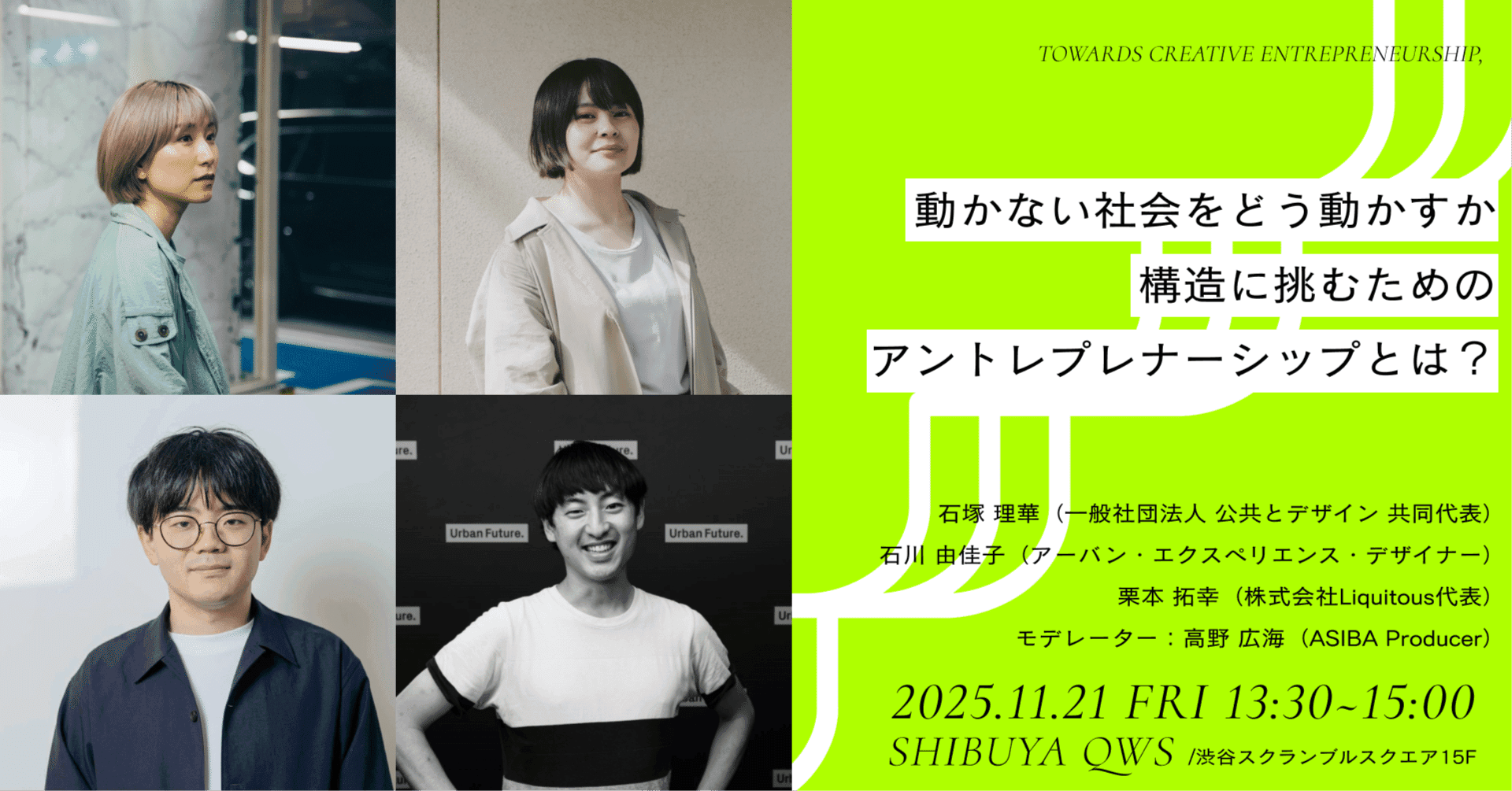
── On Friday, November 21, the one-day conference “Towards Creative Entrepreneurship: Exploring the Possibilities of Social Implementation in the Creative Field and Its Methodology” will be held at Shibuya QWS.For this article, we spoke with Rika Ishizuka of Public and Design, who will be speaking in Part 2 of the conference, titled “How to Move a Stagnant Society: What Is Entrepreneurship for Challenging Structures?”
Rika Ishizuka, Co-Representative, Public and Design (General Incorporated Association) She founded the social innovation studio “Public and Design”
with the goal of creating “a new public sphere shaped by our diversity.” She is engaged in initiatives to cultivate a democratic social environment (Creative Democracy) by working hand-in-hand with corporations, local governments, residents, and those directly affected by social issues.Her work includes supporting the establishment of an innovation lab with Shibuya Ward and “Sanamime Memo,” a project that reexamines values surrounding childbirth. She is a co-author of *Creative Democracy* (2023, BNN).
For Session 2 with Takano, we’d like to invite those of you working in fields where there is no clear “market”—such as citizen participation and the public sector—to discuss the “Theory of Change” for transforming society and the nature of entrepreneurship in these contexts.
Morihara: Mr. Ishizuka, you work independently in areas similar to workshops with local governments and design consulting. Could you tell us about the background that led you to this approach and your career path?
Ishizuka: Originally, I studied service design and interaction design in college. In the design department where I studied, the mainstream path at the time was to join major manufacturers; while design inherently included public aspects, it was taken for granted that we were learning “business-oriented design.” The turning point for me was an experience working on a project with a government agency while studying abroad.Back then, if you Googled “public design” in Japanese, the results were limited to flyers and architecture, but I realized the potential of work focused on creating “social infrastructure through software.”
Morihara: Did you pursue that path immediately after returning to Japan?
Ishizuka: No. At the time, there were no job openings for that kind of work. I tried to build social infrastructure from the business side, so I joined a major corporation and worked there for two or three years—but I began to feel increasingly out of place.
At the time, the prevailing belief was that “good design is design that contributes to business.” Especially in the web industry, where results are measured numerically, growth hacking was highly valued. But I began to wonder: Do the people using the service—and the people involved in creating the design—actually become happier?“Is this really the kind of design I studied…?” I felt a sense of crisis in a situation where people were discussing the merits of design without ever addressing these fundamental questions. Eventually, I launched the “Public and Design” initiative with my co-founders, Kawachi and Togashi, who shared that same sense of unease at the time.
Morihara: It’s true—I feel that professional ethics are woven into architecture and traditional design education, even if perhaps unconsciously.
Takano: Mr. Ishizuka, I imagine you often work with local governments. What kinds of challenges do you identify, how do you structure them, and how do you approach them?
Ishizuka: One example of a project where we structurally analyze an issue and intervene is our initiative with Shibuya Ward.
In Shibuya Ward, we’ve formed a team that operates slightly “within” the administration while connecting with the “outside” of the ward to conduct pilot experiments.To design the agenda, we’re taking on challenges such as conducting research with various experts and stakeholders to gain a systemic understanding of the social context, as well as implementing a “portfolio approach” that treats opportunities related to the issues as a portfolio.
Since we had already put the agenda-setting projects mentioned above into practice during the previous term, this term’s projects focused on implementing those initiatives. Based on the question, “What kind of changes would we like to see in people’s lives and in Shibuya, inspired by the Deaflympics?” we worked on “creating an ideal vision” and “building entry points to realize that vision.”Specifically, we first organized a workplace experience program for young working professionals who are deaf or hard of hearing, in collaboration with the staff of the Shibuya/Omotesando District at Starbucks Coffee Japan Co., Ltd.From the perspective of customers visiting the store, they might happen to walk in and witness—or learn—that people who are deaf or hard of hearing are providing customer service there as a matter of course. This could spark an interest in the social circumstances surrounding people who are deaf or hard of hearing, and it might even lead to new opportunities.Furthermore, building on this initiative, the project sought to create entry points for fostering such scenarios. Within the context of “communication,” we reached out to 11 companies—including those in the apparel industry and those interested in new business development related to Shibuya tourism—and conducted a “non-verbal communication” training session.We received cooperation from Silent Voice, an organization that provides support to children who are deaf or hard of hearing. Physical experience serves as one approach to addressing specific challenges, and it seems meaningful to scatter opportunities to create such situations throughout the city.
Takano: Could you tell me a little more about the project with Shibuya Ward? I believe initiatives like this will deepen societal understanding of deafness and hearing loss. On the other hand, what kind of changes have you observed among the deaf and hard-of-hearing individuals themselves?
Ishizuka: As I learned about the circumstances faced by people who are deaf or hard of hearing in society, I realized how limited their employment opportunities are. When it comes to job hunting, the available positions tend to be skewed toward administrative or factory work. In this environment, the individuals themselves end up believing, “I can’t do customer service—that kind of work has nothing to do with me.”
So, with the cooperation of Starbucks, we created a workplace experience program. What’s remarkable about Starbucks is that Deaf partners (store staff) actually working at their Shibuya location are already performing the same tasks as hearing employees—including operating the register and serving customers.As a result, during this workplace experience, these Deaf partners took the lead in providing on-the-job training and guidance to the participating students. For the students who participated, this experience allowed them to gain confidence, realizing, “I can actually do this.” It goes beyond customer service—it overturns the assumption that “I might not be able to do this in various situations” and helps them think, “Maybe I can.”
This isn’t necessarily about creating new businesses or initiatives. It’s about opening up opportunities tailored to each individual—beyond the narrow framework of employment—or serving as a catalyst for positive change in their lives. I feel that “social innovation” often begins when each person, inspired by a project or a particular setting, thinks, “Maybe I can do this” or “Let’s give it a try”—and that it can only truly emerge from that point.
Morihara: So it’s about how individuals can discover their own “Life Projects”—as introduced in *Creative Democracy*—and how to create an environment free from restrictions, isn’t it?
Ishizuka: Exactly. In terms of “entrepreneurship”—the theme of this discussion—the option to “start a business” could certainly be one form of a Life Project. But I also believe that starting a business isn’t the be-all and end-all. This is perhaps where my views resonate with Mr. Ishikawa’s (for Cities) work.
I believe social innovation requires two stages. The first is to increase the opportunities that spark that “impulse.” The second is to create the environment necessary to realize that “impulse.”
Right now, thanks to the dedicated efforts of many people, “infrastructure” such as platforms like Liquid and participatory budgeting has gradually been put in place. However, there is a critical lack of support for “shaping desires”—that is, helping people figure out what they actually want to do in the first place. Furthermore, there is no “path” connecting those “desires” to the “infrastructure.”We believe designing this connection is crucial. We’re still in the exploratory phase ourselves, but it would be great if we could have that discussion on the day of the event.
Credit
Related Works
Special Interview: Entrepreneurship in Urban Experience Design Starting from 'Designing the End' — Yukako Ishikawa from for Cities
CREEN Conference Special Interview #4
INTERVIEW
2025.11.16.