CREEN Conference Special Interview #3
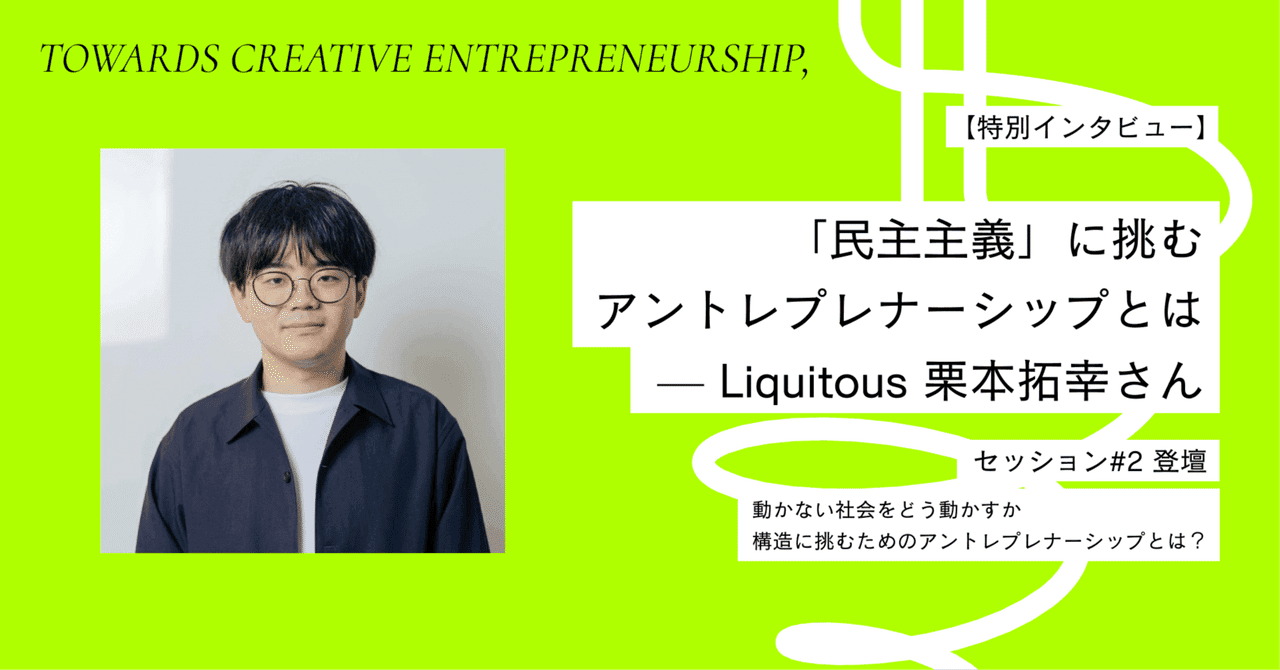
FIG.1
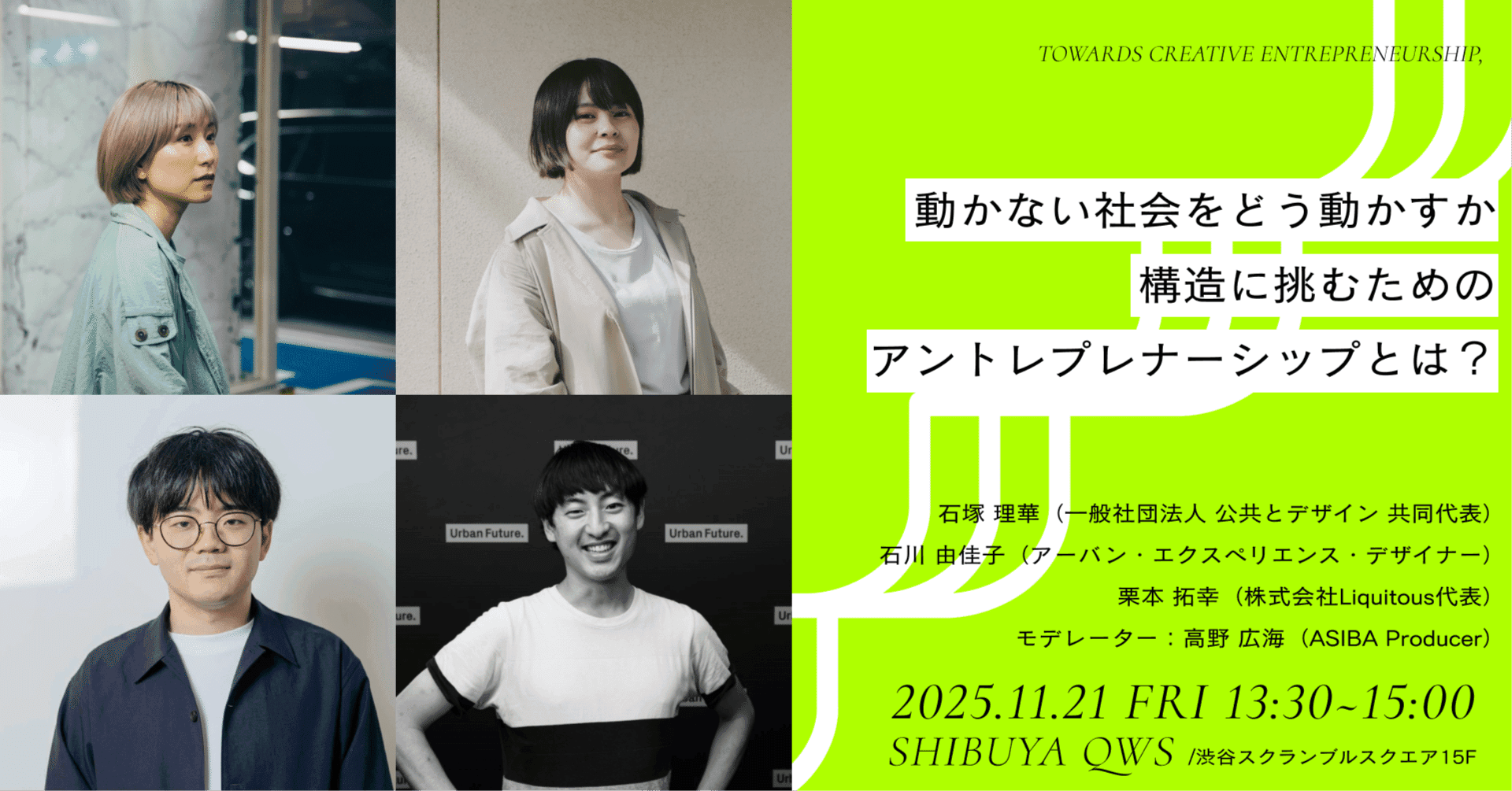
── On Friday, November 21, we will host a one-day conference titled “Towards Creative Entrepreneurship: Exploring the Possibilities of Social Implementation in the Creative Sector and the Methodologies Behind It” at Shibuya QWS.For this article, we spoke with Takuyuki Kurimoto of Liquitous, who will be speaking in Part 2 of the conference, titled “How to Move a Stagnant Society: What Is Entrepreneurship for Challenging Structural Barriers?”
Takuyuki Kurimoto, Liquitous, Inc. Born in 1999
, he served as a director for an NPO and a general incorporated association before founding Liquitous, Inc. in 2020. Aiming to create “a society where every individual can exert their influence,” he developed “Liqlid,” a citizen participation platform designed to serve as the foundation for digital democracy in local governments.He currently collaborates with local governments in Japan—including Kyoto City and Hino City—as well as in the Republic of Indonesia, such as Pekalongan City in Central Java. He serves as an advisor for the Ministry of Internal Affairs and Communications’ Project to Strengthen Financial and Management Capabilities of Local Governments and as a member of the “Consensus-Building Study Group” for Osaka Prefecture and Osaka Public University.
Takano: Much of what is recognized as entrepreneurship in the world attracts funding based on the expectation of rapid growth precisely because it is “disruptive.” In contrast, Mr. Kurimoto, you are directing your entrepreneurship toward areas where markets do not yet exist or where change is difficult to achieve. What do you think is necessary to increase such initiatives?
Kurimoto: Using the term “entrepreneurship” to describe transformation within government organizations is a very interesting perspective. Personally, while introducing our product within a local government and launching a new initiative is not disruptive, I believe it requires a higher level of entrepreneurship. It’s often said that “resilience” is crucial in entrepreneurship. In the typical startup scene, if there are 100 investors, and to put it extremely, if just one out of 100 says “YES,” you can secure funding and move forward.
However, within a government organization, things won’t move forward unless all 100 people say “YES.” I feel that the entrepreneurship required in that process—particularly the aspect of resilience—is far more challenging than in the private sector. And isn’t this precisely the area where Japan has yet to change?Japan still has several world-class private companies, and in areas where services can be provided by the private sector, change has occurred at a reasonable pace. Setting aside whether they are at the global cutting edge, the necessary services exist domestically and have been localized. So where is the lag? It lies in this realm where “things won’t move forward unless all 100 out of 100 people agree.”I feel that the pace of change in areas such as local government practices and legal regulations is far too slow. That is precisely why, unless “entrepreneurship aimed at changing what is hard to change”—which requires greater resilience and consensus-building capabilities than traditional disruptive innovation—begins to spread, Japan risks losing the opportunity to transform for the better.
Takano: In a slightly different context, it is said that citizens’ demands on the government involve two conflicting desires: fairness and efficiency. These two can be at odds with each other, and I believe that how to strike a balance between them—or how to reconcile them—is a very significant issue.Mr. Kurimoto, from the perspective of “citizen participation,” could you tell us how you view this dilemma and how you intend to approach it?
Kurimoto: I think that’s a very important perspective. To start with the basic concept, Article 1 of Japan’s Local Autonomy Act itself requires local governments to reconcile both “efficiency” and “democracy.” I believe that while “efficiency” is often discussed in the context of administrative reform, the question of whether it is “democratic” has been addressed very rarely up to now. My first basic point is that, purely in terms of the overall volume of discussion, this aspect has been lacking.
The second point is the issue of cost. Traditionally, serious efforts to implement consensus-building and citizen participation as “procedural matters” entailed enormous economic and time costs.Even though we understood its importance in principle, the prevailing argument has been that if prioritizing the costs of coordination and democracy ultimately results in higher overall costs, it might be unavoidable to overlook those aspects. However, technology has changed that premise.Thanks to technology, we can now devote time to consensus-building and democratic processes in a more multifaceted, deeper, and more meticulous way—at the same or even lower economic and time costs than before. To put it simply, in the past, when the goal was to “hear the voices of 10,000 people,” while we could collect those voices, the moment it came to analyzing them, we could only identify key issues through a labor-intensive approach. Now, however, we can use AI for that analysis.Similarly, when we want to casually gather opinions from a more diverse range of people, we can now use methods other than the traditional approach of setting up a tent in front of a train station to conduct surveys. Our basic stance is that if we can build consensus more carefully at the same or lower cost than before, there is no reason not to do so.
Takano: I feel that today, both in Japanese society and globally, the spectrum of opinions among citizens is widening, and polarization is advancing. In an era where the potential for consensus and empathy toward others are declining, what role do you think citizen participation tools play, and what do you believe they can achieve?
Kurimoto: First and foremost, it is essential for the government to accurately recognize the fact that “polarization is occurring.” While polarization of opinions can occur along various axes, there are still far too many cases where local governments in Japan generally fail to recognize that such a range of opinions exists in the first place. A clear example is the structure of advisory committees. For instance, if publicly recruited members are summoned to attend committee meetings held on weekdays during the day, the demographics of citizens who can participate through that channel will, naturally, be extremely limited.Working-age adults are generally unable to attend, resulting in a bias toward specific demographics. If existing channels remain unchanged, the voices heard will never change, leading to the false impression that “there is no division or polarization among citizens.” Many local governments in Japan may be falling into this trap. If we change the nature of these channels and create mechanisms that allow for broader participation, the voices we hear will inevitably change. I believe the first step is for local governments themselves to recognize this need for change.
Second, the primary themes addressed by the local governments—specifically, cities, towns, and villages—with which we primarily collaborate are fundamentally “issues of daily life.” As for whether complete polarization occurs regarding these issues, as it does in online discourse, the possibility is certainly not zero. However, on the other hand, we have the strength of “sharing the same living environment.”Precisely because we are flesh-and-blood human beings living our daily lives with our physical bodies, there must be a form of “embodied knowledge” that we can share. I strongly feel that on issues where we can share this embodied knowledge, even if there are differences of opinion, the possibility for dialogue remains. For example, when considering the future of a local hospital, opinions may diverge along lines such as “it should be closed,” “it should be placed under designated management,” or “it should remain publicly operated.” However, there is potential to find common ground on the point that “having some form of medical resources available allows us to live with greater peace of mind.”
And thirdly, I believe it is precisely in this aspect of “dialogue” that technology can contribute. It is true that, as has been widely discussed, social media algorithms (such as echo chambers) have tended to further polarize people.I, too, do not believe that current platforms like X or TikTok contribute to fostering dialogue or deliberation. However, should we conclude that technology as a whole drives people away from dialogue and closes off possibilities simply because “those platforms do that”? We are currently collaborating with several companies to test approaches that differ from existing social media algorithms. These include conversational mechanisms designed to uncover the deep-seated needs of specific individuals, as well as systems that combine voting mechanisms to suggest proposals with the highest potential for compromise. I call these “counter-algorithms.” I believe there is still potential to create a starting point for dialogue by designing algorithms with a different orientation than existing ones. Given these points, I believe our efforts are meaningful even in this era of increasing polarization.
Takano: Thank you. I was particularly surprised by your second point regarding the strengths of physical spaces and local contexts—specifically, how the sharing of embodied knowledge ensures the possibility of dialogue—as this is very close to what we constantly discuss in the fields of architecture and urban planning. Hearing the same observation from someone in a different field has reinforced my conviction in this idea.
Takano: There is a current debate that “being creative” is important for individual happiness and social development. On this point, what do you think the relationship is between democracy and creativity? What can democracy do to enable people to be creative?
Kurimoto: As a premise, the foundation of democracy lies in “procedures.” For example, initiatives for citizen participation have traditionally been framed as a means to ensure the “two forms of legitimacy”—namely, “rightness” and “legitimacy”—in democratic discourse. Of course, the significance of these two aspects will never disappear. On the other hand, when evaluating this from a different perspective, I believe it is important to identify purposes beyond mere procedure within democratic practices (procedures).
When it comes to creativity, the era ahead will be one in which we cannot be truly creative without a process of articulating region-specific memories and narratives.If you’re looking for a generic answer that isn’t specific to a particular region, you can simply ask ChatGPT. However, if you want AI to provide an answer specific to a particular region, humans must put into words and input the various memories, stories, and narratives unique to that region. Such region-specific information won’t appear in a Google search.Someone must turn it into data. When we consider this, it is reasonable to think that “democratic practices” could be valued as the very process of generating that data. Traditionally, citizen participation and workshops have undeniably had an aspect of mere procedural formalism—that is, serving as an alibi based on the idea that “since we explained it here, that’s good enough.” The notion was that whatever citizens said there was merely a way to let off steam, and there was no need to examine it in detail. However, it is precisely each and every story and memory expressed in those settings that should serve as the critically important “source data” for utilizing AI.
While democratic initiatives are cumbersome and costly, they possess a certain “semi-compulsory” nature. For example, workshops organized by the government have the power to bring together a diverse range of people—people who would never gather at a privately organized event and who would not normally sit at the same table. There is a form of communication that arises precisely because of these democratic processes, and the outcomes—whether through AI applications or other means—can be put to use in various contexts. I feel that building a repository of the thoughts and memories gathered through citizen participation will serve as a “source” for generating new ideas. When citizens are given the opportunity to speak about their communities, their perspectives are truly remarkable. Because they view things from the vantage point of their daily lives, they offer ideas that would never emerge from the government alone, as well as unique memories and histories that only those living in that area can share. Citizens’ perspectives are indispensable not only as a procedural matter but also for improving the quality of our initiatives.
On the other hand, a current challenge is that even when citizens take the trouble to voice their opinions, there is far too little feedback on “what actually came of it.” Whether their input is formally incorporated into procedures or leads to the creation of something new through their participation, the feedback they receive for their involvement is far too sparse. Of course, ultimately, we need to discuss changing the procedures themselves—such as the mechanisms for direct petitions and participatory budgeting. However, even if we cannot leap straight to that stage, we should first try to create something small based on the voices we’ve gathered.I believe it is crucial right now to build upon these small, creative initiatives within the existing framework and provide citizens with early feedback that their participation was meaningful. In many communities, local governments still enjoy a certain degree of trust. Even though voter turnout in elections is low, there is no other event—apart from elections—in which at least 30% of the local population participates.However, if this trust is lost and we reach a point where people feel, “Nothing will change no matter what we say to the government,” it will truly be irreversible. At the same time, I feel that such a future is drawing near. That is precisely why I feel strongly every day that we must, as early as possible, create feedback in many communities that says, “Something was created as a result of my participation.”
Takano: Thank you.We’ve invited you today, Mr. Kurimoto, as an “entrepreneur,” but you also have the side of a “researcher” who writes papers, an “activist” who is conscious of political stances, and a “scientist” or “engineer” who utilizes technology. In terms of your self-perception and self-definition, which of these roles do you feel is closest to who you are?
Kurimoto: That’s a tough one. I’m sometimes called a “social entrepreneur,” but before establishing my current corporation, there was a period when I ran a general incorporated association and an NPO. That said, I’ve now chosen the legal status of a “corporation” and am operating as an “entrepreneur.”However, since I have absolutely no motivation to make a huge profit from this, I’m always hesitant about whether it’s really appropriate to introduce myself as a “pure startup entrepreneur.” That said, I also know that working hard in the civil society sector comes with significant challenges in Japanese society, so I can’t definitively say I belong there either.
That said, what I prioritize most is “continuing to take action on the ground.”I make various adjustments on the ground and sow the seeds for new systems and mechanisms. This is where I excel, but I believe I must do both: expand these efforts on the ground while simultaneously and systematically accumulating the insights gained there. Therefore, rather than simply focusing on business efficiency, I am deeply committed to dedicating my time to “creating new systems and mechanisms on the ground.”I also don’t believe that simply selling a service is enough. If I’m going to do this, I want to create the catalyst for changing systems and structures—even if it takes time. At the same time, rather than hoarding the insights gained there within our company, I aim to give back to society in an appropriate way. These two pillars—“practical implementation” and “accumulating (and giving back) insights”—are very strong for me.Compared to the average entrepreneur, I’m far more inclined to devote time to the unprofitable aspects of “how to create systems and mechanisms.” So, while I haven’t yet found a precise term like “XXist” to describe myself, if I had to sum it up in one phrase, the mindset that is strongest within me is that I am “committed to transforming democracy.”
Takano: Finally, could you tell us if there’s anything you’d like to discuss with the other speakers during today’s session?
Kurimoto: There are two points I’d like to discuss. The first is, “With whom should we work to create the seeds of change?” For example, I imagine the other speakers also work with government agencies, but is it always the right approach to set the agenda in collaboration with the government? Especially when considering design and the nature of the public sector, I believe there are cases where that isn’t the case.I myself specialize in the “New Public,” but when we want to consider new forms of the public sphere, is the approach of saying, “We’ll work with local governments,” truly in line with the “new philosophy”? Despite the past assertion that “the public sphere is not the exclusive domain of the government,” is it truly correct to ultimately consider the nature of the public sphere in collaboration with administrative bodies? Setting aside questions of correctness or ideology, who is the actual driving force behind getting things done in reality? That is the first point I’d like to discuss.
My second point is: “When changing society, where is the most effective place to start?” There is likely no single answer to this, and I believe it varies depending on one’s position and specific initiatives. For example, some start with human resource development, others with creating spaces, and still others with changing the mindset of those involved. Of course, it would be ideal to do everything at once, but resources are limited. I’d like to hear from the speakers here today about the key insights they’ve gained from their own initiatives—specifically, the “sweet spot” where they’ve found that “starting here makes change more likely to happen.” Presumably, each speaker has some sort of “theory of change”—whether or not they’ve clearly articulated it. By sharing these theories, I’d very much like to hear how you all view ways to change the current situation, and specifically, what you prioritize as input during the initial stages.
Takano: That’s interesting. The differences in each person’s “theory of change” certainly seem likely to be at the heart of this discussion.
Kurimoto: Exactly—I think they’re surprisingly different. And I believe that’s what makes this “Entrepreneur” session so interesting. That’s because entrepreneurs can decide how to allocate resources based on their own judgment. If this were a government agency, even if there were established priorities, constraints might arise requiring resources to be allocated more or less evenly. However, private-sector entrepreneurs can set their own priorities. And they should be able to explain “why they made that decision” in their own words. I’d really like to hear more about that difference.
Credit
Related Works
Related Texts
Special Interview: The Ethics of Design Challenging Structures - Public and Design with Rika Ishizuka
CREEN Conference Special Interview #5
INTERVIEW
2025.11.18.