CREEN Conference Special Interview #2
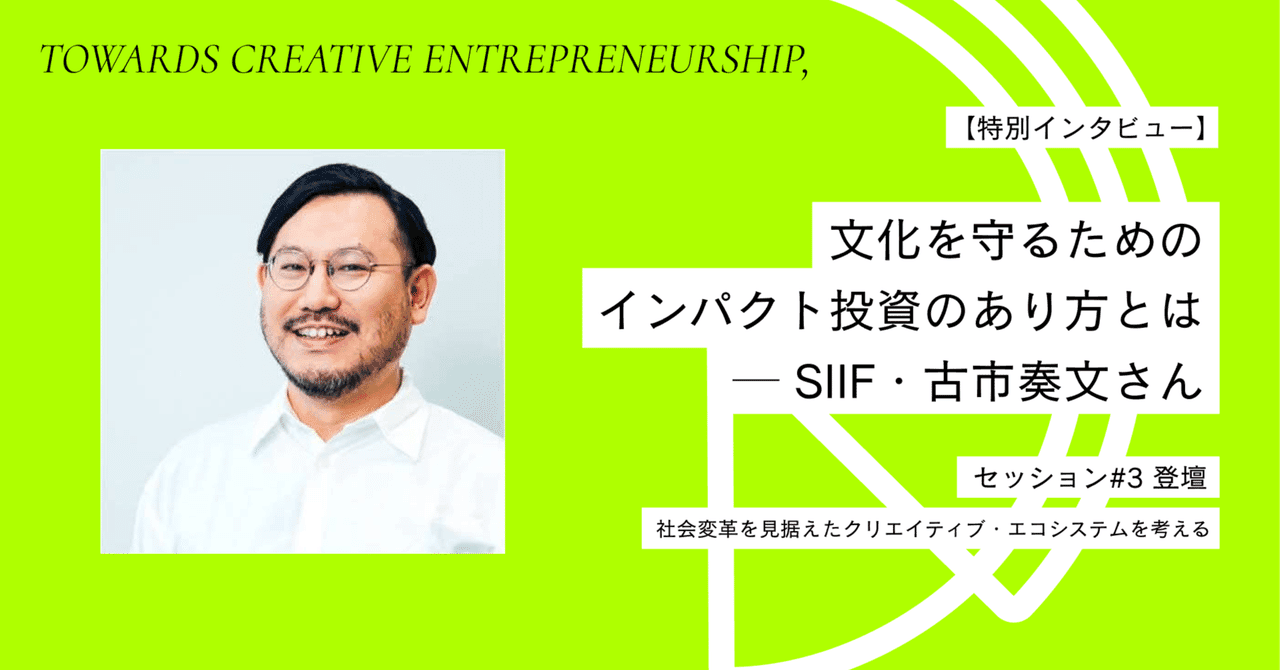
FIG.1
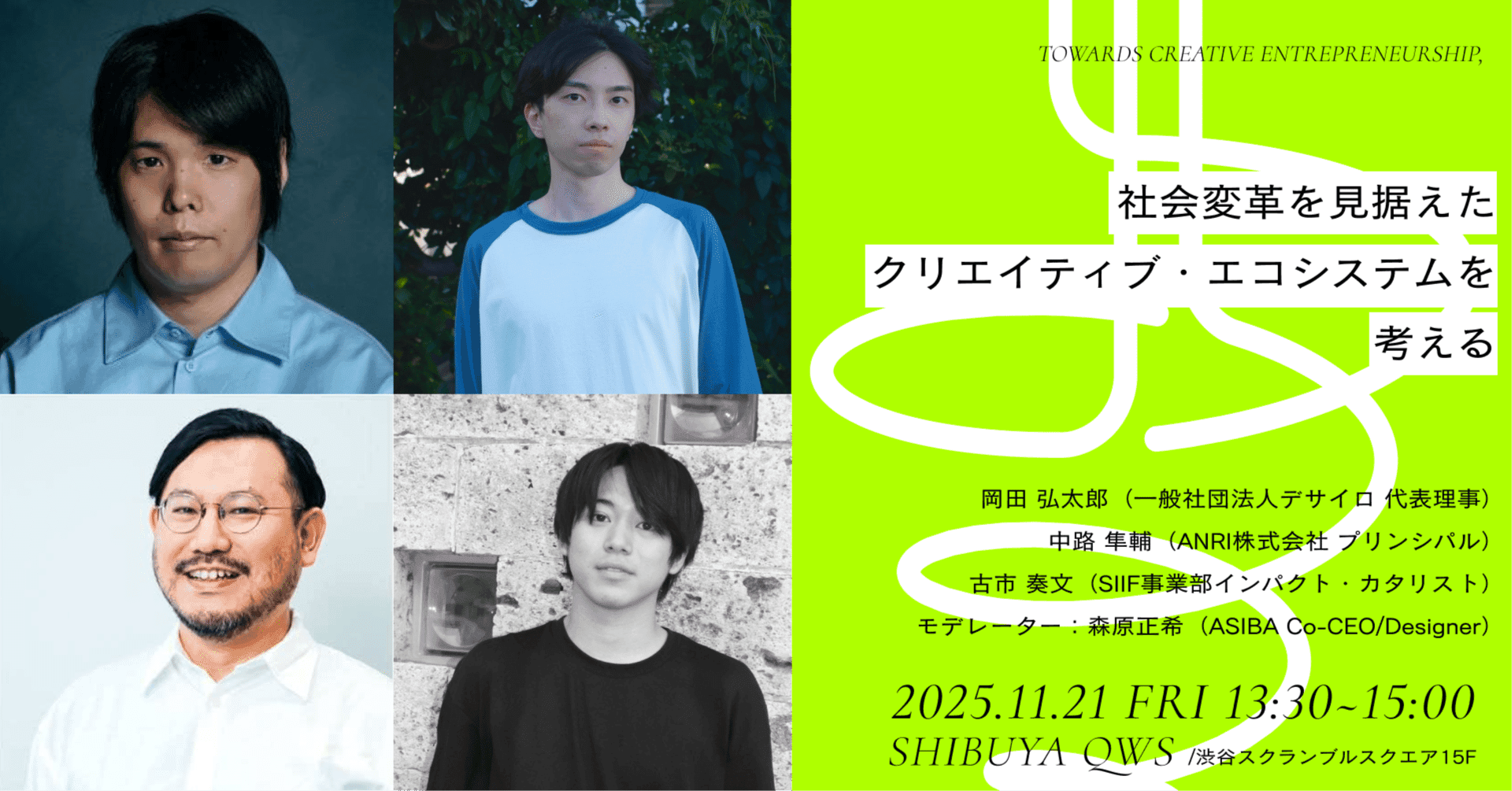
── On Friday, November 21, a one-day conference titled “Towards Creative Entrepreneurship: Exploring the Potential for Social Implementation in the Creative Sector and Its Methodologies” will be held at Shibuya QWS.For this article, we spoke with Kanbun Furuichi of SIIF, who will be speaking in Part 3 of the conference, “Envisioning a New Creative Ecosystem with a View Toward Social Change.”
Kanbun Furuichi, Impact Catalyst, Business Division, SIIF (Social Innovation and Impact Foundation). After graduating from
college, he worked in product development at a major manufacturer before gaining experience in strategic consulting and M&A advisory at a foreign-affiliated consulting firm.He subsequently worked in venture investment at the corporate venture capital arm of an IT company and at an independent venture capital firm before joining the Foundation in 2018. He works as a social impact investor. He led the launch of Hataraku FUND (Japan Impact Investment Fund No. 2) and served as project leader for the Seed Accelerator Program.Since 2022, as an Impact Catalyst, I have been leading efforts to create and research pioneering case studies both in Japan and abroad.
Mr. Moriwara Furuichi, you’ve had quite an unusual career path, haven’t you?
At Furuichi University, he researched “design thinking”—a field that had just arrived in Japan at the time—and after graduation, he worked at Sony, where he was involved in the design of PlayStation 3 games and home appliances. After that, following stints in consulting and other fields, I became a venture capitalist because I wanted to support people creating new products and businesses that would bring about significant social change. However, looking back, I realized that the investments I had made were in areas like deep tech and social tech—fields that aren’t immediately profitable but are socially meaningful—so I transitioned to my current role.
As a result, I’ve developed a solid grasp of design, business, investing, and social issues. While I’m far from being a specialist in any of these areas, I believe my strength lies in accurately understanding the contexts and language used by people in completely different fields and being able to identify the points where they intersect.
Morihara: Right now, many young architects and designers find themselves in a difficult financial situation.As economic growth slows, there’s a growing sentiment that “cultural matters can wait,” and I feel that opportunities for self-expression and hands-on practice are dwindling. As a result, even though they’re creators, they’re unable to take creative risks for the sake of society. I have a sense of crisis that, if this continues, many people will simply give up on expressing themselves and creating things altogether.
From the perspective of Furuichi Finance, I believe it is crucial to first properly instill the concept of “cultural capital” into Japanese society.For example, eyewear shops in Sabae, Fukui, and denim companies in Kurashiki, Okayama, are beginning to be acquired by global manufacturers and high-end brands. While these products are naturally valued for their high “quality,” the existence of accumulated cultural capital lies behind this success.
I believe that by shining more light on these examples from a capital perspective, we can come to understand that cultural value actually leads to significant economic outcomes. In other words, we need to create a system in which culturally valuable assets—that is, cultural capital—nurtured over a long period of time are properly valued within financial mechanisms and reflected as financial benefits. To put it simply, I view cultural capital as something akin to the crude oil reserves lying dormant beneath the Earth’s surface. The question is how to extract, process, and utilize these reserves buried throughout Japan.Even companies that have traditionally struggled to secure loans under conventional financial frameworks should be evaluated by the financial sector—and deemed worthy of investment—if they possess business models that generate or utilize cultural capital. I believe that embedding such new evaluation criteria into society is what is required of the financial sector moving forward.
Morihara: It’s true—there’s still a wealth of untapped cultural capital lying dormant throughout Japan. I believe it would be socially and economically meaningful if we could collaborate with local communities to reinterpret this capital and sustain its circulation.
Furuichi: To that end, I think it’s crucial to first bring it to market and firmly establish its place within the financial system. Of course, there’s the view that “cultural capital is precious precisely because it doesn’t generate money,” but I personally believe there are limits to discussing it solely as a matter of inner values or spirituality. The reason Japanese culture is attracting attention overseas isn’t just because of its spiritual aspects—it’s because it clearly has potential as a business asset. I feel that properly incorporating these evaluation criteria into investment and financial systems is the mission entrusted to finance professionals like us. Japan is home to a great many truly outstanding creators. The next step is to create a system where these individuals can access appropriate financing and continue their creative work. Making this a reality is our responsibility, and personally, I believe it is something we absolutely must accomplish.
Morihara: One thing that puzzles me is that while there is vigorous debate about protecting biodiversity, the importance of cultural diversity isn’t discussed nearly as strongly—I haven’t really seen people in finance talking about it much. What are your thoughts on this?
Furuichi: Recently, attention has begun to focus on this area through pluralistic keywords such as “plurality” and “pluriverse.” On the other hand, looking at global trends to date, it’s true that climate change has been positioned as the “biggest issue,” and other challenges tend to be treated as secondary.I believe that protecting our planet from climate change lies at the heart of various agendas, including the SDGs. Another point—and this is purely my hypothesis—is that, unlike Japan, there are few societies overseas that are as relatively homogeneous as ours. Since multicultural societies are the norm abroad, people there may have fewer opportunities to become aware of the “uniqueness of their own culture.” In such an environment, I feel that the ground for nurturing culture over the medium to long term is surprisingly limited.Whether in Europe or Asia, languages are standardized using the alphabet, and food cultures tend to be similar. In other words, I believe there is a tendency for many cultures to inevitably blend amid the wave of globalization. In that regard, I think Japan—partly because it is an island nation—is a truly unique entity with a rhythm of change and a timeline distinct from those of the mainland.There are cultural communities in each region, and cultures tied to the seasons and local environments are still very much alive today. I believe that is precisely where Japan’s strength lies. For example, while it may be difficult for Japan to become a global leader in the field of climate change at this point, I think there is potential for Japan to lead a new movement in promoting the values of “cultural preservation and development.”
Morihara: I believe the concept of “design thinking” emerged from an idea of valuing “meaning” and “intention” and striving to make society better. However, in recent years, the spotlight has been solely on startups and AI that drive systemic changes and structural transformations, and I feel this is actually widening the gap between people.Even when artists and architects have the desire to change society for the better, before they know it, they find themselves swallowed up by the Silicon Valley-style game. How should we address this situation?
Furuichi: I also serve as a judge for accelerators in regional areas and provide consultations, but I believe there are inherent limitations to simply transplanting a “Silicon Valley-style startup model” into rural communities as-is. What regions truly need are not high-growth startups, but business and financial models rooted in the region’s specific challenges. One example of this is the concept of “zebra companies.” Born as a counterpoint to “unicorn companies,” this concept is based on the idea that “startups don’t necessarily have to aim for a market capitalization of 100 billion yen.” They aren’t startups, but they aren’t just ordinary small and medium-sized enterprises either. When we look at regional areas, there are many business owners who take pride in the fact that “we are contributing to society in our own way,” and when they hear the term ‘zebra,’ more and more of them are saying, “That’s right—we’re zebras.”In this way, the concept of “Zebra Management” is gradually taking root in local communities. Furthermore, even for projects that conventional venture capital firms might find difficult to support, impact funds may sometimes determine that they are “worth pursuing.” By shifting our mindset away from “high risk, high return” toward “medium risk, medium return” or “low risk, long-term return,” I believe we can envision a wider range of possibilities.
Morihara: I feel that while creators and researchers may seem to operate in seemingly separate fields, they share a common underlying perspective. Researchers consider “what needs to be elucidated” from a medium- to long-term perspective, while architects operate on a timeline focused on “creating something that will endure for 100 years,” don’t they?
Furuichi: When we talk about finance, the conversation tends to revolve entirely around money and corporations, but I believe that, fundamentally, its focus should not be on individual profits or organizations, but rather on social issues and social structures themselves.In other words, I believe finance should fundamentally be a system designed to support things like culture, nature, and social capital—things that possess real value even if they’re hard to measure in monetary terms. On the day of the talk event, I hope we can have a thorough discussion, ranging from the basic concepts of impact investing to its broader relationship with society.
Credit
Related Works
Related Texts

Special Interview: The Ethics of Design Challenging Structures - Public and Design with Rika Ishizuka
CREEN Conference Special Interview #5
INTERVIEW
2025.11.18.