Creative-LAB. Phase 3 Program Report #4
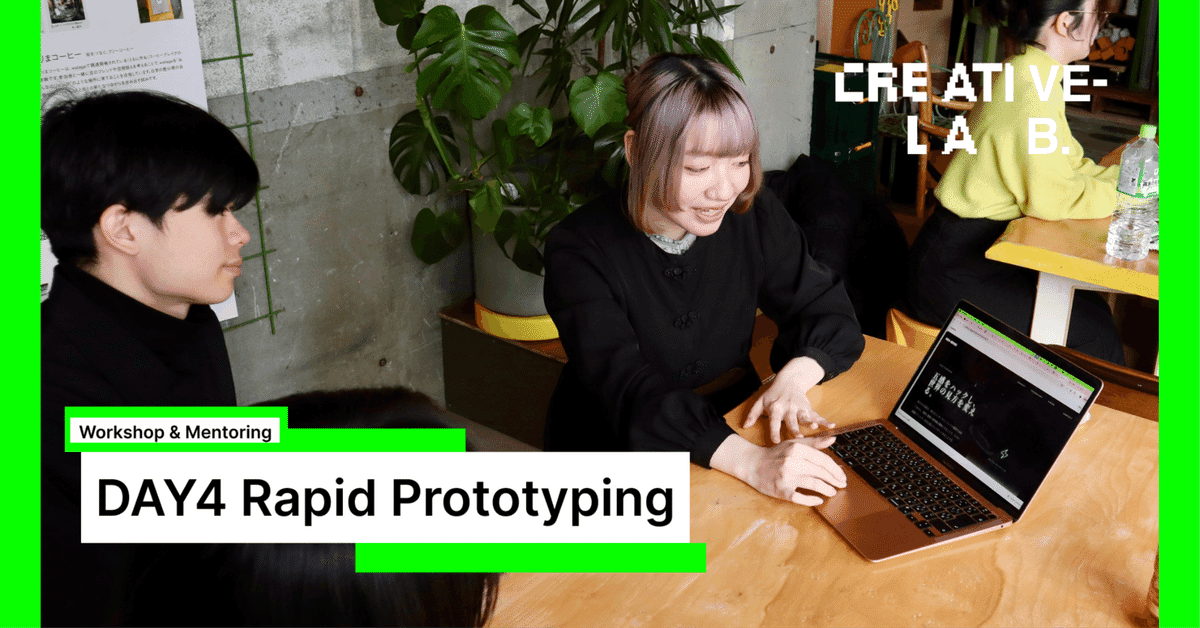
FIG.1
The moment I heard that question, my mind went completely blank. On the screen was the landing page I’d just created—a page introducing the service I’d be offering five years from now. It had a tagline, a problem statement, and even a convincing vision. Yet, when faced with the most basic business question of all—“How much does it cost?”—I couldn’t give a proper answer.Panicking, I blurted out a random number.
“Uh, um… about 30,000 yen a month, I guess?”
The person playing the sponsor was quietly looking at me.
…I hadn’t thought it through.
Saturday, February 14, 2026, at noon. I was at Creative-LAB’s DAY 4 “Prototyping Workshop + Mentoring.” The venue was “watage,” a community space that supports young people’s creative activities. I feel that they not only provided the space but also helped set the tone for this session.

FIG.2
watage - Hub for Neighborhood Cultivation -|note
I was participating as a writer to cover the event, but when Nihei from ASIBA said, “Why don’t you give it a try with us?” I ended up joining the workshop. The first exercise was to write a tagline, identify needs, propose solutions, and outline a vision for what we’re currently doing and what we want to do.
“You have 10 minutes. Please write.”
The only sound in the room was the tapping of keyboards. However, for a while, I couldn’t bring myself to type. What exactly should I write for “needs”? And how much detail should I go into for “worldview”? I thought I had it all figured out in my head.I thought I had them, but when faced with those four questions, it was as if a fog had suddenly rolled in. As I tried to put them into words, I realized the contours of my own ideas were actually quite vague.
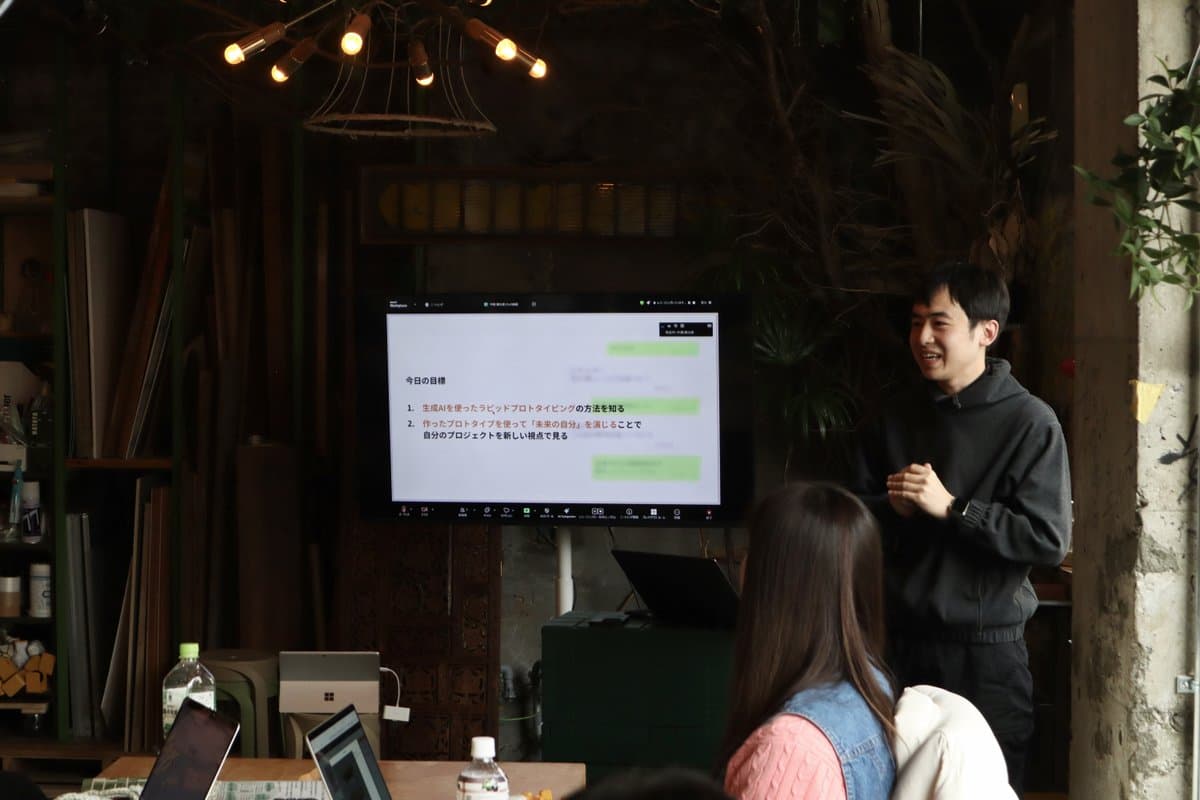
FIG.3
For the next exercise, we used Gemini’s canvas feature. I immediately typed in the prompt:
“Create a landing page for a service that you’ll be running five years from now.”
…It took less than 15 minutes to complete. It had a hero section. It had a target audience defined as “for people with these concerns.” It had a CTA button.

FIG.4
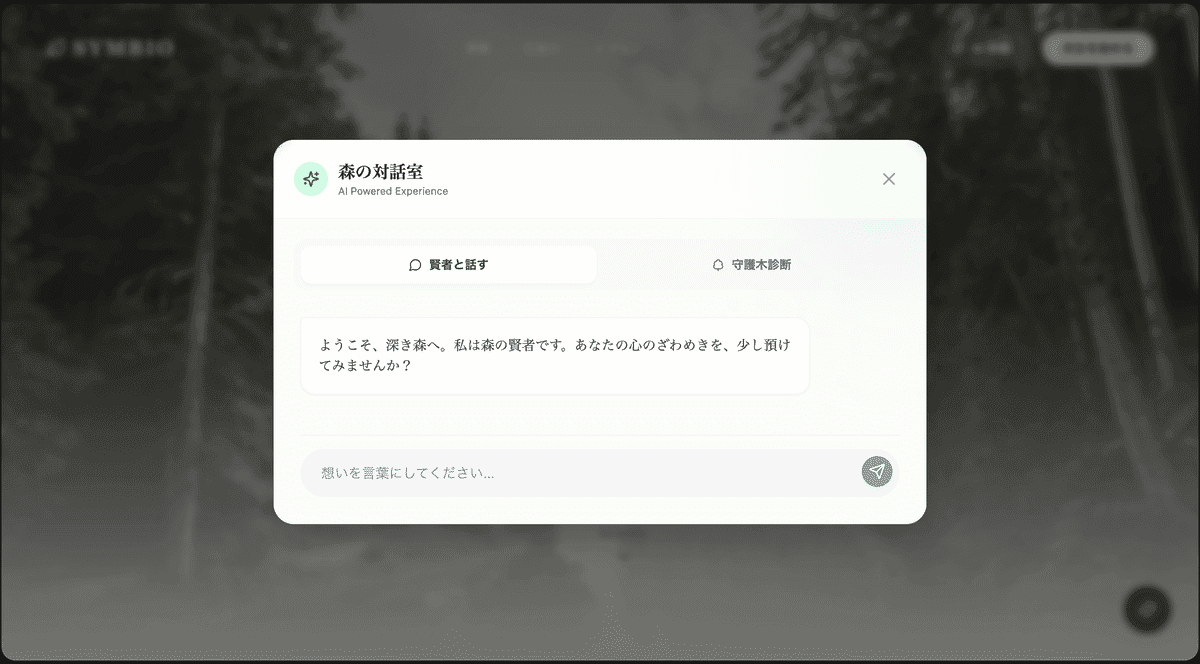
FIG.5
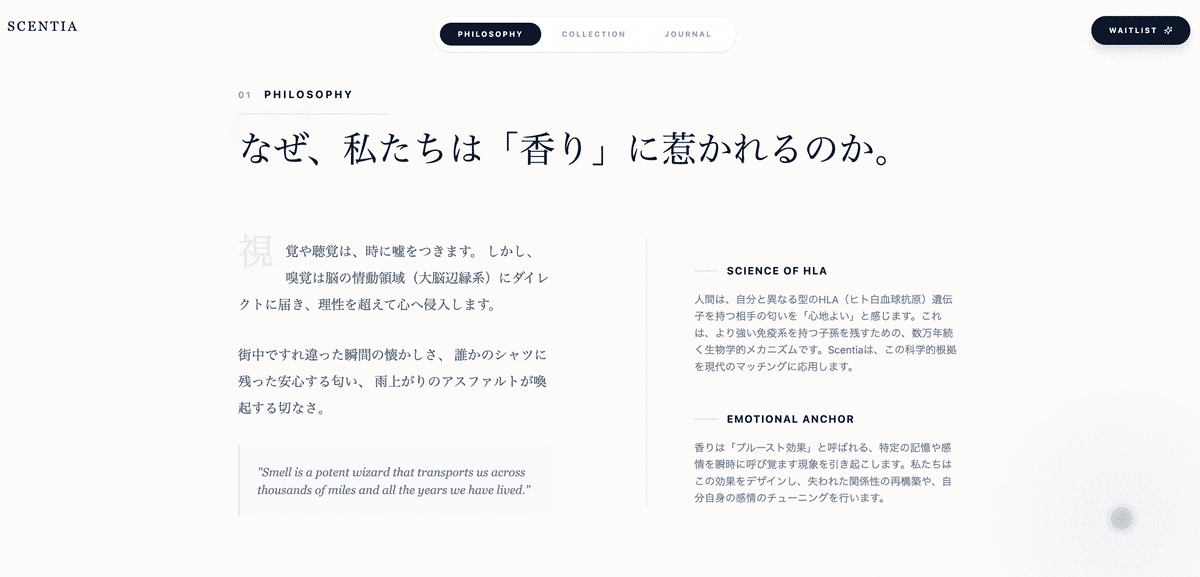
FIG.6
It actually worked. Along with my surprise, I also felt a sense of unease. The AI had “supplemented” the prompt I’d written. It had arbitrarily included “reasoning” that I hadn’t anticipated.A sentence that read, “Since X, it’s clear that Y.” I didn’t write anything like that. But admittedly, if you read it in context, it’s not impossible to interpret it that way. Is this my intention? Or is it a “version of me” that the AI has created?

FIG.7
After making repeated revisions and getting the landing page to a certain point, the next step is “LARP.”LARP stands for Live Action Role-Playing. It’s a game where participants fully embody characters in a story, act improvisationally in the real world, and weave the narrative together. Here, I had to pretend to be my successful self five years from now and give a presentation to a sponsor. This was actually pretty embarrassing.
“Um, I’m developing a service called XX…”
The words coming out of my mouth sounded somehow borrowed. It felt less like acting and more like reading from a script. Still, I continued my explanation while looking at the landing page. Despite my clumsy presentation, I tried my best to convey the vision.
Then, the person playing the sponsor asked a question.
“How much does it cost?”
In a panic, I blurted out a random number. Even I didn’t have any basis for it.
“...Who will be the first customer for that service?”
This time, I was truly at a loss for words.
“Aren’t there any competitors currently trying to solve that problem?”
There was nothing written on the landing page. No, I hadn’t even written anything. I had a vision. I had passion. But “who would buy from me, for how much, and why?”—that part was completely missing. I’d just “thought I knew” it in my head, but nothing had actually been decided.
It wasn’t so much embarrassing as it was a little scary. It was the moment when the shallowness of my thinking was laid bare.
After finishing the LARP, I calmed down a bit and realized something. AI is amazing. It really can create a landing page in 15 minutes. What used to take several people weeks—planning, design, and development—can now be done by one person in a single morning.
But AI doesn’t complement “my own intent.” It reads the context from the prompt and fills in plausible justifications and arguments on its own. “Since X, it’s clear that Y”—I didn’t write anything like that. Yet, for some reason, it’s there on the page.
In that moment, I thought instinctively: No, that’s not right.
That “that’s not right” is probably what’s important.
When I’m just mulling over ideas in my head, “what I really want to convey” remains a vague, floating concept. But when AI presents “something that seems plausible” right in front of me, I feel compelled to challenge it. It’s only by trying to bridge that gap that I gradually begin to see what I’m truly seeking.
Perhaps AI isn’t a tool that provides answers, but rather one that draws out the questions within me.
That night, even after I got home, I kept tinkering with Gemini until late into the night. “This wording is off,” “This presentation isn’t right,” “I want to include this idea too…” Once I’d worked on it until I was so exhausted I thought, “That’s enough,” I posted it on social media while still buzzing with excitement.
This was strangely fun. That feeling of being “stuck” during the LARP had lingered in my mind, and perhaps I was trying to fill that void.
The second half consisted of mentoring sessions for each participant’s project. The feedback on one project in particular really struck a chord with me.
To a participant who was planning an exhibition where visitors would write words like “like” or “dislike,” the mentor said this:
“Simply sticking Post-it notes isn’t self-reflection. For people to truly reflect, you need to design an environment that’s different from their usual surroundings. There’s still no mechanism in place for how participants will actually engage in self-reflection.”
When I heard those words, it hit me. The person who created the exhibition surely has a well-defined worldview in their mind. However, the perspective of “how the participant will act” was missing from the design. I realized that this was structurally the same as when I “got stuck when asked the price” in my own LARP.
I do have my own ideas and worldview. But the perspective of “the other person receiving it” is absent from the design. I suspect this is the root cause of why “delusions fail to translate into social implementation.”

FIG.8
Having written this far, I’m reminded once again: the essence of this workshop isn’t “creating an amazing prototype.” It’s about the cycle of Idea → Prototype → Testing with Others → Collapse → Rebuilding—and experiencing that entire cycle condensed into a single day.
Not being able to give a proper answer to the question, “How much does it cost?” was not a failure. It was precisely because of that baseless number that slipped out of my mouth in a panic that I realized the fact that “I hadn’t defined any value at all.” No matter how much I had mulled it over in my head, I wouldn’t have realized that until I was confronted with someone else’s question.
Let me ask you one last thing. That idea in your head—is it in a form where you could answer if someone asked you right now, “How much does it cost?”
It’s okay if you can’t answer. But to realize that you can’t, try giving it shape and putting it out there for others to see. It doesn’t have to be a perfect prototype. Even if you have to make it up, try creating a landing page in 15 minutes. Imagine you’re your future self five years from now and try talking to someone. The point where it falls apart is your true starting line.
(Author: Yoshihiko Kanda)
Creating the Intersection of Creation and Life / TSG Creative-LAB. Phase 3 DAY 1 Lab Joint Kickoff
Creative-LAB. Phase 3 Program Report #1
REPORT
2026.02.25.