League 4th Report

FIG.1
Nibei: Today, we’ve invited three people—Kato, Yamaji, and Nakajo—from among the buddies (*) who are supporting ASIBA Creative League 4th. I’ve prepared a few topics, so I’d like us to talk about them—though it’s fine if we don’t stick to them exactly (laughs)—and just have a fun conversation.
First, I’m curious about “what it takes to keep creating.” Kato-kun works on products, Nakajo-san does research—while the forms may differ, I think you’re all constantly engaged in the act of creating. Is there anything specific you’re conscious of to keep creating, or is it more like, “Nah, I’m just making stuff”? What do you think?
*What is a “Buddy”?*: Seniors who, through a continuous cycle of questioning and practice, have maintained their own unique worldviews and continue to expand their activities to this day. Within the program, they serve as mentors to support the participants while also accompanying them as companions who share both the hardships and joys of the journey.
Yamaji: I can’t cover everything, so if I had to pick one thing, I’d say it’s huge to have someone right next to me who I can immediately show something cool to with a “Ta-da!”At my current company, I’m teamed up with another designer, and we’re moving forward while showing each other what we’ve made and saying, “This is great! This is great!” But just posting it on social media isn’t enough—that cycle doesn’t keep going for me unless I can make someone else truly, overwhelmingly moved by it. Looking back on my creative journey so far, it started with my parents, then moved on to friends, and now it’s my team members.
Nibei: I see. Nakajo does a lot of research, but I have this image of you always working alone.
Nakajo: On the contrary, I actually find it easier to work alone. When you’re taking responsibility for moving a creative project forward in society, there are inevitably some hurdles you just can’t overcome unless one person is firmly in charge.In a startup, that means concentrating capital on one person; in research, it means designating a single person in charge. So I try to work on my own, but that alone isn’t much fun, which is why I really value moments like today—coming to Kameido and chatting with everyone about “this interesting thing I’m working on…”
Nibei: I’ve been wondering for a while—do you have some big personal goal in mind, Nakajo? Or does it feel like things just emerge from conversations with people as they happen?
Nakajo: I don’t really have any specific goals for myself. If I had to say, there’s a fundamental desire to “live a fun life,” but I feel like my idea of “living a fun life” is based on the premise that “other people are having fun.” That’s why, even in my research, I place great importance on a process where I first select a subject, conduct an interview, and then use their concerns and needs as a starting point for my thinking.But as for my own life, Nakajo, I don’t really have anything right now that feels like, “If I can do this, I’ll have reached my goal.” Do either of you have any big goals like that?
Kato: I don’t have any at all, either. With startups, it’s usually standard to set a single goal at the beginning and focus solely on that, but I’ve recently realized that I just can’t narrow down my business that way (laughs).I just can’t help but want to dabble in all sorts of things, so I’ve resigned myself to the fact that this is the way to go—I’m just focused on figuring out how to keep this going on a massive scale. It feels like I’m constantly fighting against a situation that would normally cause the business to shrink, while finding breakthroughs through various projects.
Yamaji: I think all four of us are like this, but I’m the type who comes up with a new idea once every two weeks and ends up thinking, “What am I going to do? I can’t sleep unless I do this—forget about the current business” (laughs).But when I realized that if I just kept jumping into new things on a whim, I’d never accomplish anything, I started to think that maybe that’s what a goal really is. Deep down, I have a desire—just as strong as my desire to create something new—to bring the cool ideas I come up with to life and put them into the hands of as many people as possible.I used to think I didn’t have any goals to begin with, but in that sense, I’ve been feeling lately that I do need a goal to help me narrow my focus down to one thing.
Nibei: That’s true—I think it depends on how far you want to take it. If you just want to keep creating new things, you might not actually need a goal, but to take it to the next level, you do need one.
Yamaji: Yeah, I need one. Otherwise, I’d get scattered (laughs).
Nibei: I find myself drawn to both sides. I love trying new things, but at the same time, there’s a part of me that feels I need to steadily build on them. I think it would be fun if I could be the kind of person who can do both.
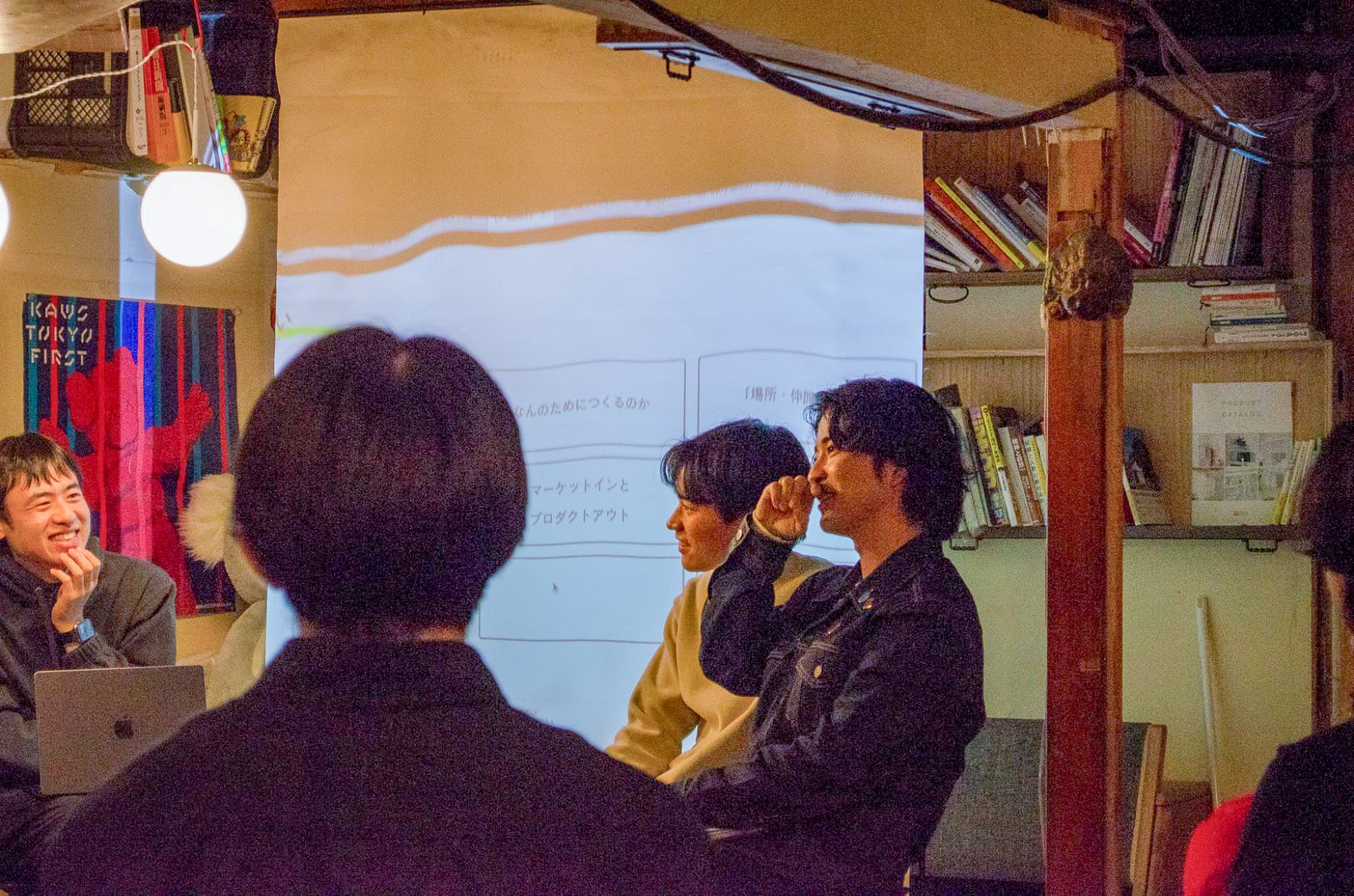
FIG.2
Nibei: The next topic I want to talk about is “market-in versus product-out.”“Market-in” is an approach where you create products and services tailored to existing clients or the market, whereas “product-out” is the mindset of making what you want to make and then working hard to sell it. I think what Yamaji is doing is totally “product-out”—but I wonder if he’s deliberately avoiding “market-in,” or if it just turned out that way.
Yamaji: When I was a junior in college, I heard a story about an elementary school teacher who, despite being busy, was carving erasers to make stamps for grading. I thought this was a business opportunity, so I mass-produced the stamps using a laser cutter and started selling them—and ended up making several million yen in profit.At that time, it was completely “market-in,” but what I realized was that with a market-in approach, you can only tackle problems that are obvious to everyone.To adopt a more intrinsic mindset and pursue initiatives with a longer-term vision, I felt I needed an approach that went beyond simply catering to existing needs. That’s how I gradually shifted toward a “product-out” approach, but even now, I make sure to stick to the principle of “making what I want.” In a sense, I suppose it means I continue to believe that I am the market.
Nakajo: Making what you want applies to your rings as well, Mr. Kato.
Kato: I run a business using 3D printing technology with silver clay to create engagement rings that anyone can design, and what sparked this was the lack of customization options I felt when I was buying my own engagement ring.While most of my ventures are fundamentally “product-out” in nature, I think there’s also an aspect to it where deliberately adopting a “market-in” approach allows me to dive deeper into the industry.For example, in the fashion industry—which I’ve been involved in for a long time—a certain kind of “amateur perspective” (in a good way) is important, but there are also times when an idea is simply impossible to implement given the production processes at sewing factories. By taking on contract work, I gain a high-resolution understanding of those realities, and then I aim to launch a “product-out” initiative all at once afterward.
Nakajo: I feel there are elements of both. In my day-to-day work designing workshops, there’s a clear client facing a specific problem, and I focus solely on how to address that using my own methodology.So while it’s market-in oriented, there’s also an underlying goal of “doing what I want to do and turning it into research,” so in that sense, it’s also product-out oriented. That’s why, even if you call it “product-out” in a single word, rather than creating something purely for myself, I think the process of effectively aligning my motivation with the market’s needs is necessary in any case.
I believe that’s also the intention behind the two types of production grants offered by the ASIBA Creative League this time. The first 100,000 yen is money intended entirely for “product-out” purposes—you use it to give shape to your own creative vision and the things you want to make.After that, as you go through the process of connecting that creation to society, trying to pursue a “market-in” approach while completely broke will just wear you down and force you to do things you don’t want to do. That’s where the 300,000 yen comes in—to address those subtle needs where people might say, “I can’t pay for it, but why not give it a try?”In reality, whether it’s a product or a company, there are plenty of target users who are facing problems but aren’t quite ready to pay for a solution, right? You get those people to actually use your product, gather feedback, and build traction. Once you reach the stage where revenue starts flowing from the intersection of what you want to do and what the market demands—that’s when the League program ends.
Yamaji: It’s like this: the 300,000 yen leads to the next 500,000 yen, and once you use that 500,000 yen, you’ll get the next 3 million yen. It doesn’t matter if it’s in the form of stock or something else—the key is to build up your credibility.Rather than raising money by making slides and giving pitches, the idea of growing by consistently meeting needs is a style that’s pretty typical of ASIBA, isn’t it?
Nibei: Besides ASIBA, there are all kinds of other support programs and grants out there, and of course I want all the participants to make full use of them. But personally, I think it’s a waste if you get too “artist-like”—that is, if you lean too heavily toward a “product-out” approach and end up thinking, “I’m satisfied just because I made one thing; now I’ll make something new.”In that sense, a stance like, “Let’s use what we’ve already created to leverage our efforts and make something 10 times better next time,” feels pretty ASIBA-like to me. I think there are various ways to leverage what you’ve created, but what really matters is how creative those approaches are.
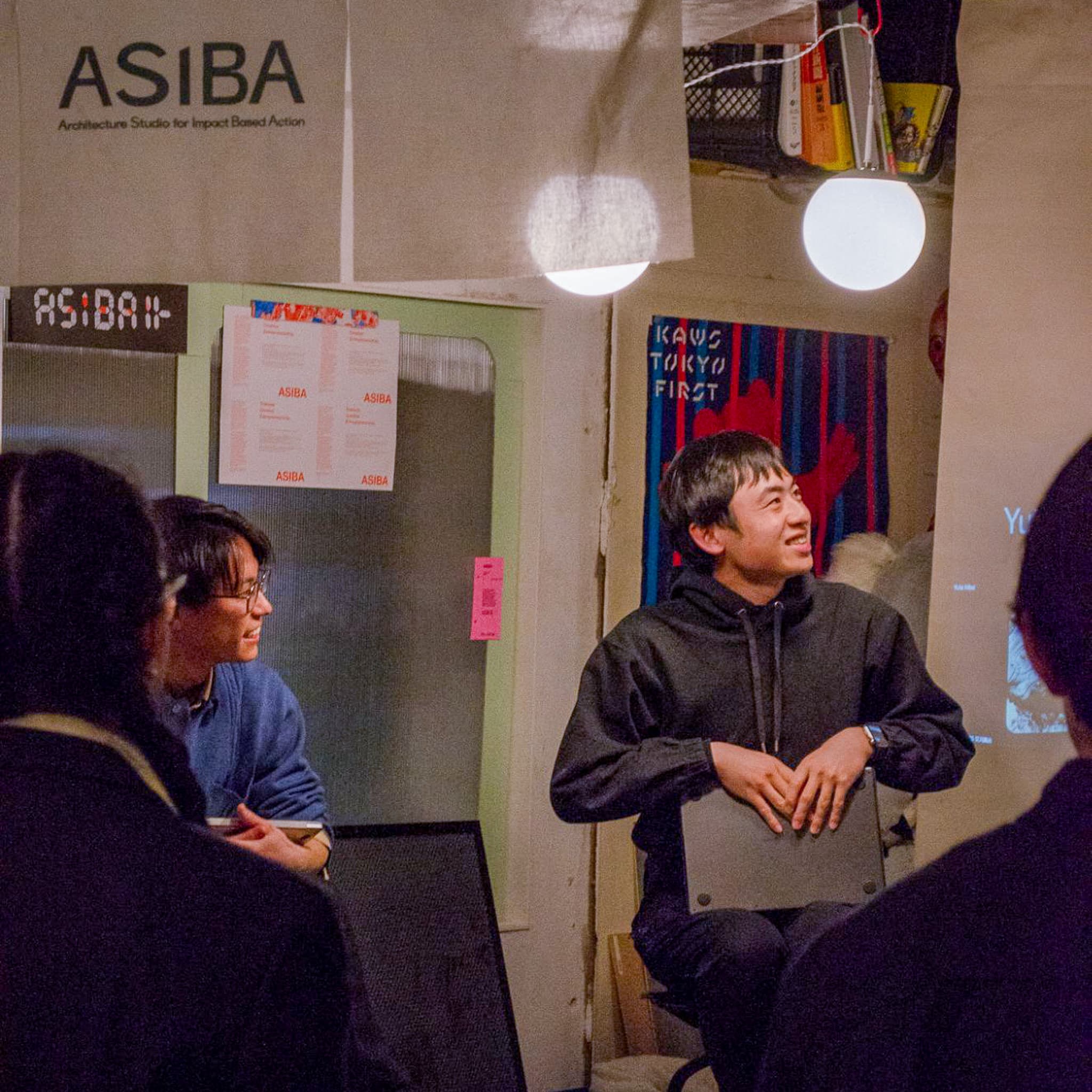
FIG.3
Yamaji: Also, I think “what I want” and “what I want to make” are completely different. ASIBA is probably a place to make what you want, not a place to keep making whatever you feel like. At some point, I think you have to narrow it down to whether it’s “something I want” or “something someone else wants.”
Nibei: Wow, that’s definitely true.
Yamaji: I think startups often get born from external desires—like “what someone else wants”—especially in fields where new technologies are constantly emerging, like AI. But architecture isn’t a field where innovation happens that quickly, so watching ASIBA, I’ve noticed that internal desires—like “what I want”—tend to be the starting point.
Kato: One thing’s been on my mind—even if you say “I want this,” you’re constantly changing as a person, so you might not want it tomorrow, right?
Yamaji: Totally—we’re always changing.
Kato: But do you just accept that?
Yamaji: On the flip side, what about you, Kato?
Kato: I tend to look at things as critically as possible—asking myself, “Is this really what I want to do?” or “Is this just a matter of pride, wanting to show someone that I’m doing this?” It’s still hard to tell for sure, but I definitely pay attention to whether I’ve ever felt that passion—even just once—where I thought, “This is it!”
Yamaji: I totally get that. Maybe the biggest question at ASIBA is, “What do I actually want?” When launching a new venture in architecture, there are quite a few times when an idea looks promising, but deep down, I don’t actually want it—or I wouldn’t even pay for it. I’m constantly struggling with that myself.
Kato: It’s not just architecture, though. With products and services too, we’re surprisingly often fooled by our own instincts.
Nibei: There are all kinds of resources available these days, but that also means we can move forward without really clarifying what it is we actually “want.” I’ve had experiences where I thought, “I made this, but actually, I didn’t really want it,” and I’m sure everyone else has too. That’s exactly why I think we keep creating—so we can keep confronting the question of “What is it that I want?”
Credit
Related Works
ASIBA Creative League 4th
PROGRAM