Behind the Scene of '30 Questions on Creative Entrepreneurship'
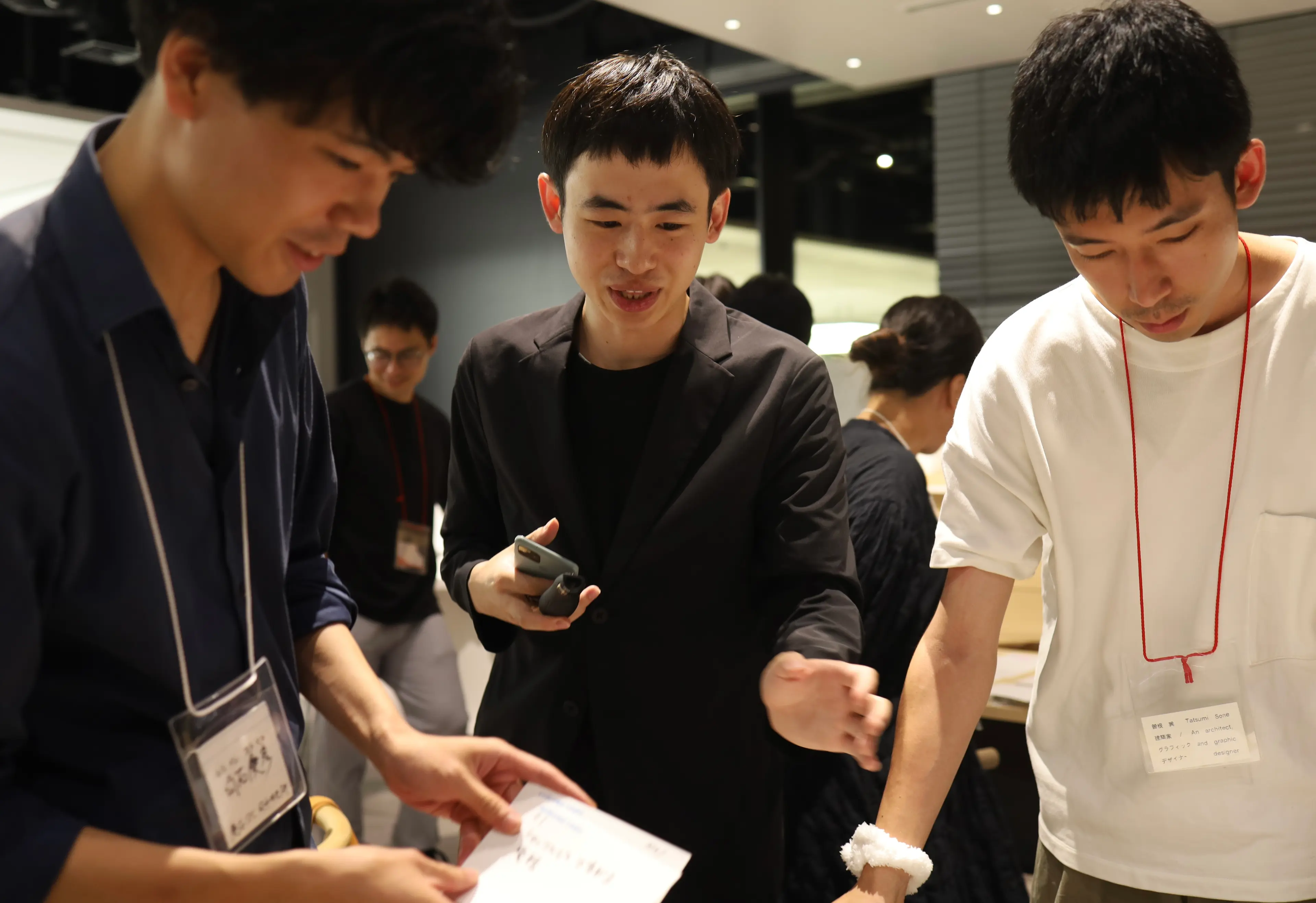
FIG.1
At the corporate community event “ASIBA ATLAS #03 Creative Means More,” held in July 2025, we conducted a workshop to explore the concept of creative entrepreneurship with approximately 50 participants, including representatives from partner companies and clients, as well as participants from the third cohort of the ASIBA Creative Incubation Program.In this article, Ms. Takano and Ms. Nakajo—who were responsible for planning and designing this workshop—reflect on the behind-the-scenes process of its design.
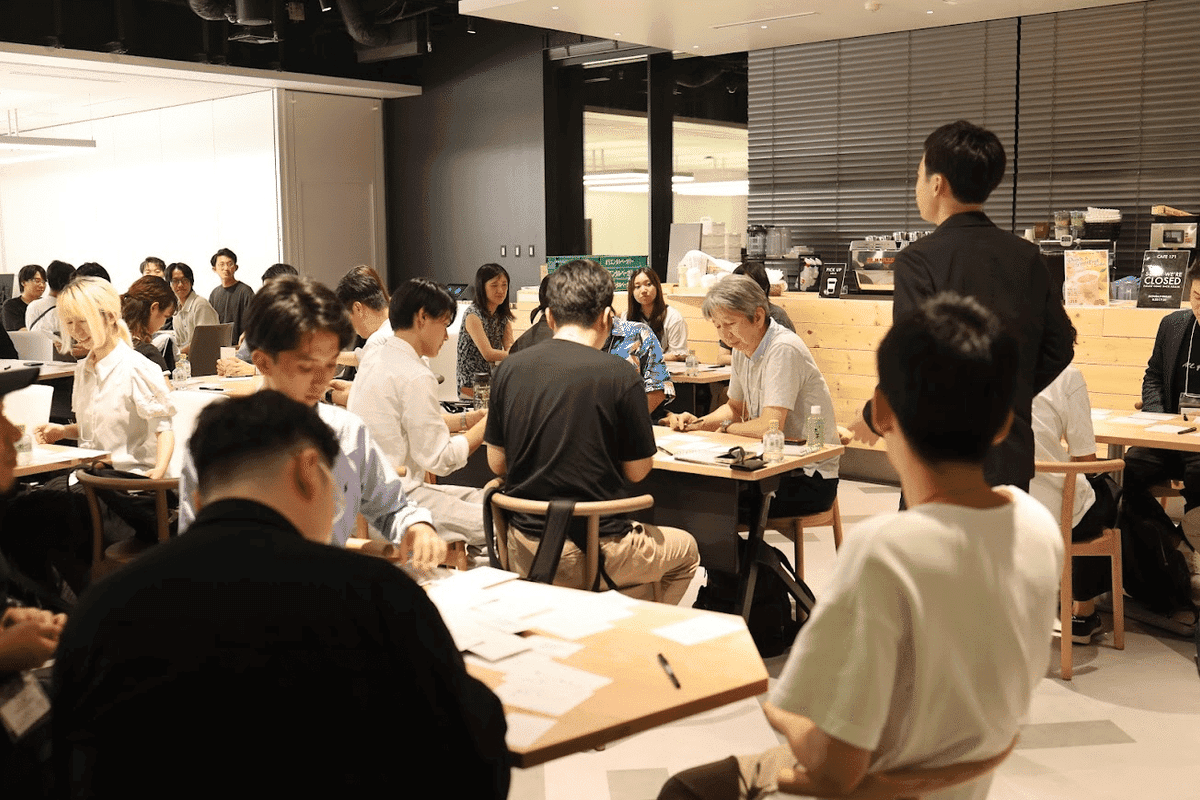
FIG.2
Interviewees
Hiromi Takano: Producer, ASIBA (General Incorporated Association); ASIBA ATLAS Planning Manager; Department of Urban Engineering, Faculty of Engineering, The University of Tokyo Rintaro
Nakajo: Doctoral Candidate, Graduate School of Interdisciplinary Information Studies, The University of Tokyo; Workshop Design and Facilitation
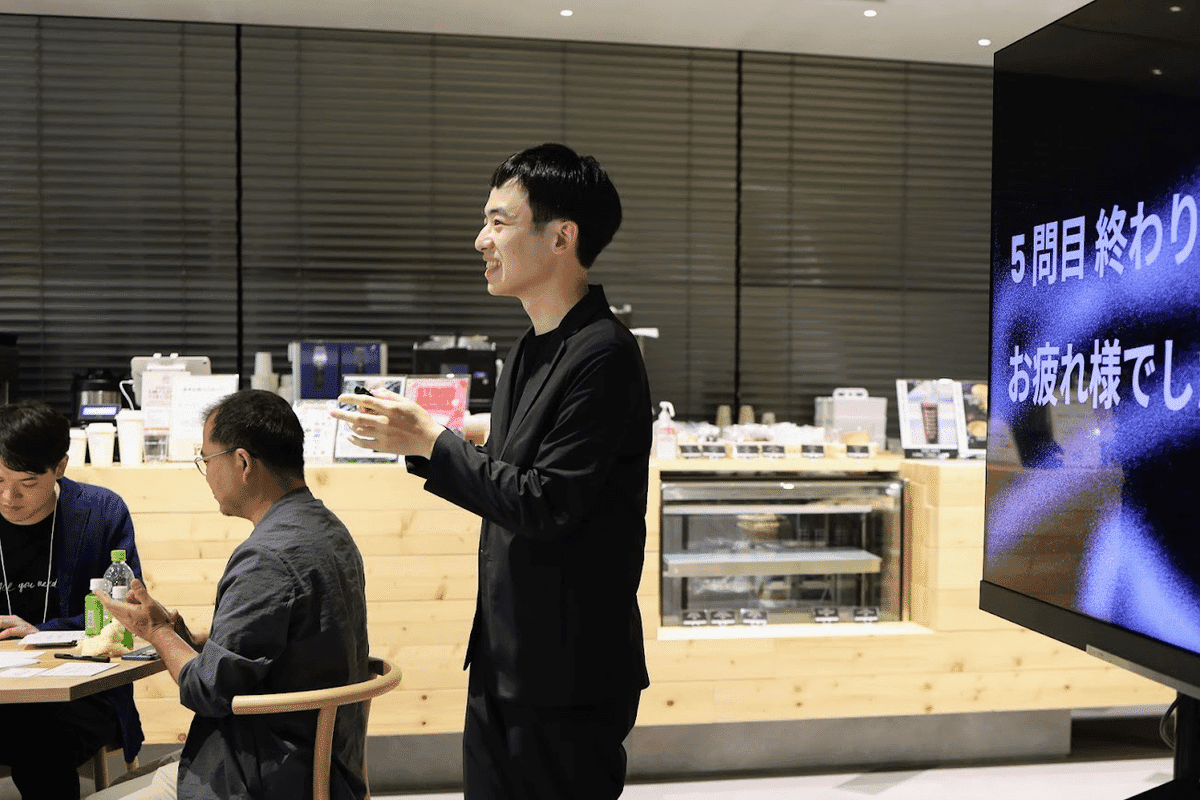
FIG.3
Nakajo: First of all, I’d like to ask why we decided to hold a workshop for this event in the first place (laughs). According to the very first proposal dated May 20, we were supposed to hold a talk session, right?
Takano: Initially, the ATLAS project began with the question of how we could communicate the work ASIBA has been doing recently to all the stakeholders.ASIBA originally started as an incubation program for young professionals, but even though our work for companies and local governments has gradually increased, we hadn’t been communicating that at all—so many people still thought we were only doing incubation (laughs).
We figured that if we were going to make a big announcement, we might as well hold an event. ASIBA’s activities are truly wide-ranging, and we wanted to do more than just explain what kind of work we do and what we’re capable of—we also wanted to showcase the underlying philosophy and consistency behind it all.

FIG.4
So, while it started as a talk session, as I was thinking about what the greatest value of such an event might be, I read the minutes from the previous ATLAS event (held in December 2024) and realized that the feedback on our projects we received from participants after the event had been incorporated into ASIBA’s subsequent work to a tremendous extent.If there’s value in openly sharing what we don’t know and learning from others, then let’s make this an event where we all think together about Creative Entrepreneurship.
Nakajo: I suppose I should briefly explain what “Clearan” is.
Takano: That’s right. At ASIBA, we refer to the mindset of formulating one’s own questions, building connections with society, and presenting new options to society through concrete actions as “Creative Entrepreneurship.”Architects, designers, artists, artisans, and engineers—who have shaped culture throughout history—have tackled previously unrecognized problems and driven social change by giving form to their own questions about society and their curiosity about creation, and by continuously presenting these to the world. We believe that by increasing such actions, we can solve the uncertain and complex problems facing society.
Speaking of Nakajo Clearan, we initially planned to launch “Clearan’s 50 Questions” as a separate project, didn’t we?
Takano: That’s right. Even within the company, we’ve had a hard time putting into words exactly what “Clearan” is. I often discussed this with our co-representative, Morihara, and I’ve always had the sense that different people would have different ideas about what Clearan is, and that Clearan itself would emerge as the outline of those diverse perspectives.By chance, while we were at a retreat during Golden Week, we saw an ad for *Kazuo Shinohara: Carving Eternity into Space—100 Questions for His 100th Birthday*, and we decided to just try coming up with 50 questions for starters.So, as a test, we started writing answers to the questions internally at ASIBA, but since each individual question was too abstract and difficult, we didn’t make any progress at all (laughs).
Nakajo: I joined the planning process after it was decided that we’d hold a workshop, but even when I asked, “What exactly is ‘Clearan’?” neither Takano nor Morihara would give me an answer at all (wry smile).
Takano: The truth is, even we don’t really understand what “Clearan” is yet (laughs). Even if we try to explain it rationally, if we follow the logic all the way through, we can see where it falls apart. So we figured we had no choice but to think about it together with everyone else.
Takano: When planning the workshop, we made sure everyone shared a common understanding of the “Why”—why “Clearan” is necessary—and then we set out together to define the “What”: What is “Clearan”? What kind of people do this work? I think the realization that we should have participants focus on the “What” rather than the “Why” was incredibly important.
Nakajo: Since we don’t know either, the approach of saying, “Let’s figure this out together,” was really great.
Takano: If we already knew the answers, there’d be no point in holding a workshop. But I think that’s a bit different from how movements are typically built.Instead of starting with someone defining it in a book, we craft the concept through copywriting, present only the framework and way of thinking, and then let various people think within that space. Precisely because we’re young people with limited experience, I believe it’s essential—as a way to build a movement—to devise ways to get a wide range of people on board.
Nakajo: It’s the “Smart Cities, Mushrooms, and Buddha” approach, isn’t it?
Takano: “A History of Living Environment Construction” and *A History of Postwar Spaces* are also similar. What makes this project unique is that, rather than presenting it as a heavy, academic dialogue among a small group of intellectuals, we’re doing it through spontaneous workshops with people from diverse fields.
Takano: The actual design of the workshop went through quite a few twists and turns, didn’t it?
Nakajo: At first, I thought we’d have everyone come up with their own questions about “Clean,” pass them on to someone else, and then have that person write down an answer—repeating this process over and over.I’d heard about the “NEW NODE Workshop: Mobility and Nodes of the Future” that ASIBA held a year and a half ago, and I had a hypothesis that when it comes to futuristic topics, the process of formulating the questions itself might hold value.I also planned to have participants express their answers using a technique called “Interactive Sketch,” which allows even people who aren’t good at drawing to present their ideas visually.
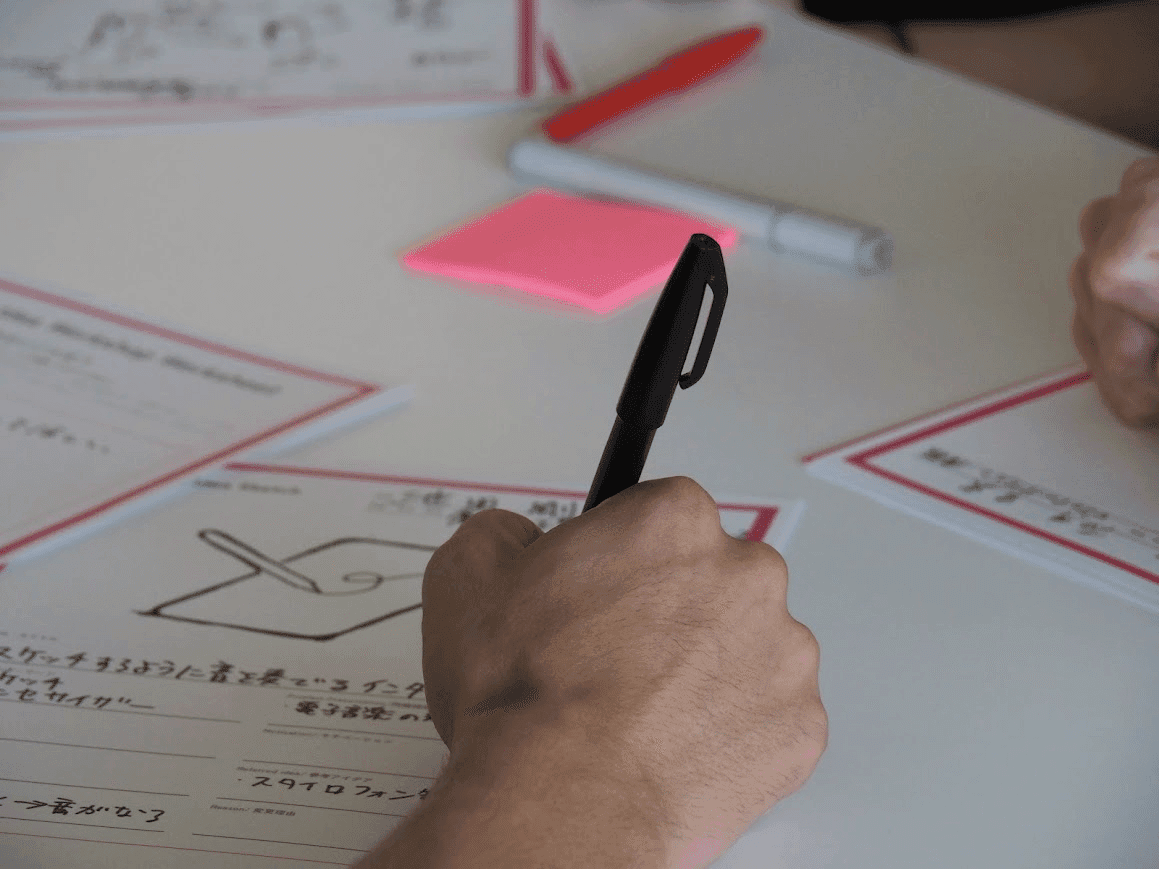
FIG.5
Even when we did a test run internally at Takano, everyone asked, “What exactly is ‘Clearan’?” (laughs), and it was also incredibly difficult to sketch such abstract concepts.
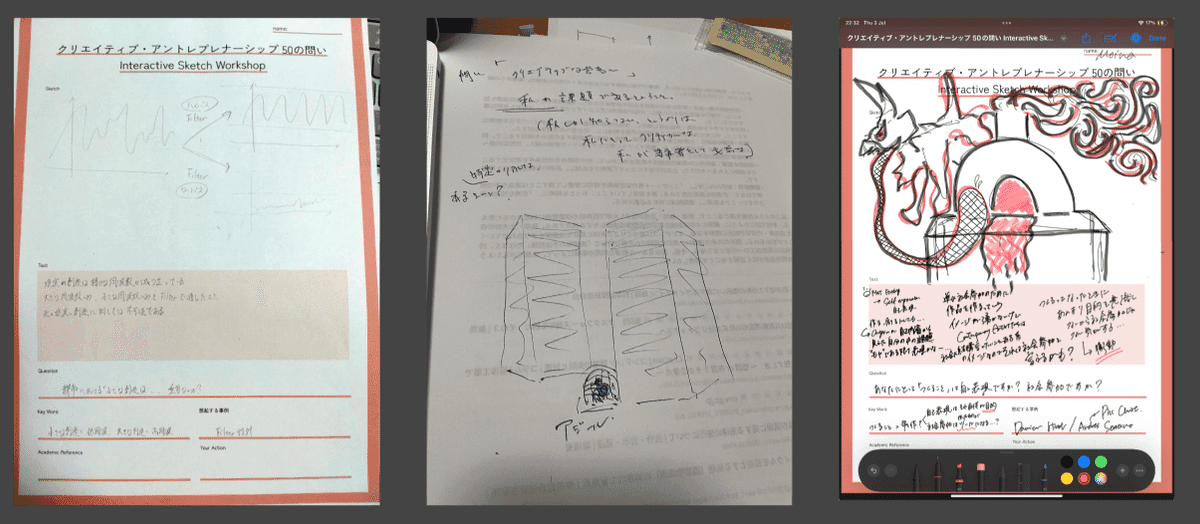
FIG.6
Nakajo: It’s impossible to formulate a question when it’s unclear what we even want to discuss in the first place. So, we decided to adopt a format where we’d prepare the questions in advance and have them answer those.
Takano: Nakajo-san generated a large number of questions while interacting with the generative AI, and the two of us selected them based on that. We’d think, “This one’s hard to answer,” or “This one seems like it would spark a broader discussion.” The key point, as Nakajo-san put it, was “questions that are easy to answer and spark discussion.”
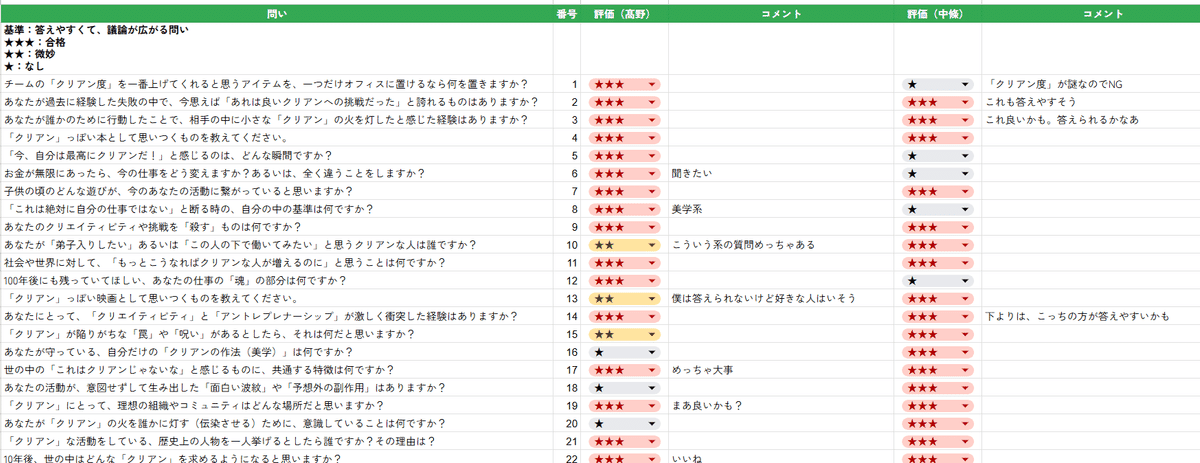
FIG.7
Nakajo: After that, we continued to refine the questions through repeated test runs. The second major change was setting a 90-second time limit per question.At first, we’d planned to give participants 4 minutes per question so they could think things through and write out their answers properly, but during a test play, we ran out of time and tried doing it in 90 seconds—and surprisingly, we realized this actually worked better.
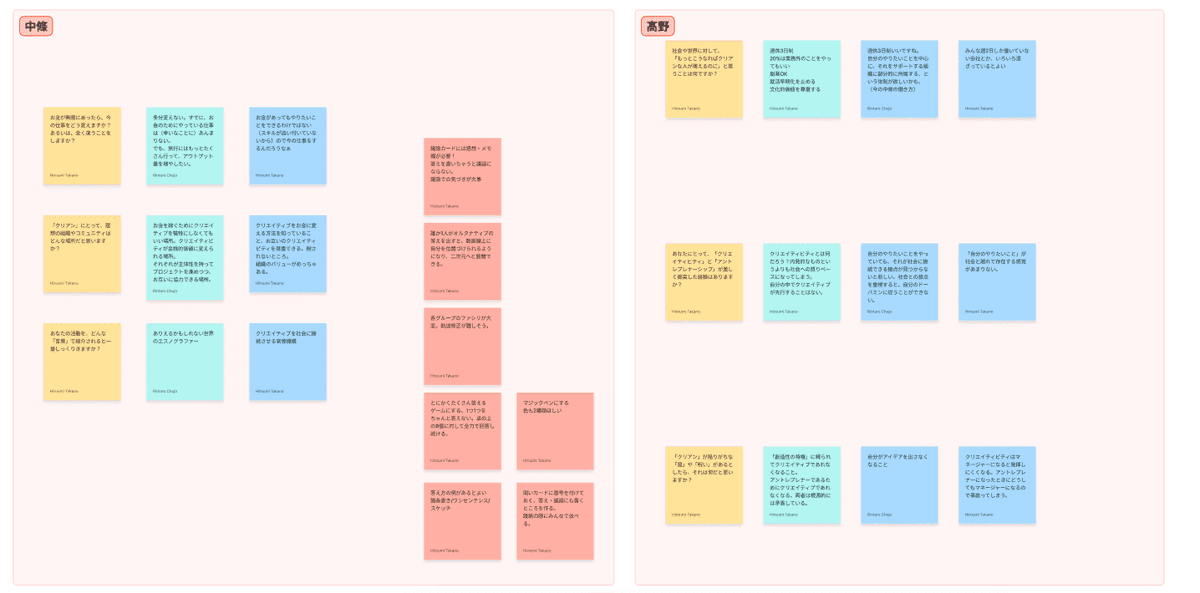
FIG.8
Takano: Since each question is difficult, spending a long time thinking about it doesn’t necessarily guarantee a good answer. Instead, we thought it would be easier to have participants write down their answers intuitively within 90 seconds. It’s only natural that they wouldn’t come up with perfect answers, so our intention was to encourage answers that would spark discussion.I also thought that having two or more answers to a single question within a group would make for more lively discussions, so I incorporated that into the design as well.
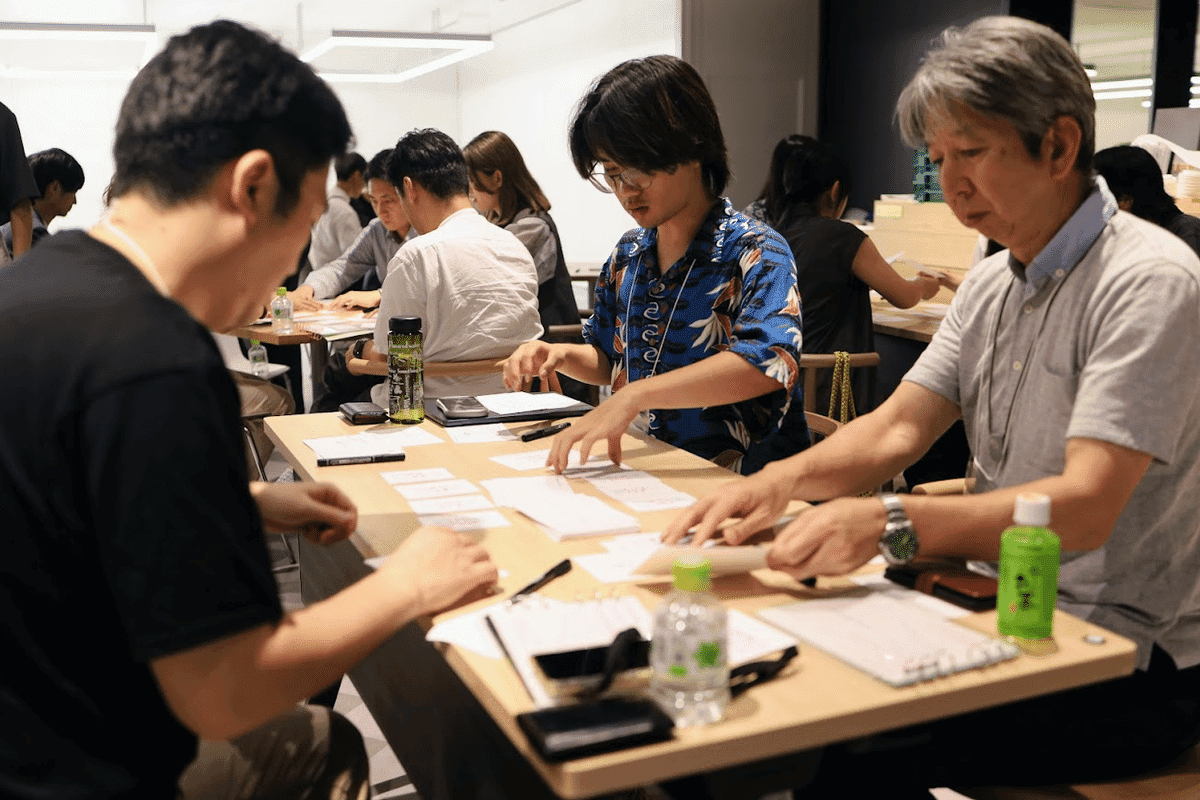
FIG.9
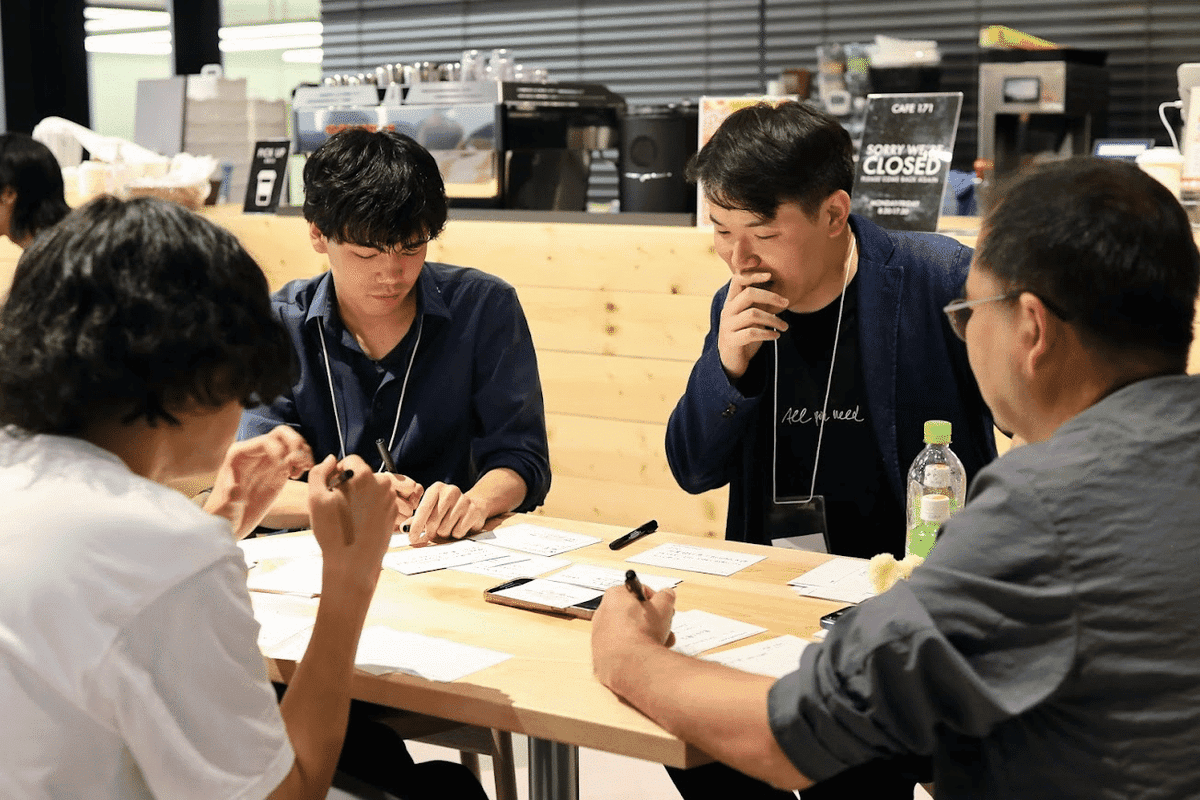
FIG.10
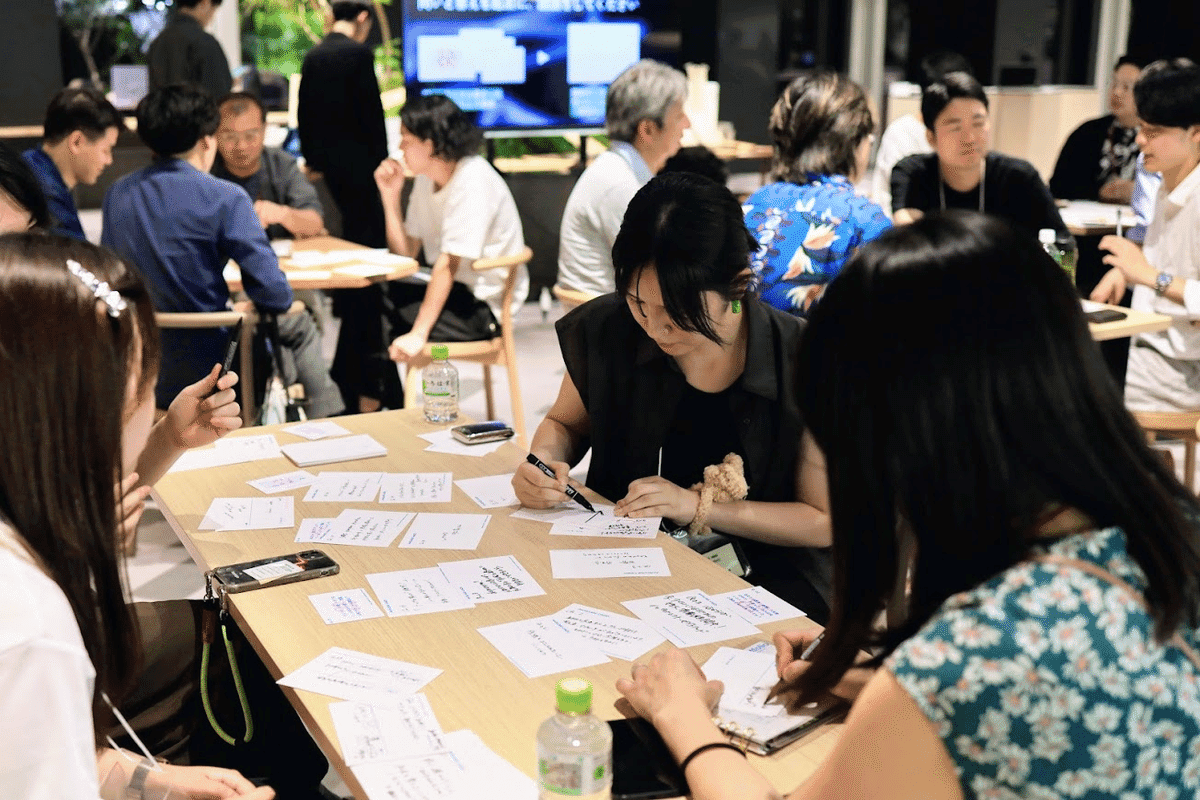
FIG.11
Takano: The “gallery walk” was a great technique for the workshop.
Nakajo: The Gallery Walk was inspired by the one we conducted at “New Hope Idea Workshop #1,” which we organized in collaboration with the Japan Design Promotion Association. It’s a method where cards written by each group are laid out on the tables, and then everyone stands up and walks around reading them, allowing the content of the discussions and the results to be shared across groups.
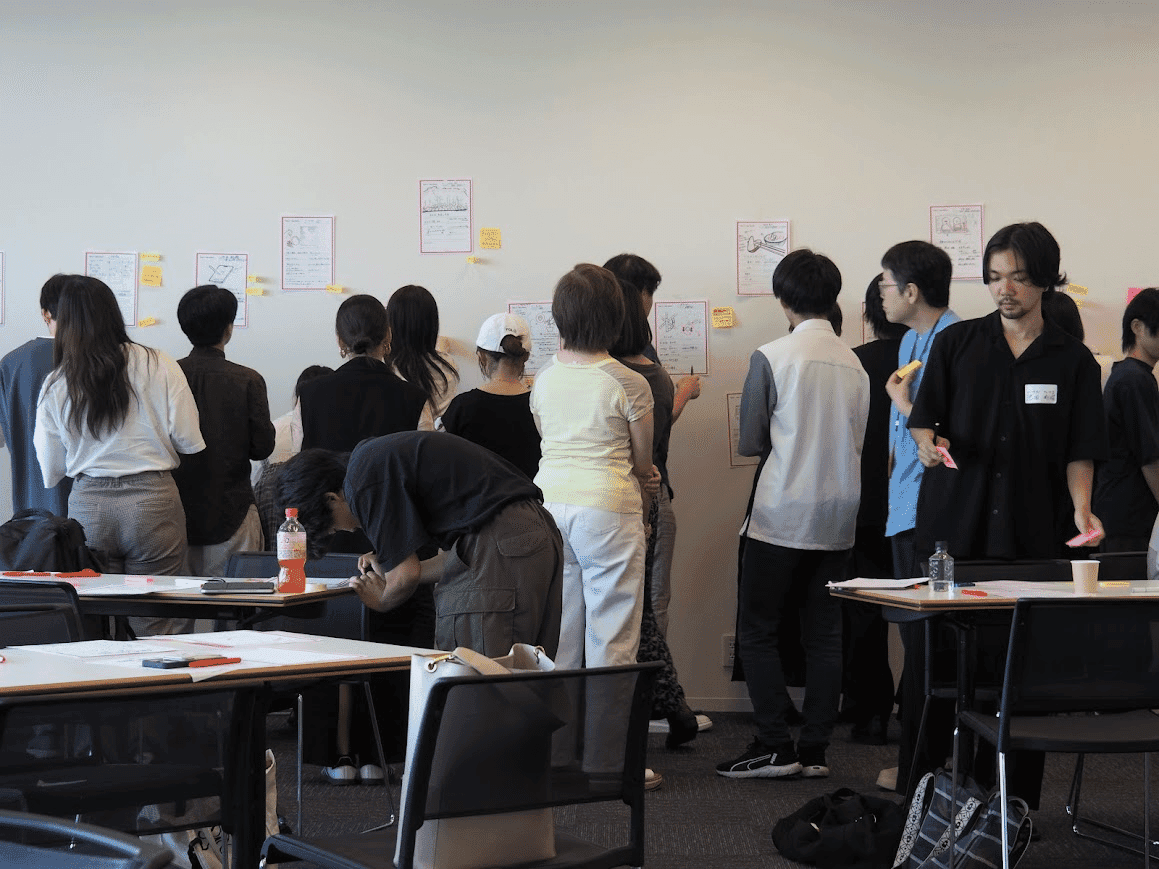
FIG.12
From a theoretical perspective, it draws on the “Think-Pair-Share” methodology, which is one of the active learning techniques. In other words, by ensuring participants follow this three-step process—thinking individually, discussing in pairs or groups, and then sharing with the whole group—their thinking deepens. The gallery walk corresponds to the final sharing stage.
Takano: It’s a shame when a typical whole-group sharing session just ends with introducing the discussions from a few groups, isn’t it? By designing the Gallery Walk so that participants select a card set from another group and bring it back to their own, I believe we automatically incorporated the step of forming their own position after considering the big picture.
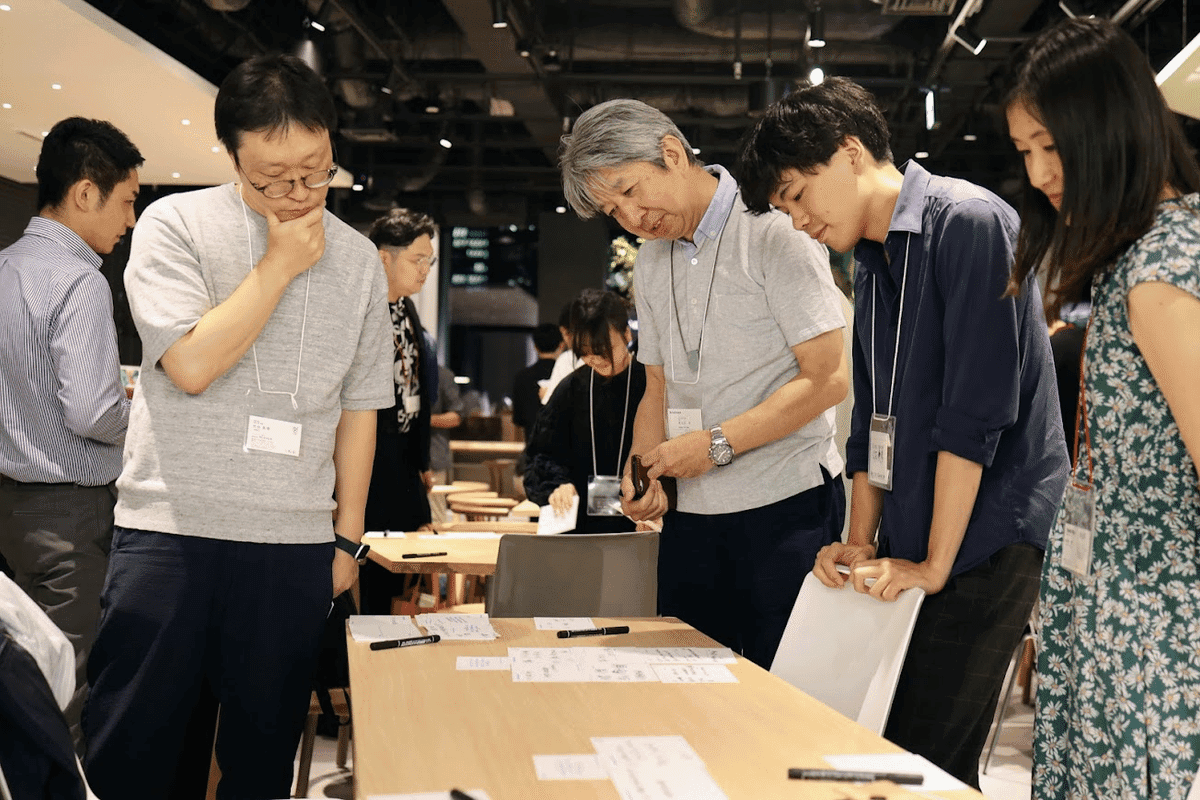
FIG.13
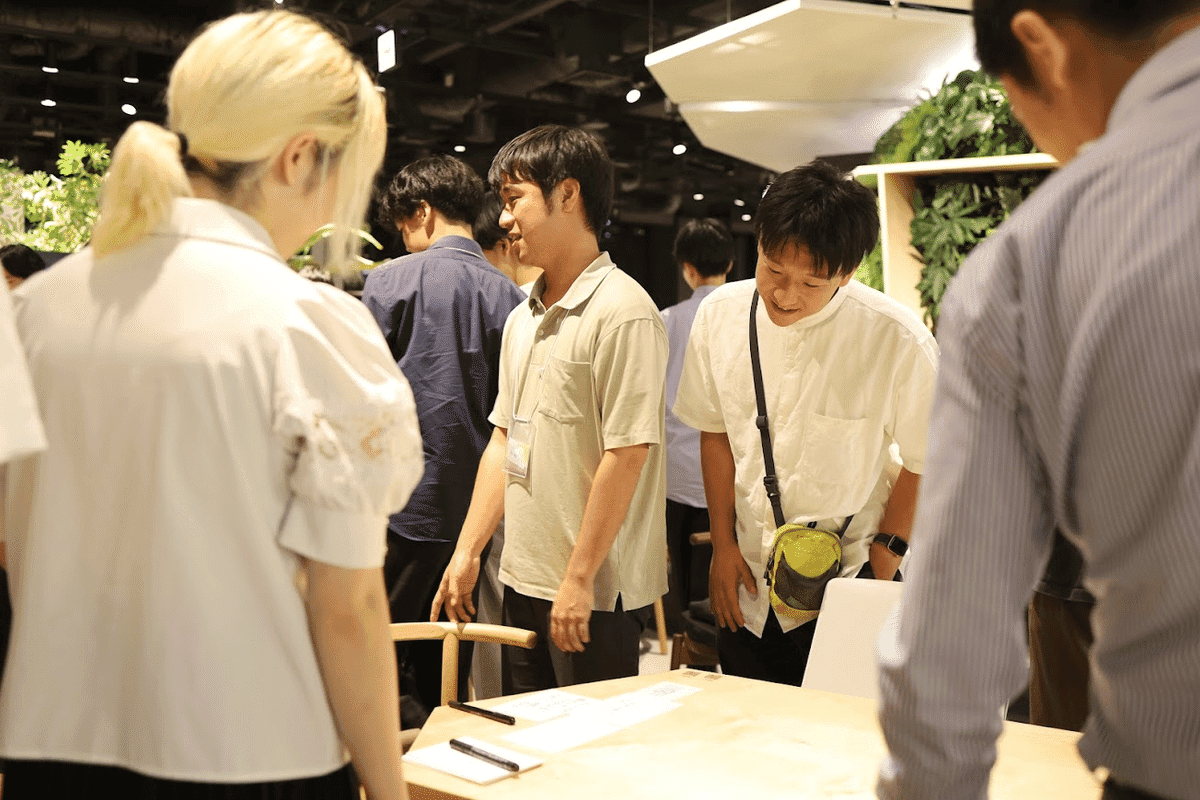
FIG.14
Nakajo: Exactly. The design was such that after selecting a card set, participants would write their own response to that discussion on an “answer card,” and then conclude with one final round of sharing and discussion within their group.
Takano: The flow—individual → group → whole group → individual → group—was carried out effectively in a short amount of time, wasn’t it?
Nakajo: Actually, the gallery walk was also intended to help participants—who were mentally exhausted from the workshop—refresh themselves by getting up and walking around.Also—and this is something I didn’t realize during the planning phase—by letting participants take home the card sets that caught their interest, the cards naturally disappeared over time, and when it was time to wrap up, they naturally returned to their own tables. It’s usually difficult to keep sessions like this on schedule, so this was an unexpected bonus.
It was also great that Ms. Nakajo-Sudo (ASIBA Design Engineer) made the cards using a Risograph. The event began with a table full of cards, and as everyone wrote on them, showed them to each other, and discussed them, the cards really helped create a tangible, hands-on feel for the workshop.
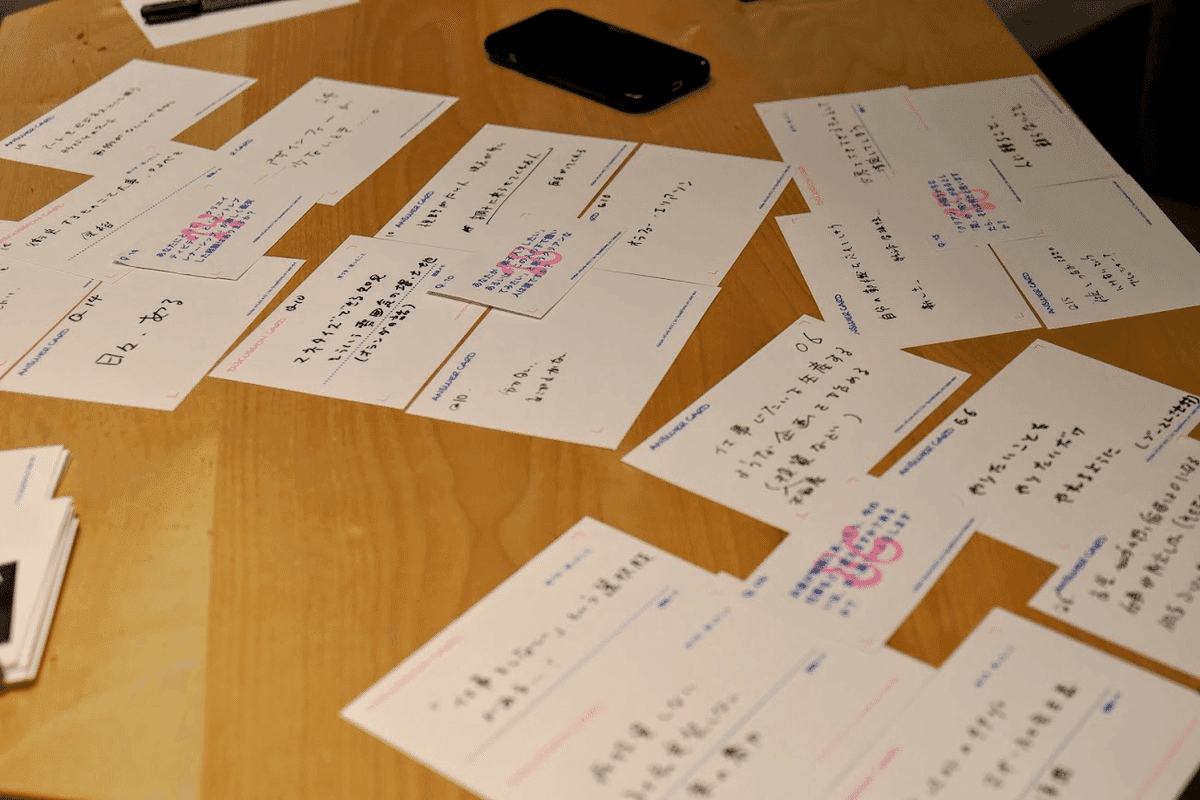
FIG.15
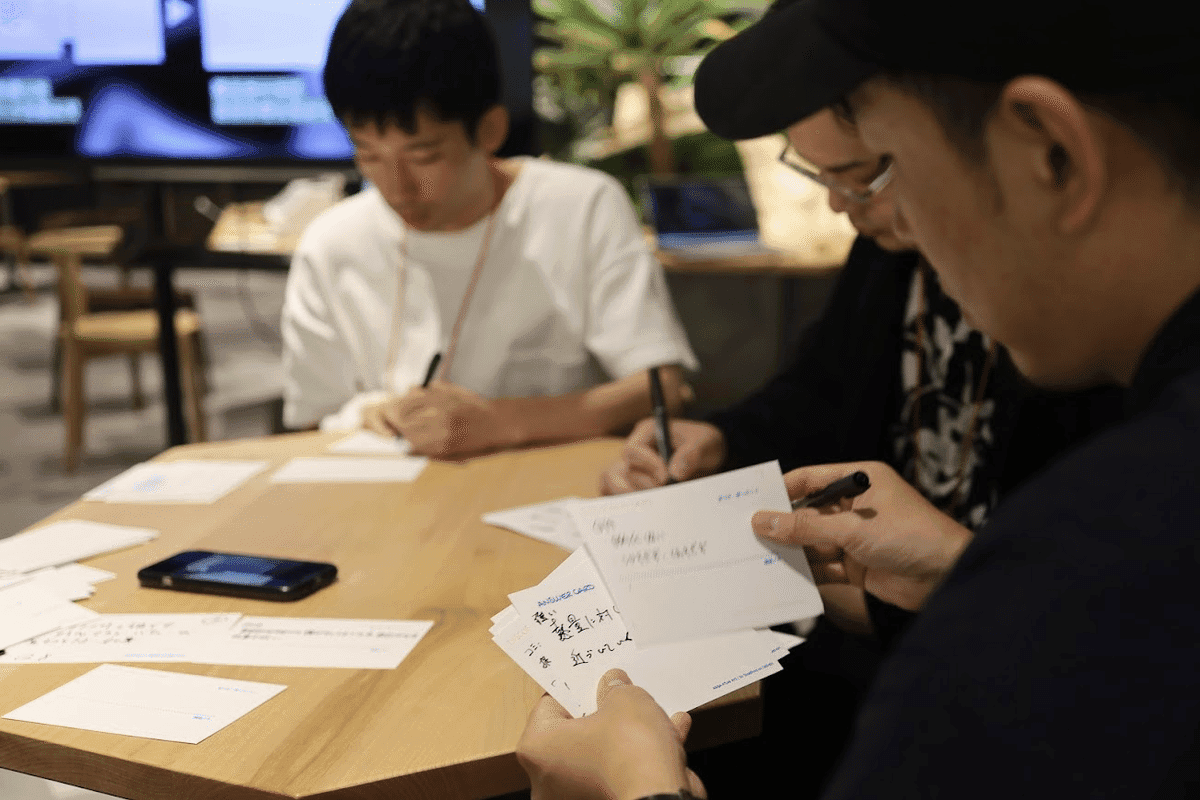
FIG.16
We also discussed various aspects of Takano’s design, and above all, the texture was excellent. If the paper had been flimsy, I’m sure no one would have written on them nearly as much.
Nakajo: We scanned the cards that participants had written on before they took them home, and we ended up with data for over 350 cards in total.
Takano: I think there were probably quite a few people who took their cards home without scanning them, so in reality, even more cards were written. Also, since the discussions in each group were recorded, I think it would be interesting to make good use of those recordings to uncover what everyone was thinking and saying about creative entrepreneurship.
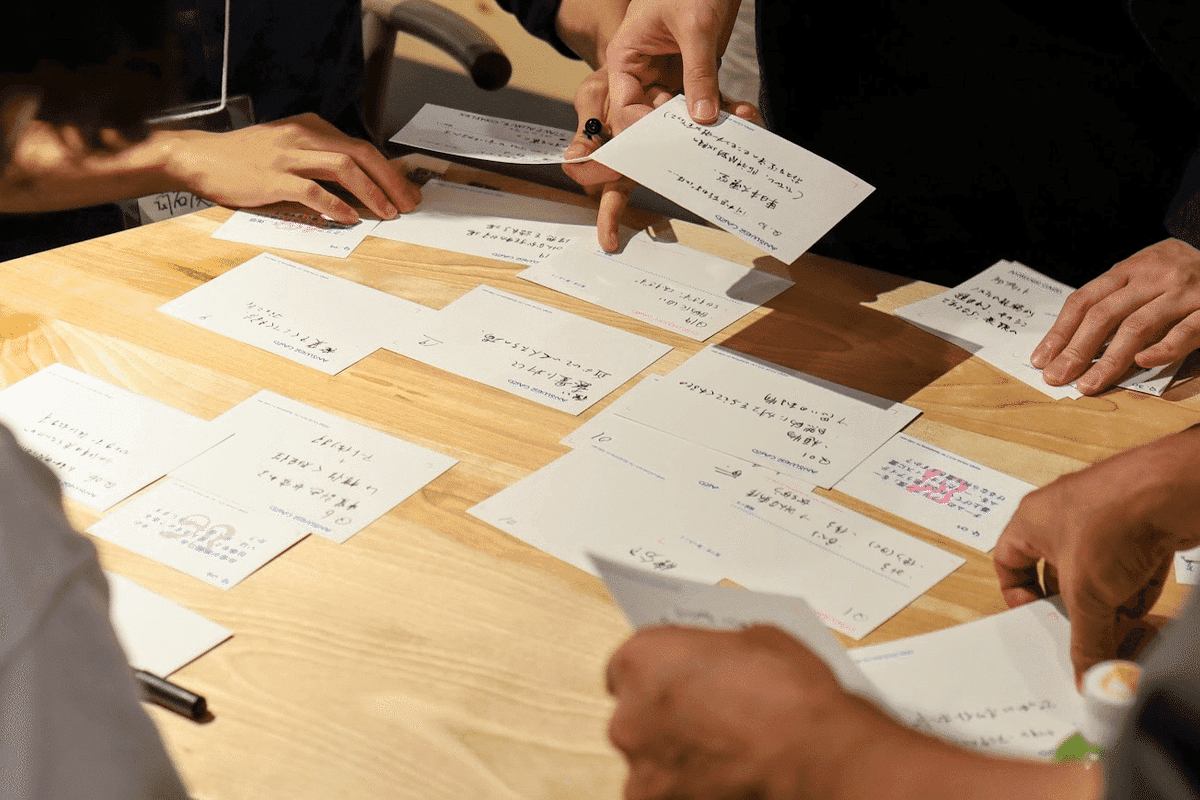
FIG.17
Nakajo: I’m proud to say this was such a great workshop that it would be a shame to let it end with just this one session. I’d love to explore these ideas with even more people.
Takano: Even just reading through the cards, I’m making so many discoveries. I believe the workshop was so fruitful because each participant brought diverse perspectives to the table, and together we explored multifaceted answers.Moving forward, I want to deepen our thinking on this theme while involving even more people, and I believe that putting the ideas we’ve synthesized into practice is precisely the mission of ASIBA. I look forward to continuing to take on new challenges together with all of you.
===============
Beyond our search for an answer to the question, “What is creative entrepreneurship?” what we ultimately arrived at was the very approach to engaging with “questions without answers.” Moving back and forth between questioning and action, gradually increasing our understanding. And opening up these questions to diverse stakeholders, involving them, and thinking together.Confronting uncertain and complex social issues must begin with this very mindset.
We plan to further deepen the discussion regarding the insights gained from this workshop through ASIBA’s podcast and other channels. We would be delighted if you continue to reflect on Clearan together with ASIBA.
===============
A co-creative workshop that uses 30 questions about “Creative Entrepreneurship (Clean)” to elicit diverse answers and dialogue from participants, allowing everyone to explore the contours of the concept together.
⓪ Preparation: Place 10
A7 “Question Cards” face down on each group’s table. Also, prepare 30 A6 “Answer Cards” and 30 A6 “Discussion Cards.”① Icebreaker
: Write down your answer to “What was the first thing that came to mind when you heard the word ‘Clearan’?” and introduce yourselves in groups of four.② Individual Work: Choose one Question Card from the
table and write your answer on an “Answer Card” within 90 seconds. Repeat this five times.③ Group Work 1: As a group
, select 4 “Question Cards” that received the most answers, and discuss each one for 4 minutes. Write down your thoughts from the discussion on the “Discussion Cards,” and create a set consisting of one “Question Card” and several “Answer Cards” and “Discussion Cards” for each.④ Gallery Walk: Place your card
sets on the table and walk around to look at the cards on other tables. Take home one set of cards that caught your interest.⑤ Individual Work 2: For
the card set you brought back, write your own answers on the “Answer Cards.”⑥ Group Work 2: One
by one, participants explain the card set they brought back and their own answers. Listeners use “Discussion Cards” to add comments.
By the end of the workshop, a total of over 350 “Answer Cards” and “Question Cards” had been created. Immediately after the workshop ended, the card sets were scanned, punched, and bound into each participant’s own zine for them to take home.
Credit
Related Works