FIG.1
Hello everyone. Once again, my name is Nihei, Representative Director of the General Incorporated Association ASIBA. I look forward to working with you today.
By now, I hope you’ve begun to get a sense of what ASIBA is all about. However, you may not yet have a complete picture of what ASIBA actually does or what our goals are. To be honest, these aspects have only gradually become clearer to us as well, through our ongoing collaboration with all of you.
For those of you who have been with us so far, as well as those who will join us in the future, I’ve summarized what we’re thinking right now and where we’re headed, so I’d like to share that with you. I’ll be moving through this rather quickly, but I hope you’ll take a look at the parts that interest you later on.
After everything we’ve discussed so far, you might be wondering, “So, what exactly is ASIBA, anyway?” I sometimes feel that way myself. The core of ASIBA’s activities—and what will likely remain at the center moving forward—is our incubation program. Starting with the first cohort, followed by the second and third, we’ve been able to reach this point thanks to everyone’s cooperation.
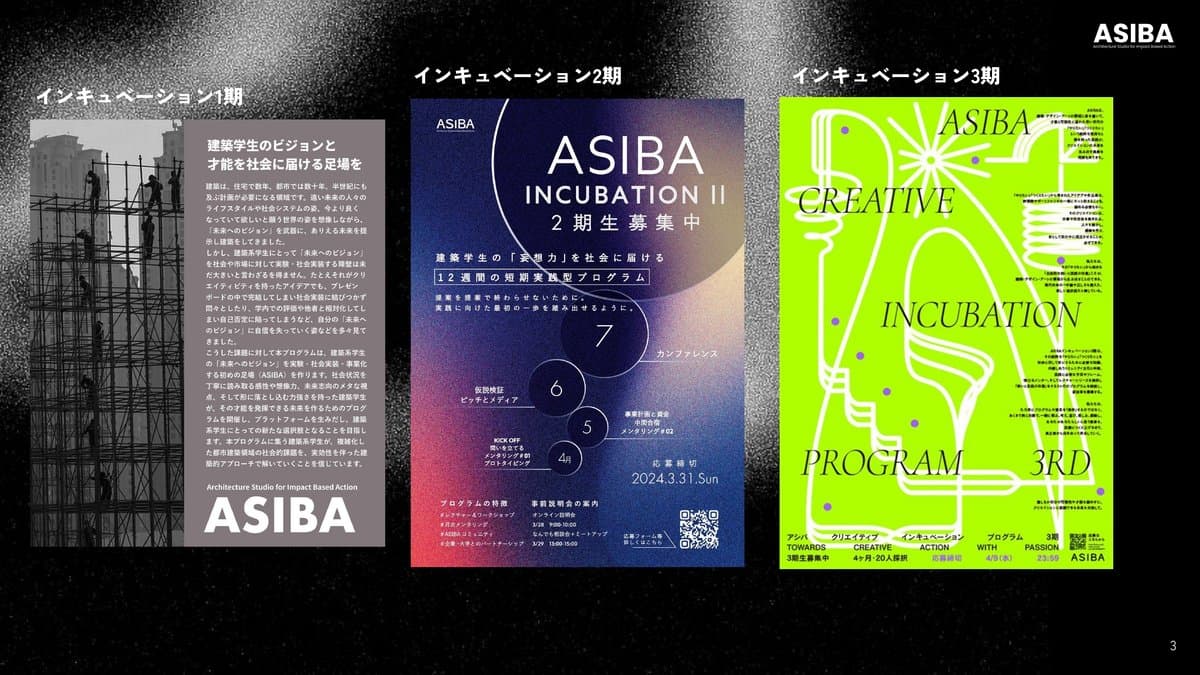
FIG.2
Of course, we’ll continue the incubation program going forward, but I don’t think that’s all there is to it. The incubation program is the result of our unwavering commitment to our goal of fostering “creative entrepreneurs.” However, to be honest, when we started the incubation program two years ago, we had absolutely nothing.We had no knowledge, no funding, and no partners—nothing at all—so we started the incubation program by creating it ourselves and inviting others to join us.
However, over the past two years, as we’ve continued to move forward together with all of you, our capabilities have gradually expanded, our community has grown, and our resources have fallen into place. Above all, I feel that our very capacity to imagine new possibilities has matured.
For example, even after completing the incubation program, the number of projects in which teams continue to collaborate with ASIBA is increasing. Teams that emerged from our incubation program are continuing their activities even after the program ends, and with ASIBA’s ongoing guidance and support, they’re moving on to the next stage.
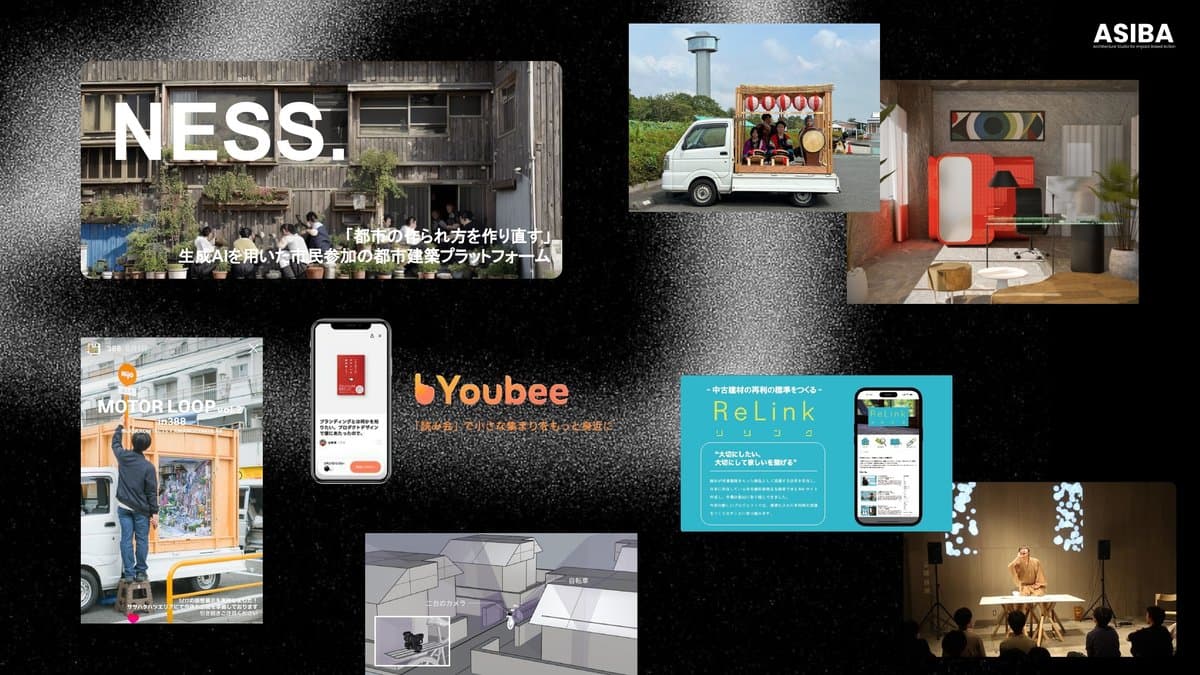
FIG.3
For instance, I happened to be in Suwa today, where there’s a team called ReLink that’s promoting glass reuse in collaboration with a glass manufacturer. Working in partnership with companies and local governments—with ASIBA handling management and production—the team, ASIBA, and the partner organizations are acting as a unified trio to explore the potential for reusing demolition materials.
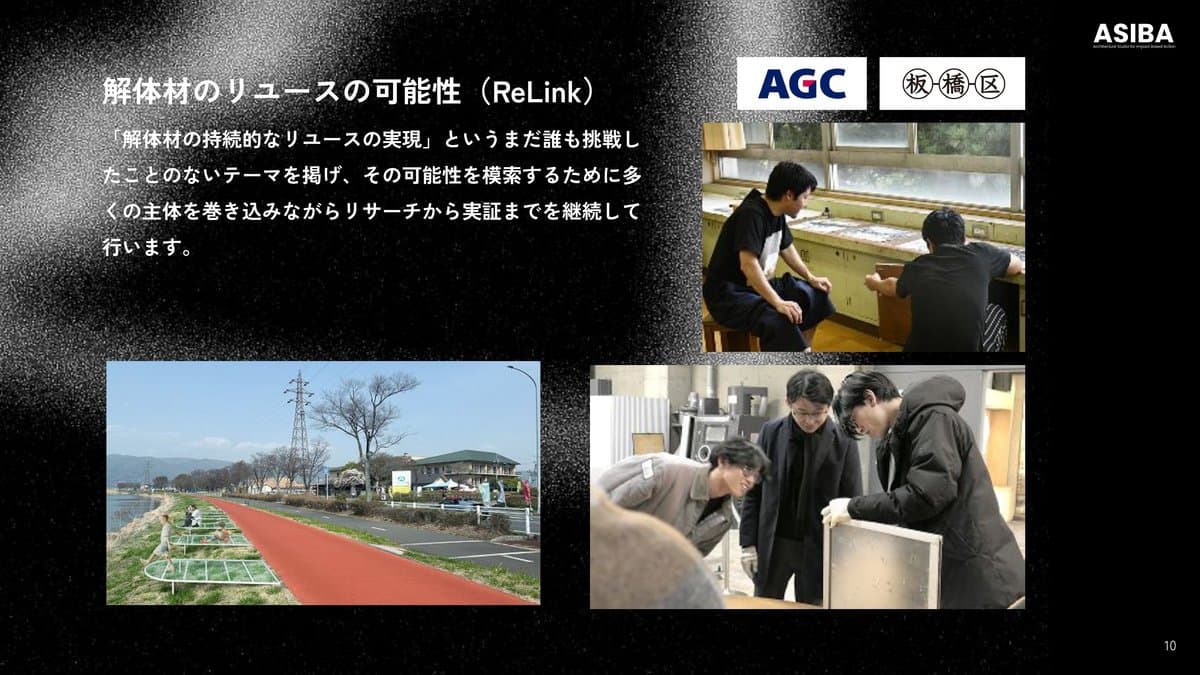
FIG.4
Another example is Youbee, a team developing a book club service. They did a great job studying the bottom-up community-building process and bringing their idea to life, but when it came to actually implementing the service and testing it with others, ASIBA stepped in to provide support—even acting as a client to try out the service itself—to help this incubated project move to the next stage.
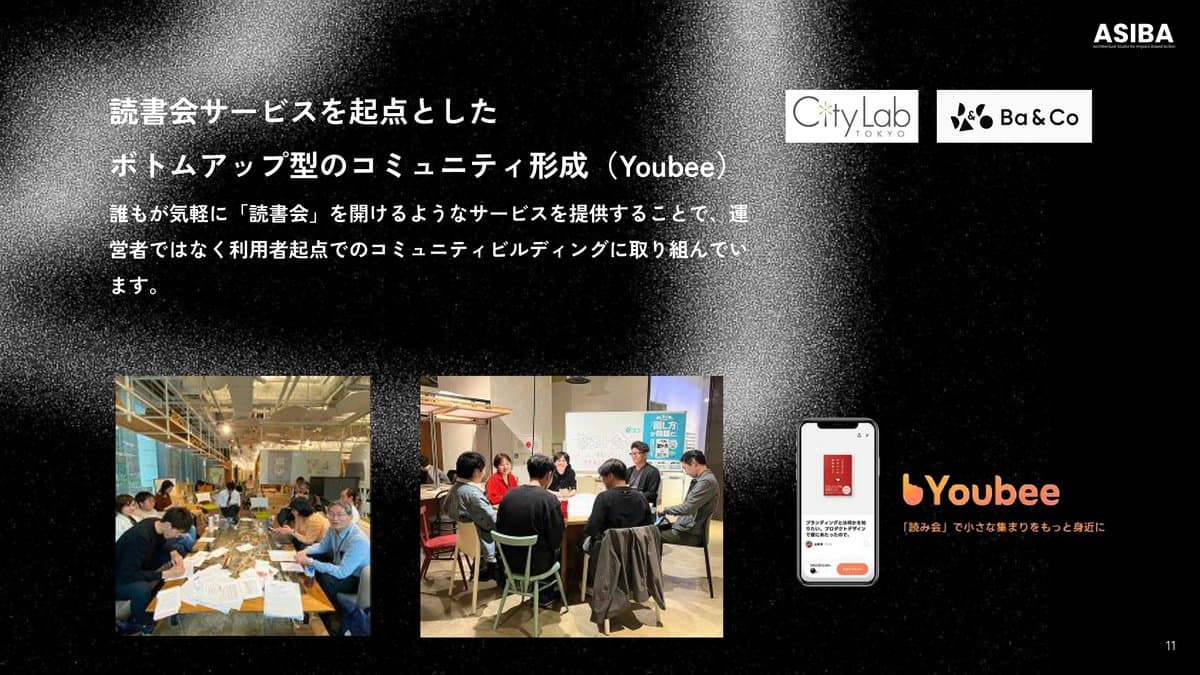
FIG.5
Furthermore, as a project moves to the next stage, it enters a phase where the project and ASIBA jointly secure new projects or work together to build them into viable businesses. For example, in a project we collaborated on with Panasonic, centered on the theme of redesigning communication technology, the project team from ASIBA’s first incubation cohort and ASIBA worked as one.We held workshops exploring new ways to use communication and how to integrate them into spaces and cities, and we managed the entire process—including media outreach—as a comprehensive package.
In this way, we are gradually seeing examples where a single project transcends its original scope and grows alongside ASIBA. Although we are still feeling our way forward, we decided to give this initiative a name, and just last week we launched the “ASIBA PROJECT LABEL.”
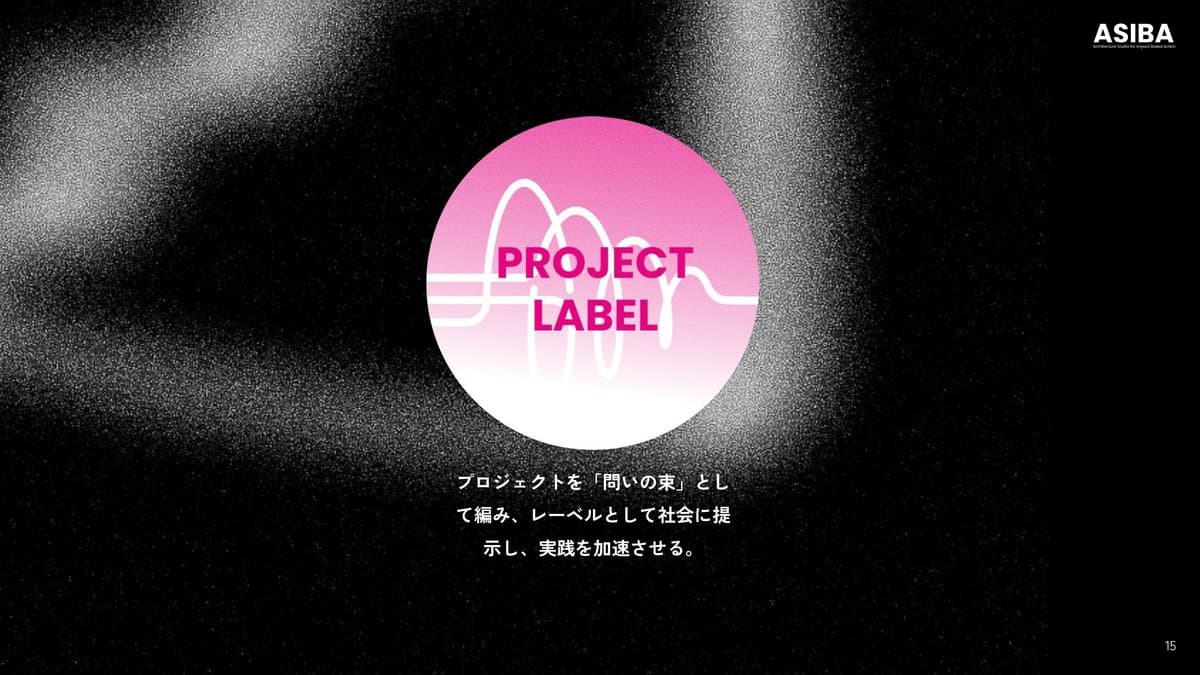
FIG.6
With ASIBA PROJECT LABEL, rather than investing in projects ourselves, we will provide management support and guidance as part of the same team. Much like a music label, we envision a future where we nurture multiple projects and grow together within the strong bonds of the “ASIBA Mafia.”
Furthermore, as we’ve moved forward with various other projects, we at ASIBA have gradually accumulated our own insights and resources. By leveraging these, we’re now pursuing a new challenge: “ASIBA STUDIO.”

FIG.7
At “ASIBA STUDIO,” ASIBA itself takes the lead, leveraging the expertise and track record in architecture, design, and creativity cultivated through our past activities to handle everything from design research to business development in an integrated manner. We at ASIBA will pose our own “questions” and aim to drive transformation and create impact by engaging large corporations and government agencies.
Moving forward, we will formally advance joint business creation and contract development in collaboration with ASIBA’s partner companies and local governments, as well as joint ventures and contract development with seed projects belonging to the “ASIBA Project Label.”
To highlight a few projects currently underway at “ASIBA STUDIO,” we are, for example, designing a workshop program in collaboration with Nippon Steel & Kowa Real Estate and Taisei Corporation, exploring themes such as “How should we think about biodiversity within cities?” and “What do cities look like from the perspective of living organisms?”Nakajo, who facilitated the session earlier, has taken the lead in developing the content. We plan to hold the second session this summer.
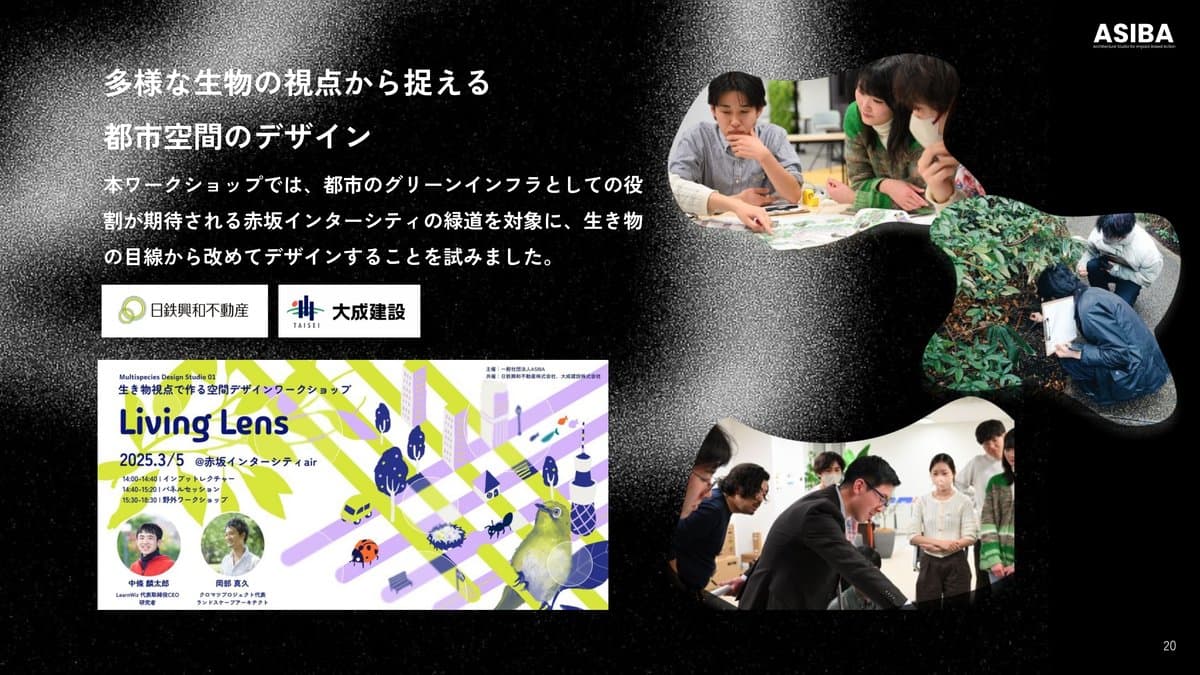
FIG.8
We are also collaborating with the Tokyo Metropolitan Government and the 23 special wards to conduct workshops that explore community-rooted questions and foster the emergence of local projects.For example, through a participatory workshop with Shibuya Ward’s Sasahata Hatsu Machi Lab that uses AI to create a community radio station for the year 2040, we are collecting emotions and memories about the neighborhood that have not been gathered before, and will incorporate these into future urban development efforts.We are also promoting projects of significant public interest in collaboration with Itabashi Ward, Setagaya Ward, Kita Ward, and the Tokyo Metropolitan Government, among others.
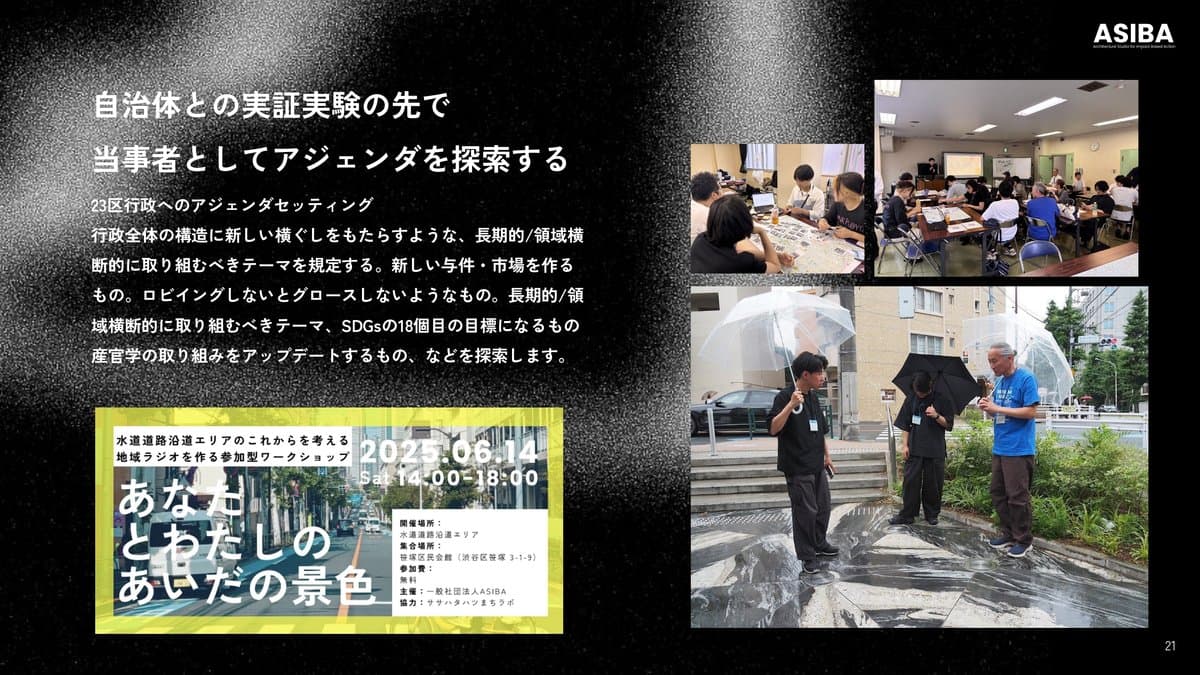
FIG.9
FIG.10
As for incubation, having been involved in so many incubation initiatives, I feel I’ve gained at least a little insight into what it truly means to incubate.Using that insight, we’ve taken a step further to address the question, “How can we transform university education in architecture and design itself?” within a broader framework, and have launched a new competition called the “ASIBA Creative Challenge.” We plan to hold this competition annually starting next year.
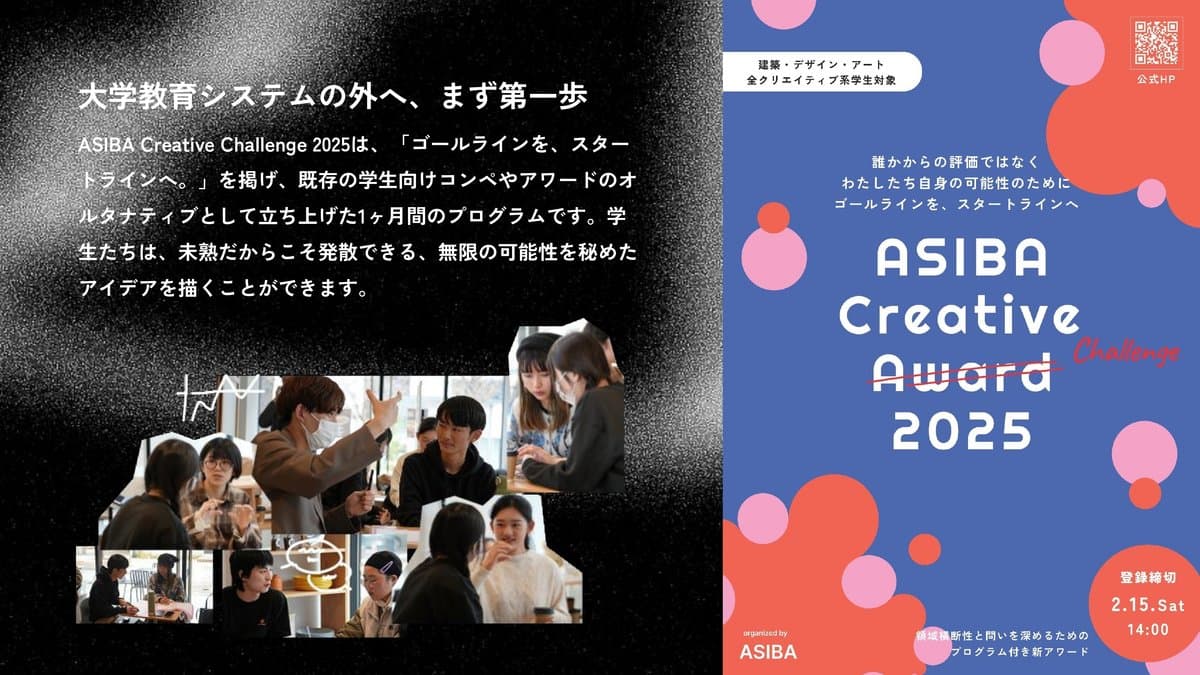
FIG.11
Furthermore—and this is a new announcement—as the first step in expanding our incubation efforts to regional areas, we will be holding a program in Yamagata starting this fall. Over the next few years, we plan to expand from Yamagata to other regions, creating a future where regional disparities in access to creative opportunities are eliminated and local challenges are resolved autonomously.
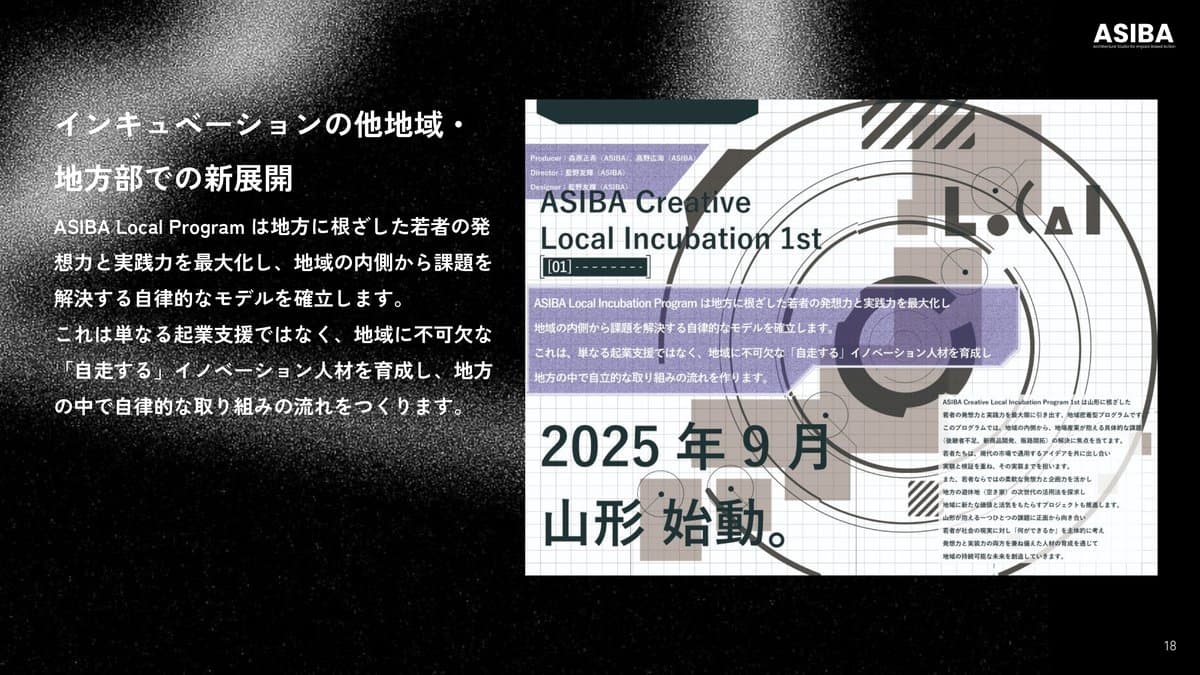
FIG.12
Beyond that, we have begun applying and adapting the insights gained from our incubation program to other organizations and communities. For example, we are collaborating with the NPO ETIC. and the Japan Design Promotion Association to help build design communities from the ground up.
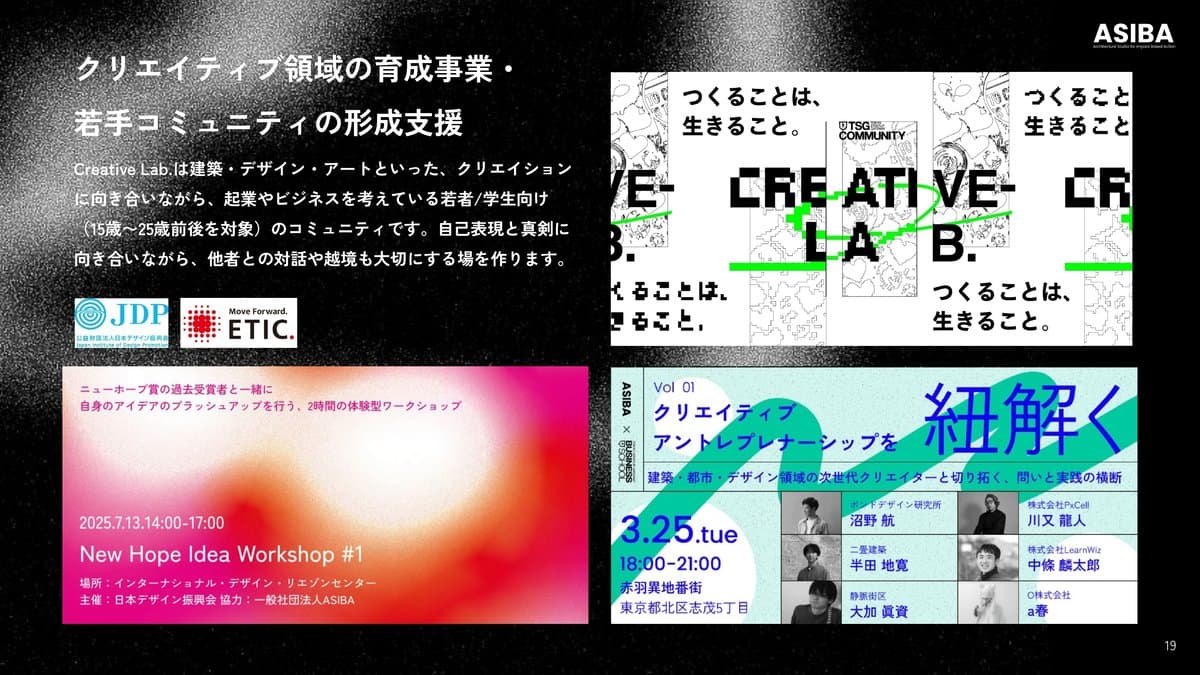
FIG.13
We still have a long way to go, but starting with our flagship program, “ASIBA Creative Incubation,” we aim to build a society where everyone can take on creative challenges without giving up on their potential.
ASIBA INC, ASIBA PROJECT LABEL, and ASIBA STUDIO. With these three pillars, we aim to build an ecosystem where creative actions are born, spurred, and ultimately lead to social change.
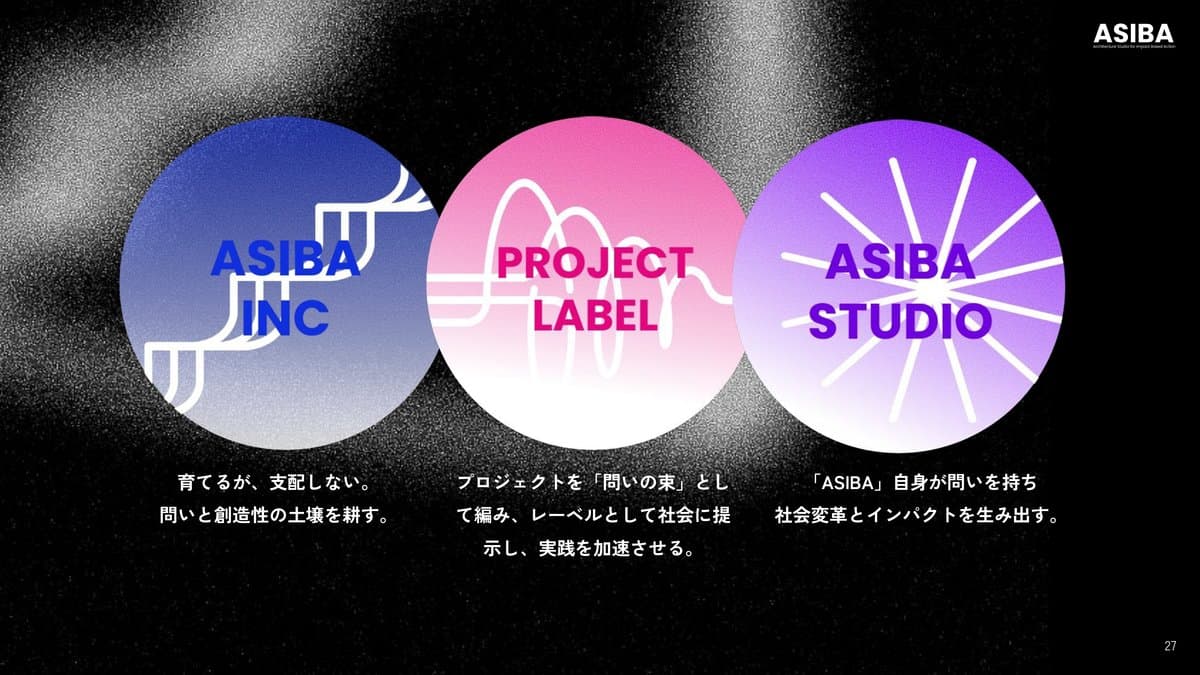
FIG.14
I’m truly excited and looking forward to the journey ahead as we race forward together with all of you, and I look forward to your continued support.
FIG.15
Credit